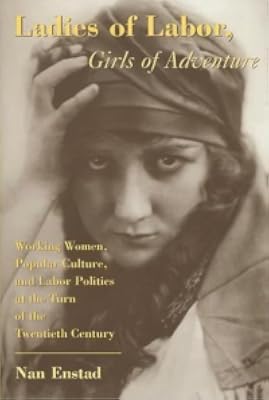
Ladies of Labor, Girls of Adventure
by Nan Enstad
On This Page
Description
At the beginning of the twentieth century, labor leaders in women's unions routinely chastised their members for their ceaseless pursuit of fashion, avid reading of dime novels, and "affected" ways, including aristocratic airs and accents. Indeed, working women in America were eagerly participating in the burgeoning consumer culture available to them. While the leading activists, organizers, and radicals feared that consumerist tendencies made working women seem frivolous and dissuaded them show more from political action, these women, in fact, went on strike in very large numbers during the period, proving themselves to be politically active, astute, and effective. In Ladies of Labor, Girls of Adventure, historian Nan Enstad explores the complex relationship between consumer culture and political activism for late nineteenth- and twentieth-century working women. While consumerism did not make women into radicals, it helped shape their culture and their identities as both workers and political actors. Examining material ranging from early dime novels about ordinary women who inherit wealth or marry millionaires, to inexpensive, ready-to-wear clothing that allowed them to both deny and resist mistreatment in the workplace, Enstad analyzes how working women wove popular narratives and fashions into their developing sense of themselves as "ladies." She then provides a detailed examination of how this notion of "ladyhood" affected the great New York shirtwaist strike of 1909-1910. From the women's grievances, to the walkout of over 20,000 workers, to their style of picketing, Enstad shows how consumer culture was a central theme in this key event of labor strife. Finally, Enstad turns to the motion picture genre of female adventure serials, popular after 1912, which imbued "ladyhood" with heroines' strength, independence, and daring. show lessTags
Recommendations


















Member Reviews
In Ladies of Labor, Girls of Adventure: Working Women, Popular Culture, and Labor Politics at the Turn of the Twentieth Century, Nan Enstad argues, “Consumer culture offered working-class women struggling with extremely difficult material and ideological constraints a new range of representations, symbols, activities, and spaces with which to create class, gender, and ethnic identities” (pg. 6). In this way, “For middle-class women, fashion served as a display of class distinction and taste, a cultural marker of privilege that differentiated them from working-class women and women of color. When working-class women dressed in elaborate styles, they staged a carnivalesque class inversion that undermined middle-class efforts to show more control the definition of ‘lady’” (pg. 10). Enstad further argues, “Working women used popular culture as a resource to lay claim to dignified identities as workers, sometimes from the very terms used by others to degrade them” (pg. 13). Addressing the historiography, Enstad argues that a reassessment of political activism and popular culture “is needed to understand how working-class women shaped their experiences in both realms” (pg. 14). Enstad builds largely upon Kathy Peiss’ Cheap Amusements while incorporating Judith Butler’s theories of gender and the work of film scholars.
Enstad writes, “Working women’s relationship to consumerism, then, was shaped in part by the effects of production already inhering in the goods they bought. This is not to say that working women simply imbibed ideological messages conveyed by these commodities; on the contrary, they wound the products into their own social context and imbued them with their own meanings. However, the workings of the market dramatically shaped the range and nature of the commodities available to working women” (pg. 19). In terms of book publication, “Producers added working female heroines to the ranks of dime novels’ central characters in part because of increased newspaper coverage of women’s wage work” (pg. 38). Enstad continues, “Domestic fiction bore structural resemblances to the dime novel romances, but middle-class women insisted that their fiction, like their fashion, differed from commodities consumed primarily by the working class because of its moral value” (pg. 41). In this way, “The nature of these commodities was contradictory: they were richly laden with cultural connotations and available for a variety of readings and uses in working women’s daily lives” (pg. 47).
Enstad writes, “Perhaps most disturbing was that working women incorporated their consumption of fashion and fiction into a social practice of calling and presenting themselves as ladies, complete with an affected style of speech, walk, and manners” (pg. 49). Turning to consumption, Enstad writes, “Working women’s consumption of fiction and fashion engaged their identities as workers, as women, and as immigrants. Through their purchases, women used the money they had earned, thus participating in consumption as workers” (pg. 50). The discussion of these novels helped women establish a common rapport amongst their fellow workers. Enstad writes, “Working women, however, did not simply imbibe wish images embedded in the dime novel narratives and the fashion products; they enacted wish images when they made themselves into ladies” (pg. 69). There was a further subversive aspect to these novels, as Enstad writes, “In the dime novels, true ladies exhibited bravery and strength, as well as beauty and charm – that is, ladyhood included a transgression of gender norms” (pg. 76).
Enstad argues, “The public debate about the strike, including labor leaders’ contributions, constricted the intelligibility of working ladies’ own attempts to claim formal political subjectivities. That is, existing ideals of what a political subject looked like obscured working ladies’ identities” (pg. 86). Further, “Working women collectively created the cultural practices of ladyhood from the addresses of the fashion industry, employers, native-born Americans, and middle-class women. Indeed, as ladyhood became established and shared, working women interpellated others into it” (pg. 110). In terms of film, Enstad argues, “Theaters and the range and content of films themselves regularly replicated hierarchies working women found elsewhere in society. Nevertheless, women’s social practices of motion picture consumption generated new resources for the creation of public identities” (pg. 163). Further, “Women’s social practices of film consumption thus created a collective culture connected to their consumption of other commodities, such as dime novels and fashion. Film became more than an object or a narrative in women’s lives; it became part of their imaginative landscape – or collective dreamworld – and as such was integral to their enacted identities” (pg. 186).
Enstad concludes, “Working women embraced dime novels, fashion, and film products and used them to create distinctive and pleasurable social practices and to enact identities as ladies. Consumer culture producers thus profited from the women’s capacity to imagine and create, even as factory bosses sought to remove those abilities from women’s daily part in the production process” (pg. 202). Critiquing the historiography, she writes, “The analytical binary between consumerism and politics creates a myth of a rational political actor who does not obtain an identity within commodity culture, and precludes understanding the diverse paths to political identities” (pg. 205). show less
Enstad writes, “Working women’s relationship to consumerism, then, was shaped in part by the effects of production already inhering in the goods they bought. This is not to say that working women simply imbibed ideological messages conveyed by these commodities; on the contrary, they wound the products into their own social context and imbued them with their own meanings. However, the workings of the market dramatically shaped the range and nature of the commodities available to working women” (pg. 19). In terms of book publication, “Producers added working female heroines to the ranks of dime novels’ central characters in part because of increased newspaper coverage of women’s wage work” (pg. 38). Enstad continues, “Domestic fiction bore structural resemblances to the dime novel romances, but middle-class women insisted that their fiction, like their fashion, differed from commodities consumed primarily by the working class because of its moral value” (pg. 41). In this way, “The nature of these commodities was contradictory: they were richly laden with cultural connotations and available for a variety of readings and uses in working women’s daily lives” (pg. 47).
Enstad writes, “Perhaps most disturbing was that working women incorporated their consumption of fashion and fiction into a social practice of calling and presenting themselves as ladies, complete with an affected style of speech, walk, and manners” (pg. 49). Turning to consumption, Enstad writes, “Working women’s consumption of fiction and fashion engaged their identities as workers, as women, and as immigrants. Through their purchases, women used the money they had earned, thus participating in consumption as workers” (pg. 50). The discussion of these novels helped women establish a common rapport amongst their fellow workers. Enstad writes, “Working women, however, did not simply imbibe wish images embedded in the dime novel narratives and the fashion products; they enacted wish images when they made themselves into ladies” (pg. 69). There was a further subversive aspect to these novels, as Enstad writes, “In the dime novels, true ladies exhibited bravery and strength, as well as beauty and charm – that is, ladyhood included a transgression of gender norms” (pg. 76).
Enstad argues, “The public debate about the strike, including labor leaders’ contributions, constricted the intelligibility of working ladies’ own attempts to claim formal political subjectivities. That is, existing ideals of what a political subject looked like obscured working ladies’ identities” (pg. 86). Further, “Working women collectively created the cultural practices of ladyhood from the addresses of the fashion industry, employers, native-born Americans, and middle-class women. Indeed, as ladyhood became established and shared, working women interpellated others into it” (pg. 110). In terms of film, Enstad argues, “Theaters and the range and content of films themselves regularly replicated hierarchies working women found elsewhere in society. Nevertheless, women’s social practices of motion picture consumption generated new resources for the creation of public identities” (pg. 163). Further, “Women’s social practices of film consumption thus created a collective culture connected to their consumption of other commodities, such as dime novels and fashion. Film became more than an object or a narrative in women’s lives; it became part of their imaginative landscape – or collective dreamworld – and as such was integral to their enacted identities” (pg. 186).
Enstad concludes, “Working women embraced dime novels, fashion, and film products and used them to create distinctive and pleasurable social practices and to enact identities as ladies. Consumer culture producers thus profited from the women’s capacity to imagine and create, even as factory bosses sought to remove those abilities from women’s daily part in the production process” (pg. 202). Critiquing the historiography, she writes, “The analytical binary between consumerism and politics creates a myth of a rational political actor who does not obtain an identity within commodity culture, and precludes understanding the diverse paths to political identities” (pg. 205). show less
Ratings
Members
- Recently Added By
Author Information
2 Works 122 Members
Nan Enstad is professor of history at the University of Wisconsin-Madison.
Classifications
- Genres
- Nonfiction, History, General Nonfiction, Sexuality and Gender Studies, Art & Design
- DDC/MDS
- 305.42 — Society, government, & culture Social sciences, sociology & anthropology Social group - Age, Gender, Ethnicity Women Social role and status of women
- LCC
- HD6058 .E57 — Social sciences Industries. Land use. Labor Industries. Land use. Labor Labor. Work. Working class Classes of labor
- BISAC
Statistics
- Members
- 100
- Popularity
- 321,094
- Reviews
- 1
- Rating
- (3.96)
- Languages
- English
- Media
- Paper
- ISBNs
- 2