On This Page
Tags
Recommendations






















Member Reviews
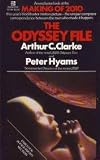
Much like he did in The Lost Worlds of 2001, Arthur C. Clarke explores the process of adapting one of his novels to film in The Odyssey File. Rather than feature early treatments, script rewrites, and short stories/sequences, Clark presents this process as a dialogue between himself and director Peter Hyams. The most unique aspect was that conflicting schedules and geography required the two to use email in the early 1980s.
Clarke is magnanimous about any changes that Hyams wants, offering suggestions for ways to incorporate the changes and even the names of people on whom Hyams could call as technical advisers. Hyams, for his part, displays the nervousness of a man entrusted with adapting the sequel to one of the greatest films, show more regardless of genre, of the twentieth century. While the book does offer insight into the film-making process, it is not a complete "making of" or "behind the scenes" book, though Clarke explains that this was due to the need to get the book to press in time for the film's release.
The book's appendices feature an essay by Steven Jongeward, a production assistant on 2010, that describes the changes from book to film and how the change in medium necessitated Hyams' alterations. The second appendix describes the process for sending an email in 1983 using the technology of the time.
The book will likely not attract as wide an audience as Clarke's fiction, but will appeal to film scholars, devoted fans of Clarke, and those interested in the early days of the technology that became the Internet. show less
Clarke is magnanimous about any changes that Hyams wants, offering suggestions for ways to incorporate the changes and even the names of people on whom Hyams could call as technical advisers. Hyams, for his part, displays the nervousness of a man entrusted with adapting the sequel to one of the greatest films, show more regardless of genre, of the twentieth century. While the book does offer insight into the film-making process, it is not a complete "making of" or "behind the scenes" book, though Clarke explains that this was due to the need to get the book to press in time for the film's release.
The book's appendices feature an essay by Steven Jongeward, a production assistant on 2010, that describes the changes from book to film and how the change in medium necessitated Hyams' alterations. The second appendix describes the process for sending an email in 1983 using the technology of the time.
The book will likely not attract as wide an audience as Clarke's fiction, but will appeal to film scholars, devoted fans of Clarke, and those interested in the early days of the technology that became the Internet. show less
Interesting to read the early correspondence between Arthur C. Clarke and Peter Hyams but unfortunately there is very little in here about the actual making of the movie as the film was still in pre-production when the publishers gathered their correspondence together to put together this book. So rather than being subtitled the 'Making of 2010' it would perhaps be better subtitled as 'Early Stage Planning on the Making of 2010'.
Ratings
Members
- Recently Added By
Author Information

860+ Works 130,163 Members
Arthur C. Clarke was born in Minehead, Somerset, England, on December 16, 1917. During World War II, he served as a radar specialist in the RAF. His first published piece of fiction was Rescue Party and appeared in Astounding Science, May 1946. He graduated from King's College in London with honors in physics and mathematics, and worked in show more scientific research before turning his attention to writing fiction. His first book, Prelude to Space, was published in 1951. He is best known for his book 2001: A Space Odyssey, which was later turned into a highly successful and controversial film under the direction of Stanley Kubrick. His other works include Childhood's End, Rendezvous with Rama, The Garden of Rama, The Snows of Olympus, 2010: A Space Odyssey II, 2062: Odyssey III, and 3001: The Final Odyssey. During his lifetime, he received at least three Hugo Awards and two Nebula Awards. He died of heart failure on March 19, 2008 at the age of 90. (Bowker Author Biography) show less

36+ Works 1,426 Members
Series

Classifications
- Genre
- General Nonfiction
- DDC/MDS
- 791.43 — Arts & recreation Recreation, sports, and performing arts Movies, TV, Video Motion pictures, radio, television, podcasting Motion pictures
- LCC
- PN1997 .T8 — Language and Literature Literature (General) Literature (General) Drama Motion pictures Plays, scenarios, etc.
Statistics
- Members
- 83
- Popularity
- 382,732
- Reviews
- 2
- Rating
- (3.14)
- Languages
- English
- Media
- Paper
- ISBNs
- 2
- ASINs
- 2