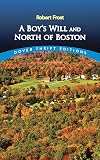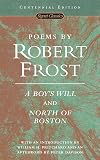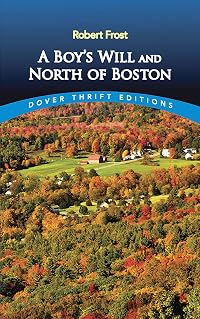
A Boy's Will/North of Boston
by Robert Frost
On This Page
Description
A collection of two of Robert Frost's most celebrated poems in their original form: A Boy's Will and North of Boston. The publication of A Boy's Will (1913) and North of Boston (1914) marked the debut of Robert Frost as a major talent and established him as the true poetic voice of New England. Four of his volumes would win the Pulitzer Prize before his death in 1963, and his body of work has since become an integral part of the American national heritage. This is the only edition to show more present these two classics in their original form. A Boy's Will introduced readers to Frost's unmistakable poetic voice, and in North of Boston, we find two of his most famous poems, "Mending Wall" and "The Death of the Hired Man." With an introduction by distinguished critic and Amherst professor William H. Pritchard and an afterword by poet and critic Peter Davison, this centennial edition stands as a complete and vital introduction to the work of the quintessential modern American poet. show lessTags
Recommendations
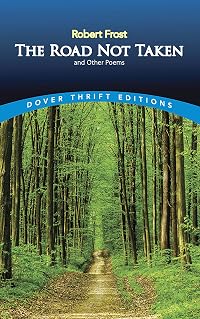























Member Reviews
I'm a pessimistic poetry reader. Some people may say I'm a pessimistic reader in general, but we're talking poetry here. I think, perhaps, my expectations are too high. I expect intricate complexities and beautiful imagery, something deep and wonderful, conveying emotions and feelings in just a few, small sentences. Sadly, I also expect rhythm and rhymes. Yes, rhymes. I imagine all the poetry connoisseurs are aghast at that statement. When a poem doesn't rhyme, it just feels like generic sentences cut up into fragments that look like poetry, but not actual poetry. Well, I'm happy to say that Robert Frost here has completely changed my opinion on that matter.
The book I read contained two poems, A Boy's Will and North of Boston. A Boy's show more Will was a collection of short, rhyming poems that filled me with happiness. Poets actually write poems that rhyme, I thought? Who knew? It was wonderfully fun to read, filled with remarkably simple yet insightful poems that were both fun to read through quickly and fun to read multiple times to comprehend the deeper meaning. How refreshing! Here, allow me to quote one of my favorites, "Rose Pogonias"
There we bowed us in the burning,
As the sun's right worship is,
To pick where none could miss them
A thousand orchises;
For though the grass was scattered,
Yet every second spear
Seemed tipped with wings of color,
That tinged the atmosphere.
We raised a simple prayer
Before we left the spot,
That in the general mowing
That place might be forgot;
Or if not all so favoured,
Obtain such grace of hours,
That none should mow the grass there
While so confused with flowers.
Now, why on earth can no one come remotely close to writing something like that?
The 2nd batch, North of Boston, was free verse, and I was a bit hesitant. But, as I mentioned earlier, Robert Frost changed my opinion of this form completely. It was stunning. I could spout out some adjectives, but why? Just let me say that Frost has entirely altered my view of poetry, and I have realized that some people can actually write it well. Never would have guessed. I am optimistic now that not all poets are bad, just most of them. 5 stars. show less
The book I read contained two poems, A Boy's Will and North of Boston. A Boy's show more Will was a collection of short, rhyming poems that filled me with happiness. Poets actually write poems that rhyme, I thought? Who knew? It was wonderfully fun to read, filled with remarkably simple yet insightful poems that were both fun to read through quickly and fun to read multiple times to comprehend the deeper meaning. How refreshing! Here, allow me to quote one of my favorites, "Rose Pogonias"
There we bowed us in the burning,
As the sun's right worship is,
To pick where none could miss them
A thousand orchises;
For though the grass was scattered,
Yet every second spear
Seemed tipped with wings of color,
That tinged the atmosphere.
We raised a simple prayer
Before we left the spot,
That in the general mowing
That place might be forgot;
Or if not all so favoured,
Obtain such grace of hours,
That none should mow the grass there
While so confused with flowers.
Now, why on earth can no one come remotely close to writing something like that?
The 2nd batch, North of Boston, was free verse, and I was a bit hesitant. But, as I mentioned earlier, Robert Frost changed my opinion of this form completely. It was stunning. I could spout out some adjectives, but why? Just let me say that Frost has entirely altered my view of poetry, and I have realized that some people can actually write it well. Never would have guessed. I am optimistic now that not all poets are bad, just most of them. 5 stars. show less
I've taught half a dozen of these poems for forty years, many from memory, first, The Pasture. My Crocket Ridge, Maine, grandparents really had a pasture spring, the cow Polly, and yearly calf--whom Polly defended from the dog Jerome by lifting my brother, in front of the dog, over the stone wall. The spring had great water, down a couple feet, and of course a frog living there. The Tuft of Flowers (the mower spared) I have growing in my back yard, in fact a dozen of them: orange Butterfly Weed, Asclepias Tuberosa. (Perhaps only Pritchard's edition keeps the line, "Finding them Butterfly Weed when I came" after "I left my place to know them by their name.") Speaking of Pritchard, Frost was his interlocutor, and a presence at my show more undergrad Amherst College. (I published a poem, After the Fall, on JFK and my teacher MacLeish dedicating the Frost Library a month before Dallas. My first poem in that publication, Ars Docentis, compares leading cows like Polly and leading classes: on heifers, "They.. attack afraid/ And retreat feeling real brave. There's/ No understanding them…)
By memory, The Road Not Taken, which every reader, every student, thinks describes their life--that remarkable, emphatic use of line end as conversational pause in colloquial repetition: "I--/ I took the one less travelled by…." Such a New England poem, yet written in England, perhaps recalling NE.
Lots of my Frost teaching was aloudreading in class: say, Home Burial. One student, narrator, I the husband, another student, the wife despising the husband, who says a remarkable line, the reason I grabbed the part: "What was it brought you up to think it the thing/ To take your mother-loss…"
"What was it" does not sound like a pentameter, but it is with one extra syllable on the last foot.
Or aloudreading, because my students were 2/3 women, average age mid-twenties, A Servant to Servants, where students read it all--a woman driven crazy by housing her mad brother-in-law, but mostly by servitude, though living with great views. Driving in N NH I think of her Lake Willoughby: "There's more to it than just window-views/ And living by a lake." I think that in my hometown too, all the ocean-views. (No more to it?) The best definition of "housework" in all lit: "doing/ Things over and over that just won't stay done."
"Death of the Hired Man" features a farm couple, Warren and Mary, and the independent old hired man Silas, who often left at haying time. I know about that, from my Gramp's 40 acre farm on Crockett ridge, where I drove his Model B tractor pulling a mower or hay rake. (The road's now named for Gramp, ralph richardson road.) Silas has aged, but has a plan to "ditch the meadow." Mary says Warren must accept Silas at his word,
"He's come to help you ditch the meadow.
He has a plan. You musn't laugh at him"
Why? We learn, Death with Dignity.
By the way, best definitions of "home" in this poem: Warren,
"Home is the place where, when you have to go there,
They have to take you in."
"I should have called it
Something you somehow haven't to deserve." Mary answers (82)
In his penultimate poem, "The Wood-Pile," Frost again takes a walk, in winter snow,
"I was just far from home.
A small bird flew before me. He was careful
To put a tree between us when he lighted." (156)
Brought to mind Emerson's poem "To a Titmouse [Chickadee]" where he's in a blizzard, 3 miles from
home, saved by a Chickadee, "this scrap of valor" whose tune says, like Caesar, "Ve-ni Vi-di Vi-ci."
See the Addendum to my new book, "Conversations with Birds: the Metaphysics of Bird and Human Communication."
Some of these he wrote in high school, like "My Butterfly" age 18, even then fine lines like the butterfly's "airy dalliance" and "the soft mist/ of my regret"(68)
Even one of the lesser (earlier?) poems, the sonnet Vantage Point, tells how "tired of trees, I seek again mankind" so he walks at dawn to a hill where "cattle keep the lawn" and he can see far off white homes of men, then farther, a hill of burial; "living or dead" his choices. By noon, too much of these, he has "but to turn on my arm," and "lo, my breathing shakes the bluet like a breeze," he smells the earth and plant,:"I look into the crater of the ant" (48). Great last line: Frost a fine critic of his own writing, puts his best line last. show less
By memory, The Road Not Taken, which every reader, every student, thinks describes their life--that remarkable, emphatic use of line end as conversational pause in colloquial repetition: "I--/ I took the one less travelled by…." Such a New England poem, yet written in England, perhaps recalling NE.
Lots of my Frost teaching was aloudreading in class: say, Home Burial. One student, narrator, I the husband, another student, the wife despising the husband, who says a remarkable line, the reason I grabbed the part: "What was it brought you up to think it the thing/ To take your mother-loss…"
"What was it" does not sound like a pentameter, but it is with one extra syllable on the last foot.
Or aloudreading, because my students were 2/3 women, average age mid-twenties, A Servant to Servants, where students read it all--a woman driven crazy by housing her mad brother-in-law, but mostly by servitude, though living with great views. Driving in N NH I think of her Lake Willoughby: "There's more to it than just window-views/ And living by a lake." I think that in my hometown too, all the ocean-views. (No more to it?) The best definition of "housework" in all lit: "doing/ Things over and over that just won't stay done."
"Death of the Hired Man" features a farm couple, Warren and Mary, and the independent old hired man Silas, who often left at haying time. I know about that, from my Gramp's 40 acre farm on Crockett ridge, where I drove his Model B tractor pulling a mower or hay rake. (The road's now named for Gramp, ralph richardson road.) Silas has aged, but has a plan to "ditch the meadow." Mary says Warren must accept Silas at his word,
"He's come to help you ditch the meadow.
He has a plan. You musn't laugh at him"
Why? We learn, Death with Dignity.
By the way, best definitions of "home" in this poem: Warren,
"Home is the place where, when you have to go there,
They have to take you in."
"I should have called it
Something you somehow haven't to deserve." Mary answers (82)
In his penultimate poem, "The Wood-Pile," Frost again takes a walk, in winter snow,
"I was just far from home.
A small bird flew before me. He was careful
To put a tree between us when he lighted." (156)
Brought to mind Emerson's poem "To a Titmouse [Chickadee]" where he's in a blizzard, 3 miles from
home, saved by a Chickadee, "this scrap of valor" whose tune says, like Caesar, "Ve-ni Vi-di Vi-ci."
See the Addendum to my new book, "Conversations with Birds: the Metaphysics of Bird and Human Communication."
Some of these he wrote in high school, like "My Butterfly" age 18, even then fine lines like the butterfly's "airy dalliance" and "the soft mist/ of my regret"(68)
Even one of the lesser (earlier?) poems, the sonnet Vantage Point, tells how "tired of trees, I seek again mankind" so he walks at dawn to a hill where "cattle keep the lawn" and he can see far off white homes of men, then farther, a hill of burial; "living or dead" his choices. By noon, too much of these, he has "but to turn on my arm," and "lo, my breathing shakes the bluet like a breeze," he smells the earth and plant,:"I look into the crater of the ant" (48). Great last line: Frost a fine critic of his own writing, puts his best line last. show less
Of the two parts of this presentation of Frost's poetry, I preferred the second: "North of Boston". I like the story form. My favorites were: "The Death of the Hired Man" and "Blueberries". But - there is a lot of the form that I don't get. I think perhaps I am too crusty to want to spend time on pondering meaning and style. I prefer to be told something rather than be exhorted to divine for myself just what the writer was inferring when he used those words - in that way.
Two early volumes of poetry (1913-1914) contain many of the poet's finest, best-known works: "Mending Wall," "After Apple-Picking," "The Death of the Hired Man," more. Reprinted complete and unabridged. Alphabetical lists of titles and first lines.
Ratings
Members
- Recently Added By
Author Information

292+ Works 26,571 Members
Robert Frost, the quintessential poet of New England, was born in San Francisco in 1874. He was educated at Dartmouth College and Harvard University. Although he managed to support himself working solely as a poet for most of his life and holding various posts with a number of universities, as a young man he was employed as a bobbin boy in a mill, show more a cobbler, a schoolteacher, and a farmer. Frost, whose poetry focuses on natural images of New England, received the Pulitzer Prize for Poetry four times for: New Hampshire, Collected Poems, A Further Range, and A Witness Tree. His works are noted for combining characteristics of both romanticism and modernism. He also wrote A Boy's Will, North of Boston, Mountain Interval, and The Gift Outright, among others. Frost married Elinor Miriam White in 1895, and they had six children--Elliott, Lesley, Carol, Irma, Marjorie, and Elinor Bettina. He died in Boston in 1963. (Bowker Author Biography) show less
Series
Belongs to Publisher Series
Work Relationships
Contains
Common Knowledge
- Canonical title
- A Boy's Will/North of Boston
- Original publication date
- 1913 (A Boy's Will) (A Boy's Will); 1914 (North of Boston) (North of Boston)
- First words
- One of my wishes is that those dark trees,
Classifications
Statistics
- Members
- 654
- Popularity
- 44,140
- Reviews
- 4
- Rating
- (3.79)
- Languages
- English
- Media
- Paper, Ebook
- ISBNs
- 10
- UPCs
- 2
- ASINs
- 9