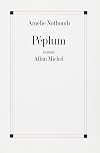
Péplum
by Amélie Nothomb
On This Page
Description
"Tra tutto ciò che è accaduto e ciò che non è accaduto c'è la stessa differenza che esiste tra più zero e meno zero."Attorno a questo paradosso si svolge un serrato duello verbale tra Celsius, presuntuoso filosofo di un futuro asettico quanto noioso, e una scrittrice rompiscatole.Tags
Recommendations







































Member Reviews
Amelie Nothomb has a discussion with a friend about her theory that the city Pompei was destroyed on purpose to freeze the beauty of the city in time for generations to come. The friend dismisses her theory as absurd but lo and behold, waking up after surgery at hospital she finds herself in year 2580. Why? Because the future fears the fact that she has discovered the secret of Pompei. She has been kidnapped by Celsius, a Great of 2580, and the innovator of the Pompei lava burial. What follows is a 150 page discussion on the ins and outs of how and why and what has changed and been done leading up to the year 2580.
I was worried about this one because when my mom read it she said she didn't like it and usually we have pretty much the show more same taste. However, I read this in one day as I was fairly enraptured by Amelie Nothomb's little book. Her humor and wit were on point and I found myself smiling and laughing more than a few times out loud. She is just so clever with dialogue and her self-deprecating humor was so in touch with her critics. It was interesting to see her attack herself and to see her defense. Although full of some plot holes (after all, we are dealing with time travel basically) and some questionable parts of back and forth conversations (ie. Nothomb suddenly using the same reasoning as Celsius as if she came up with herself) and perhaps a slight loss in luster in 20 or so pages towards the end, I found myself highly engaged in this book. It was definitely a good reading cleanse, like ginger on a sushi plate.
But, you'll either like or hate it. I feel like there is no in between. show less
I was worried about this one because when my mom read it she said she didn't like it and usually we have pretty much the show more same taste. However, I read this in one day as I was fairly enraptured by Amelie Nothomb's little book. Her humor and wit were on point and I found myself smiling and laughing more than a few times out loud. She is just so clever with dialogue and her self-deprecating humor was so in touch with her critics. It was interesting to see her attack herself and to see her defense. Although full of some plot holes (after all, we are dealing with time travel basically) and some questionable parts of back and forth conversations (ie. Nothomb suddenly using the same reasoning as Celsius as if she came up with herself) and perhaps a slight loss in luster in 20 or so pages towards the end, I found myself highly engaged in this book. It was definitely a good reading cleanse, like ginger on a sushi plate.
But, you'll either like or hate it. I feel like there is no in between. show less
Ca, on ne peut pas reprocher à Amélie Nothomb de ne pas être originale... mais parfois c'est peut-être un tout petit peu trop.
Experimental fiction. Written entirely as a conversation. Strange, but entertaining.
original, easy to whip through, light-hearted pseudo-philosophical meanderings.
Cherchez à qui le crime profite. Quand un roman commence par cette phrase, on s'attend à ce que ce soit un polar. On n'a pas tort, ce livre pourrait être un polar. Sauf qu'il n'y a pas de policier. Mais il y a un crime. Mobile : Pompéi. Arme du crime : Vésuve. Et le coupable ? Ce pourrait être le temps. À moins qu'il n'ait un alibi.
Dec 31, 2011French
Avec l'idée initiale d'une histoire de science-fiction, Nothomb nous offre une longue conversation à la manière des dialogues philosophiques de l'ancienne Grèce, mais avec son propre style.
Oct 17, 2015Catalan
Members
- Recently Added By
Lists

Dishonourable Mentions of 2013
189 works; 62 members

French SF / SF française
52 works; 1 member

Best Science Fiction Originally Published in a Language Other Than English
449 works; 34 members
Author Information

83 Works 16,078 Members
Some Editions
Series
Belongs to Publisher Series
Le livre de poche (14489)
Work Relationships
Is contained in
Common Knowledge
- Canonical title*
- Péplum
- Original title
- Peplum
- Original publication date
- 1996
- People/Characters
- Amelie Nothomb; Celsius
- First words
- Cherchez à qui le crime profite.
- Last words
- (Click to show. Warning: May contain spoilers.)Personne n'a daigne me croire.
- Original language*
- Français
*Some information comes from Common Knowledge in other languages. Click "Edit" for more information.
Classifications
- Genres
- Fiction and Literature, General Fiction, Science Fiction
- DDC/MDS
- 843.914 — Literature & rhetoric French Literature French fiction 1900- 20th Century 1945-1999
- LCC
- PQ2674 .O778 .P46 — Language and Literature French, Italian, Spanish and Portuguese literatures French literature Modern literature 1961-2000
Statistics
- Members
- 388
- Popularity
- 80,502
- Reviews
- 9
- Rating
- (3.01)
- Languages
- 5 — Dutch, English, French, Italian, Polish
- Media
- Paper, Audiobook, Ebook
- ISBNs
- 11
- ASINs
- 7