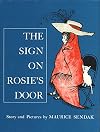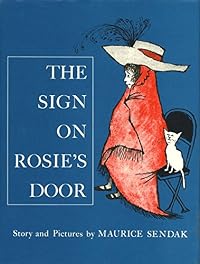
The Sign on Rosie's Door
by Maurice Sendak
On This Page
Description
When Rosie pretends to be a lovely singer, or a firecracker, or cat, her friends have fun even if they don't believe her.Tags
Recommendations















Member Reviews
Oh, yes. Highly recommended for fans of Sendak's sometime partner [a:Ruth Krauss|12961|Ruth Krauss|https://images.gr-assets.com/authors/1495054958p2/12961.jpg] ([b:A Hole is to Dig|118077|A Hole is to Dig|Ruth Krauss|https://images.gr-assets.com/books/1347664265s/118077.jpg|515786] etc.) as well as fans of [b:Where the Wild Things Are|19543|Where the Wild Things Are|Maurice Sendak|https://images.gr-assets.com/books/1384434560s/19543.jpg|3020535]. Rosie is just as imaginative as Max, but instead of dreaming of running away, Rosie goes out to play with the other children in the neighborhood and leads them on some wonderful imaginary adventures.
I love the extra depth in the story, as we adults see the melancholy in Rosie's spirit when her show more friends realize they have elsewhere to be and she has lost her audience. Never fear, though, as each of these children have plenty of reasons to come back and play tomorrow. show less
I love the extra depth in the story, as we adults see the melancholy in Rosie's spirit when her show more friends realize they have elsewhere to be and she has lost her audience. Never fear, though, as each of these children have plenty of reasons to come back and play tomorrow. show less
Rosie, a fictional character based on Sendak's real-life neighbor, is an imaginative little girl who spends a few summer days playing with the neighborhood children in this book. She's a bit bossy and dictates how that playing will go, from a musical show to a special Fourth of July parade. The book is presented almost as a series of short vignettes, although they are interrelated. It doesn't have that clear introduction/problem, climax, and resolution structure. The characterization of Rosie does feel very realistic at times, especially in her conversations with her mother. However, the "story" seems to drag in parts, and my listening audience started getting bored. The illustrations -- black-and-white drawings with dashes of red and show more blue coloring -- show exactly what is going on in the text. show less
Rosie, a perfectly ordinary little girl, like all perfectly ordinary children, is filled with strange and wonderful fancies. When it gets too monotonous being just plain Rosie, she transforms herself into a variety of alluring creatures, all of whom bear the mark of the original Rosie in their whimsy and intensity. Maurice Sendak, both through text and illustrations, fuses the appealingly familiar with the magical in a book of outstanding charm.
This is one of the lighter books written and illustrated by Sendak. It harkens back to a simple time, a time when pretend was a daily game and neighborhood children who grew bored with summer and with each other, could create fantasies and play.
Rosie is quite a character -- stubborn, bossy and creative.
She insists that others listen when she dresses up and becomes the world famous singer Alinda.
Compared to the strong messages in other Sendak book, this one took me by surprise and was quite uninspiring.
Rosie is quite a character -- stubborn, bossy and creative.
She insists that others listen when she dresses up and becomes the world famous singer Alinda.
Compared to the strong messages in other Sendak book, this one took me by surprise and was quite uninspiring.
For a beginner's reader, this four-chapter picture book is a delight! It's a blend of Dr. Seuss and Minarik's Little Bear series. It tells a timeless tale reminiscent of a quieter, gentler time when kids who had nothing to do had to rely on their imaginations. Like many second-graders, Rosie is a creative genius when it comes to thinking up things to keep her pals "busy."
Maurice Sendak did both the story and the illustration and I love the way the art work blends right in with the words to further the story. Second graders are going to love reading this extremely funny book all by themselves, and everyone else can enjoy it too.
Maurice Sendak did both the story and the illustration and I love the way the art work blends right in with the words to further the story. Second graders are going to love reading this extremely funny book all by themselves, and everyone else can enjoy it too.
"The Sign on Rosie's Door" is about a young girl named Rosie who post a sign on her door saying, "Is you want to know a secret, knock three times." For anyone who knocked, Rosie would come out dressed up as a famous singer named, Alinda. Throughout the story she switches between her plain self, Rosie and her famous self, Alinda. I think that this story is perfect for independent readers who are moving onto longer books by themselves. The book is broken down into four really short chapters, but it gives the young reader the feel of moving onto chapter books. It shows them what chapters are, exercising their growth, while never losing sight of the creativity and imagination of our main character.
"I have nothing to do, Mamma," Rosie said. "Well, do something," her mother said. So Rosie pastes a note on her front door and sits down to wait for Magic Man who will tell her what to do. When friends find Rosie's note and join her, they discover that the day isn't long enough for all the games they've found to play.
Members
- Recently Added By
Lists

Written and Illustrated By
805 works; 1 member
Author Information

171+ Works 67,828 Members
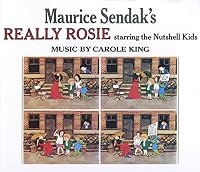
Maurice Sendak was born on June 10, 1928 in Brooklyn, New York. While in high school, he worked part time as an illustrator for All-American Comics adapting the Mutt and Jeff newspaper comic strip to a comic book format. His first professional illustrations were for a physics textbook, Atomics for the Millions, published in 1947. He later worked show more as a window-display director for F.A.O. Schwartz while attending night school at the Art Students League. In 1950, he illustrated his first children's book The Wonderful Farm by Marcel Aymé. He wrote his first children's book Kenny's Window in 1956 and went on to become a prolific author-illustrator. His works include Chicken Soup with Rice; In the Night Kitchen; Outside Over There; Higglety Pigglety Pop; The Sign on Rosie's Door; We Are All in the Dumps with Jack and Guy; Brundibar; Bumble Ardy; and My Brother's Book. He received numerous awards including the Caldecott medal for Where The Wild Things Are in 1964, the Hans Christian Andersen International Medal in 1970, the Laura Ingalls Wilder Award, and the National Medal of Arts in 1996. Characters from two of his books were the basis of an animated television special, Really Rosie, which first aired in 1975. He was also the set designer and lyricist for a subsequent off-Broadway musical of the same title. He was the lyricist, as well as the set and costume designer, for the original production of an opera based on Where The Wild Things Are in 1980. In addition, he has designed sets and costumes for performances of operas by Mozart, Prokofiev, and other classical composers. He died due to complications from a recent stroke on May 8, 2012 at the age of 83. (Bowker Author Biography) show less
Work Relationships
Has the adaptation
Common Knowledge
- Original publication date
- 1960
- Related movies
- Really Rosie (1975 | IMDb)
- Dedication
- Remembering Pearl Karchawer
all the Rosies
and Brooklyn - First words
- There was a sign on Rosie's door.
- Last words
- (Click to show. Warning: May contain spoilers.)"Meow," answered Rosie.
Classifications
Statistics
- Members
- 342
- Popularity
- 92,149
- Reviews
- 12
- Rating
- (3.95)
- Languages
- 6 — Dutch, English, French, German, Portuguese, Spanish
- Media
- Paper
- ISBNs
- 18
- ASINs
- 5