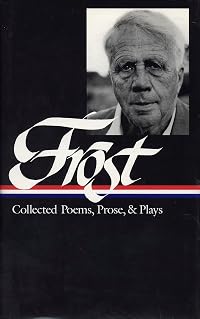
Robert Frost: Collected Poems, Prose, and Plays
by Robert Frost
On This Page
Description
This collection brings together all the major poetry, a generous selection of uncollected poems, all of Frost's dramatic writing, and an extensive gathering of his prose writings.Tags
Recommendations
Member Reviews
Reading this right after books of poetry by Coleridge and Shelley was a pleasure, even a relief. I don't hold "doth" and "lady fair" against poets such as Shakespeare and Donne--they seem to be using their own natural language. But I can't help roll my eyes at times at the romantic poets with their classical allusions and archaic language. They write of flowers and brooks as if it came from reading dusty volumes inside by a fire. Frost writes of nature as if from observing outside in the midst of it--with greater eloquence and sharpness of detail than Thoreau. And his voice is conversational, colloquial, as if he's speaking to you as a friend. And though he died before I was born, and started publishing poems before my grandmother was show more born, he doesn't feel dated. At the same time, he's not obscurist or dada-ish such as many modernist poets. He's not the verse equivalent of Jackson Pollock. Frost is quoted as saying that ""I would sooner write free verse as play tennis with the net down." Conversational his poetry might be, they do have structure.
He's not particularly prolific. From what I can gather from online sources, he only published about 130-odd poems in his lifetime. Compare that to the output of Emily Dickinson, along with Walt Whitman, the other American poet with a first-class world reputation--she wrote over 1,700. Each of Frost's poems is telling though and worth reading, and more varied than I expected. Yes, here you can find the familiar poems "Mending Wall," "The Road Not Traveled" and "Stopping by Woods on a Snowy Evening" "Birches" and "After Apple-Picking" that fit his persona as a New England Farmer poet. But there are also works such as "Home Burial" and "Death of a Hired Man" that read like short stories--works of Flash Fiction. (Home is the place where, when you have to go there/They have to take you in.). There are very short epigrammatic works of a couple of lines such as "Precaution." (I never dared be radical when young/For fear it would make me conservative when old.) There are works that treat of science and a few that deal with the political and philosophical. Particularly in retrospect after reading about his take on justice versus mercy in Milton's Paradise Lost in his letter to a friend, I found these lines in his verse play A Masque of Mercy very striking:
The rich in seeing nothing but injustice
In their impoverishment by revolution
Are right. But 'twas intentional injustice.
It was their justice being mercy-crossed.
The revolution Keeper's bring on
Is nothing but an outbreak of mass mercy,
Too long pent up in rigorous convention--
A holy impulse towards redistribution.
To set out to homogenize mankind
So that the cream could never rise again.
And as for science, one of my favorite Frost poems was supposedly inspired by his conversation with an astronomer about the end of the world--although there are also echoes of Dante:
Some say the world will end in fire,
Some say in ice.
From what I’ve tasted of desire
I hold with those who favor fire.
But if it had to perish twice,
I think I know enough of hate
To say that for destruction ice
Is also great
And would suffice.
There's something in the tone I just adore in this one. Irony? Whimsey? I don't know how to characterize it, except I found Frost's way at looking at so many things an unexpected pleasure in poem after poem I'd never read encountering Frost in anthologies or quoted here and there. So in content this is five stars--easily, which is why I rated it that way. Frost is a favorite poet. If I was tempted to mark the rating down, it's because I'm not sure if I had to do it over I'd buy this particular edition edited by Latham and Thompson. They say in their very brief introduction that the "texts... are allowed to speak for themselves" and that the "editors have deliberately avoided making interpretations." Certainly Frost is very accessible, but I would have liked a little value-added--more notes on the context and background. And listing the individual poems in the Table of Contents or an index of first lines would certainly have been welcome. show less
He's not particularly prolific. From what I can gather from online sources, he only published about 130-odd poems in his lifetime. Compare that to the output of Emily Dickinson, along with Walt Whitman, the other American poet with a first-class world reputation--she wrote over 1,700. Each of Frost's poems is telling though and worth reading, and more varied than I expected. Yes, here you can find the familiar poems "Mending Wall," "The Road Not Traveled" and "Stopping by Woods on a Snowy Evening" "Birches" and "After Apple-Picking" that fit his persona as a New England Farmer poet. But there are also works such as "Home Burial" and "Death of a Hired Man" that read like short stories--works of Flash Fiction. (Home is the place where, when you have to go there/They have to take you in.). There are very short epigrammatic works of a couple of lines such as "Precaution." (I never dared be radical when young/For fear it would make me conservative when old.) There are works that treat of science and a few that deal with the political and philosophical. Particularly in retrospect after reading about his take on justice versus mercy in Milton's Paradise Lost in his letter to a friend, I found these lines in his verse play A Masque of Mercy very striking:
The rich in seeing nothing but injustice
In their impoverishment by revolution
Are right. But 'twas intentional injustice.
It was their justice being mercy-crossed.
The revolution Keeper's bring on
Is nothing but an outbreak of mass mercy,
Too long pent up in rigorous convention--
A holy impulse towards redistribution.
To set out to homogenize mankind
So that the cream could never rise again.
And as for science, one of my favorite Frost poems was supposedly inspired by his conversation with an astronomer about the end of the world--although there are also echoes of Dante:
Some say the world will end in fire,
Some say in ice.
From what I’ve tasted of desire
I hold with those who favor fire.
But if it had to perish twice,
I think I know enough of hate
To say that for destruction ice
Is also great
And would suffice.
There's something in the tone I just adore in this one. Irony? Whimsey? I don't know how to characterize it, except I found Frost's way at looking at so many things an unexpected pleasure in poem after poem I'd never read encountering Frost in anthologies or quoted here and there. So in content this is five stars--easily, which is why I rated it that way. Frost is a favorite poet. If I was tempted to mark the rating down, it's because I'm not sure if I had to do it over I'd buy this particular edition edited by Latham and Thompson. They say in their very brief introduction that the "texts... are allowed to speak for themselves" and that the "editors have deliberately avoided making interpretations." Certainly Frost is very accessible, but I would have liked a little value-added--more notes on the context and background. And listing the individual poems in the Table of Contents or an index of first lines would certainly have been welcome. show less
Although I've enjoyed poems by many other 20th century American poets, I keep coming back to Frost. There is always something new to be gleaned from his work.
Not exactly my cup of tea beyond the early poems.
Members
- Recently Added By
Lists

American Lit for Eng 11 Research Project
368 works; 6 members
Author Information

292+ Works 26,571 Members
Robert Frost, the quintessential poet of New England, was born in San Francisco in 1874. He was educated at Dartmouth College and Harvard University. Although he managed to support himself working solely as a poet for most of his life and holding various posts with a number of universities, as a young man he was employed as a bobbin boy in a mill, show more a cobbler, a schoolteacher, and a farmer. Frost, whose poetry focuses on natural images of New England, received the Pulitzer Prize for Poetry four times for: New Hampshire, Collected Poems, A Further Range, and A Witness Tree. His works are noted for combining characteristics of both romanticism and modernism. He also wrote A Boy's Will, North of Boston, Mountain Interval, and The Gift Outright, among others. Frost married Elinor Miriam White in 1895, and they had six children--Elliott, Lesley, Carol, Irma, Marjorie, and Elinor Bettina. He died in Boston in 1963. (Bowker Author Biography) show less
All Editions
Awards and Honors
Notable Lists
Series
Belongs to Publisher Series
Library of America (081)
Common Knowledge
- Canonical title
- Robert Frost: Collected Poems, Prose, and Plays
- Original publication date
- 1995-10-01
- Publisher's editor
- Poirier, Richard; Richardson, Mark
- Disambiguation notice
- This is an omnibus unique to the Library of America; therefore, all CK facts apply to this publication only.
Classifications
Statistics
- Members
- 1,045
- Popularity
- 24,798
- Reviews
- 3
- Rating
- (4.36)
- Languages
- English
- Media
- Paper
- ISBNs
- 2
- ASINs
- 2