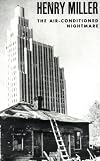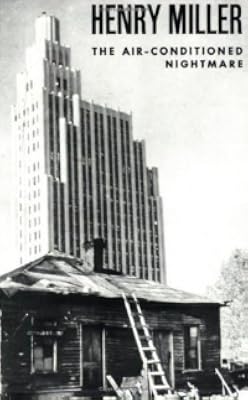
The Air-Conditioned Nightmare
by Henry Miller
On This Page
Description
"In 1939, after ten years as an expatriate, Henry Miller returned to the United States with a keen desire to see what his native land was really like--to get to the roots of the American nature and experience. He set out on a journey that was to last three years, visiting many sections of the country and making friends of all descriptions. The Air-Conditioned Nightmare is the result of that odyssey." --Page 4 of cover.Tags
Recommendations





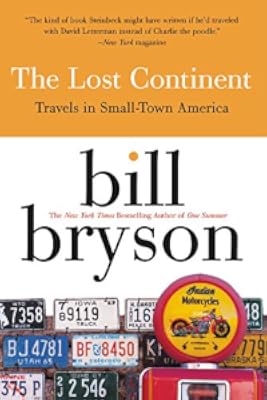
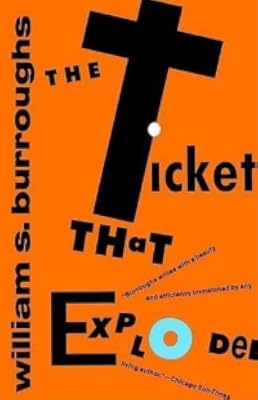
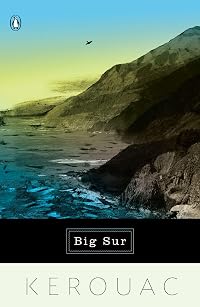


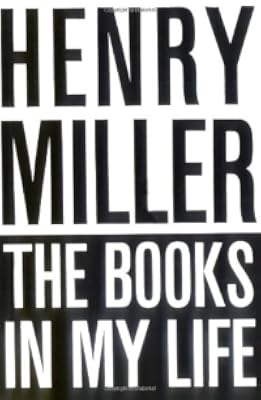



















Member Reviews
Miller grabs you by the mental testicles and yanks. Scathing social commentary hits the bullseye with clarity and breadth. This happens to be the first work of Miller's I've read, oddly enough, and I'm already an addict. On to more...
Henry Miller's return to the United States in 1939 following ten years of self-imposed exile in Paris gave rise to his controversial and frequently biting critique of American society in The Air-Conditioned Nightmare. This memoir, which was first published in 1945, is based on Miller's observations from a three-year cross-country road trip. Miller was disillusioned with what he saw as the superficial, materialistic, and culturally sterile landscape of his native country.
Miller's main grievance is America's excessive fixation on material goods and unrelenting quest for "progress" at the price of true spiritual fulfillment, artistic expression, and human connection. As a result of being taught to crave these things, he sees a country show more "cluttered with useless objects" and a people who have been exploited and dehumanized.
Miller, who had flourished in Paris's thriving artistic and intellectual scene, discovered that America was generally uninterested in, if not hostile to, artistic endeavors. Artists are considered "moral lepers" and "economic misfits," he contends, and anything that cannot be purchased or sold is prohibited.
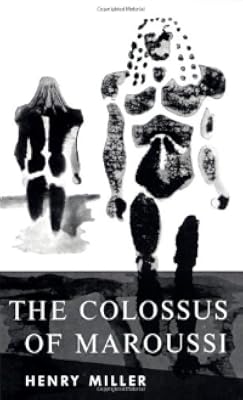
The Air-Conditioned Nightmare is an honest, unvarnished portrayal of Henry Miller's disenchantment with his native country rather than a typical travelogue. Even though some readers might find his viewpoints self-indulgent or his criticisms excessively harsh, the book is still a potent and prophetic critique of elements of American culture that are relevant today. It provides an intriguing, if frequently unsettling, journey into the "nightmare" that Miller saw beneath the polished exterior of America for fans of his distinctive voice and unapologetic social commentary. It's often recommended for those already familiar with his other works, such as *Tropic of Cancer* and *The Colossus of Maroussi*, as it continues his exploration of the artist's struggle in a consumer-driven world. show less
Miller's main grievance is America's excessive fixation on material goods and unrelenting quest for "progress" at the price of true spiritual fulfillment, artistic expression, and human connection. As a result of being taught to crave these things, he sees a country show more "cluttered with useless objects" and a people who have been exploited and dehumanized.
Miller, who had flourished in Paris's thriving artistic and intellectual scene, discovered that America was generally uninterested in, if not hostile to, artistic endeavors. Artists are considered "moral lepers" and "economic misfits," he contends, and anything that cannot be purchased or sold is prohibited.
The Air-Conditioned Nightmare is an honest, unvarnished portrayal of Henry Miller's disenchantment with his native country rather than a typical travelogue. Even though some readers might find his viewpoints self-indulgent or his criticisms excessively harsh, the book is still a potent and prophetic critique of elements of American culture that are relevant today. It provides an intriguing, if frequently unsettling, journey into the "nightmare" that Miller saw beneath the polished exterior of America for fans of his distinctive voice and unapologetic social commentary. It's often recommended for those already familiar with his other works, such as *Tropic of Cancer* and *The Colossus of Maroussi*, as it continues his exploration of the artist's struggle in a consumer-driven world. show less
The best part of The Air-Conditioned Nightmare is the title. Miller's prose is often merely serviceable, and he is better when he can force himself to write about someone or something that is not Henry Miller. Like the 8-yr old kid in the ‘Negro quarter’ of Charleston in the porkpie hat who swaggers into the drugstore, asks the soda jerk for a match then flips a coin through the air to pay for a magazine (“Heroic Comics”) before twirling to strike the match on the edge of the bar, lighting the cigarette dangling from his mouth then bounding out on to the street. Or the nearly-submerged ruins of the health resort Monte Ne in northwest Arkansas, the legacy of Wm. ‘Coin’ Harvey, who died before finishing the giant obelisk that show more was to serve as a repository for the knowledge (Harvey’s own) necessary to rebuild human civilization now that the existing one (circa 1901) was so obviously near collapse.
One of the more successful chapters is “My Dream of Mobile,” in which Miller connects his own idiosyncratic mental picture of Mobile (I kept hearing Dylan sing “Oh, Mama, can this really be the end…”) with the kind of imaginative aspirations that inspire adventuresome travelers everywhere, then folds in his first impressionable encounter with the work of Marco Polo (all readers know the feeling of finding a magical book) and comes back to the present dangerous moment in a world we fool ourselves into thinking we understand.
Our conception of these places, of the people that fill them, of their striving, their goals and their fulfillment is almost nil. Our adventurers and explorers lose themselves there, our scholars are confounded there, our evangelists and zealots and bigots are reduced to nullity there, our colonials rot there, our machines look puny and insignificant there, our armies are swallowed up there. Vast, multiform, polyglot, seething with unharnessed energy, now stagnant, now alert, ever menacing, ever mysterious....
The American South is no less mysterious and confounding for being close at hand.
It would be impossible to live in the South without being undermined. The climate, the landscape, the manners and customs, the soft speech exert a charm which is difficult to resist. This world of the South corresponds more nearly to the dream life which the poet imagines than do other sections of the country.
Miller’s perspective can surprise, even when the ideas are more suggestive than well-rendered. As much as some of these essays impress me, though, I was left ambivalent. Too many terrible sentences. Inane observations. Miller's propensity for clunky, clichéd phrasing.
”…oodles of time…”
“…Have faith. Dreams come true…”
“…a silence unlike anything we have experienced…”
“…spinning like a top…”
“…three sheets to the wind…”
“…make your hair stand on end…”
“…beyond the shadow of a doubt…”
“…ready in a jiffy…”
“…drunk with exaltation…”
“…hit the hay…”
Ugh. show less
One of the more successful chapters is “My Dream of Mobile,” in which Miller connects his own idiosyncratic mental picture of Mobile (I kept hearing Dylan sing “Oh, Mama, can this really be the end…”) with the kind of imaginative aspirations that inspire adventuresome travelers everywhere, then folds in his first impressionable encounter with the work of Marco Polo (all readers know the feeling of finding a magical book) and comes back to the present dangerous moment in a world we fool ourselves into thinking we understand.
Our conception of these places, of the people that fill them, of their striving, their goals and their fulfillment is almost nil. Our adventurers and explorers lose themselves there, our scholars are confounded there, our evangelists and zealots and bigots are reduced to nullity there, our colonials rot there, our machines look puny and insignificant there, our armies are swallowed up there. Vast, multiform, polyglot, seething with unharnessed energy, now stagnant, now alert, ever menacing, ever mysterious....
The American South is no less mysterious and confounding for being close at hand.
It would be impossible to live in the South without being undermined. The climate, the landscape, the manners and customs, the soft speech exert a charm which is difficult to resist. This world of the South corresponds more nearly to the dream life which the poet imagines than do other sections of the country.
Miller’s perspective can surprise, even when the ideas are more suggestive than well-rendered. As much as some of these essays impress me, though, I was left ambivalent. Too many terrible sentences. Inane observations. Miller's propensity for clunky, clichéd phrasing.
”…oodles of time…”
“…Have faith. Dreams come true…”
“…a silence unlike anything we have experienced…”
“…spinning like a top…”
“…three sheets to the wind…”
“…make your hair stand on end…”
“…beyond the shadow of a doubt…”
“…ready in a jiffy…”
“…drunk with exaltation…”
“…hit the hay…”
Ugh. show less
Very insightful. Some of Henry Miller's observations about Americans and American culture ring true over 50 years later. Mr.Miller has a talent for observation. His best asset.
a good pick if you are feeling like this country bites.
un regard sur l'Amérique des années 40 des plus visionnaire et des plus critiques sur ce style de vie qui ce prépare pour les générations futures.
get over it!
Members
- Recently Added By
Author Information

232+ Works 31,673 Members
Some Editions
Awards and Honors
Series
Belongs to Publisher Series
New Directions Paperbook (302)
Work Relationships
Common Knowledge
- Original title
- The Air-conditioned Nightmare
- Original publication date
- 1945
- First words
- It was in a hotel in Pittsburgh that I finished the book on Ramakrishna by Romain Rolland.
- Quotations
- A new world is not made simply by trying to forget the old. A new world is made with a new spirit, with new values. Our world may have begun that way, but today it is caricatural. Our world is a world of things.... What we dr... (show all)ead most, in the face of the impending death
- Last words
- (Click to show. Warning: May contain spoilers.)It is all over now. A new South is being born. The old South was ploughed under. But the ashes are still warm.
- Original language*
- englanti
*Some information comes from Common Knowledge in other languages. Click "Edit" for more information.
Classifications
- Genres
- Nonfiction, Travel, Biography & Memoir
- DDC/MDS
- 917.30491 — History & geography Geography & travel Geography of and travel in North America United States subdivisions and modified standard subdivisions Travel; guidebooks 1901- 1901-1953
- LCC
- E169 .M6 — History of the United States United States General
- BISAC
Statistics
- Members
- 943
- Popularity
- 28,369
- Reviews
- 8
- Rating
- (3.83)
- Languages
- 13 — Czech, Danish, English, Finnish, French, German, Greek, Hungarian, Italian, Polish, Portuguese (Portugal), Russian, Spanish
- Media
- Paper, Ebook
- ISBNs
- 15
- ASINs
- 19