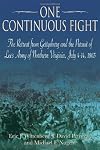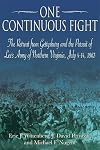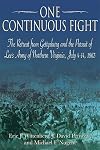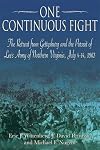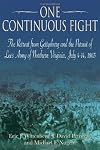
One Continuous Fight: The Retreat from Gettysburg and the Pursuit of Lee's Army of Northern Virginia, July 4-14, 1863
by Eric J. Wittenberg (Author), Michael F. Nugent (Author), J. David Petruzzi (Author)
On This Page
Description
An account of what really happened following the Confederate retreat from Gettysburg. The book is a comprehensive study loaded with incisive tactical commentary, new perspectives on the strategic role of the Southern and Northern cavalry, and fresh insights on every engagement, large and small, fought during the retreat.Tags
Recommendations











Member Recommendations
Donogh Both are accomplished studies of the same event, albeit with a different emphasis
Member Reviews
With Lee defeated at Gettysburg and Grant victorious at Vicksburg, the Union could have won the war in July 1863 - if George Gordon Meade had not acted according to his character. It is true, many of his units were mauled in battle and he was faced with Lincoln's restriction of keeping his army between Lee's army and Washington. The South Mountain range further shielded Lee's forces from a vigorous pursuit. After all, the battle of Gettysburg only happened because General Heth exposed his forces beyond the South Mountain range. Finally John Imboden and Jeb Stuart both handed in stellar performances in leading the wounded, the POWs, the trains and the army back to Falling Waters, blocking all attempts of the Federals of inflicting show more extensive destruction.
Meade did not make good use of the road network. Instead of either mounting a vigorous push pursuit along the northern approach road from Chambersburg to Falling Waters or of cutting Lee off via Harper's Ferry, he sent his forces onto country roads. His disastrous cavalry corps commander Alfred Pleasanton further diminished the effectiveness of the pursuers by splitting up his cavalry forces into division-sized attacks which were too weak to break through the Confederate rearguards. A good part of Wittenberg's book is devoted to these costly but futile cavalry skirmishes that exhausted both sides but proved indecisive.
The Federal infantry was hampered by an absence of confident commanders. Most aggressive Union generals had been wounded or killed during the battle. Thus, the pursuit was under the direction of the plodding General Sedgwick - under orders NOT to bring on a general engagement. Union caution allowed Lee to retreat back to Virginia. Not attacking Lee in his entrenched position at Falling Waters was probably a sane decision. Otherwise a lost chance.
Wittenberg is a cavalry specialist, thus the book will be enjoyed most by those interested in the mounted arm. The movement of the infantry forces is only sketchily presented. On the maps, the Union movements are indicated at the corps level, to abstract for my taste. A real theater map would have shown the abundance of idle Federal forces.
The combination of the two included driving tours and Google Streetview allows neat armchair tourism of this beautiful remote area. Unfortunately, the Google Streetview ends in the middle of the road at Falling Waters (never reaching the Potomac Fish club). It is surprisingly difficult to catch a glimpse of the Potomac in Google Streetview due to the foliage and the sketchy coverage of the smaller roads. show less
Meade did not make good use of the road network. Instead of either mounting a vigorous push pursuit along the northern approach road from Chambersburg to Falling Waters or of cutting Lee off via Harper's Ferry, he sent his forces onto country roads. His disastrous cavalry corps commander Alfred Pleasanton further diminished the effectiveness of the pursuers by splitting up his cavalry forces into division-sized attacks which were too weak to break through the Confederate rearguards. A good part of Wittenberg's book is devoted to these costly but futile cavalry skirmishes that exhausted both sides but proved indecisive.
The Federal infantry was hampered by an absence of confident commanders. Most aggressive Union generals had been wounded or killed during the battle. Thus, the pursuit was under the direction of the plodding General Sedgwick - under orders NOT to bring on a general engagement. Union caution allowed Lee to retreat back to Virginia. Not attacking Lee in his entrenched position at Falling Waters was probably a sane decision. Otherwise a lost chance.
Wittenberg is a cavalry specialist, thus the book will be enjoyed most by those interested in the mounted arm. The movement of the infantry forces is only sketchily presented. On the maps, the Union movements are indicated at the corps level, to abstract for my taste. A real theater map would have shown the abundance of idle Federal forces.
The combination of the two included driving tours and Google Streetview allows neat armchair tourism of this beautiful remote area. Unfortunately, the Google Streetview ends in the middle of the road at Falling Waters (never reaching the Potomac Fish club). It is surprisingly difficult to catch a glimpse of the Potomac in Google Streetview due to the foliage and the sketchy coverage of the smaller roads. show less
Ratings
Members
- Recently Added By
Author Information

Eric J. Wittenberg is author of many acclaimed books on Civil War history, including Gettysburg's Forgotten Cavalry Actions, Battle of Monroe's Crossroads and the Civil War's Last Campaign, and The Union Cavalry Comes of Age: Hartwood Church to Brandy Station.
Common Knowledge
- Canonical title
- One Continuous Fight: The Retreat from Gettysburg and the Pursuit of Lee's Army of Northern Virginia, July 4-14, 1863
- People/Characters
- Robert E. Lee; George Gordon Meade
- Important places
- Gettysburg, Pennsylvania, USA; Pennsylvania, USA; Adams County, Pennsylvania, USA
- Important events
- American Civil War (1861 | 1865); Gettysburg Campaign (1863)
- Disambiguation notice
- ISBN 1932714200 is for Plenty of Blame to Go Around: Jeb Stuart's Controversial Ride to Gettysburg
Classifications
Statistics
- Members
- 136
- Popularity
- 240,606
- Reviews
- 1
- Rating
- (4.25)
- Languages
- English
- Media
- Paper, Ebook
- ISBNs
- 3
- ASINs
- 3