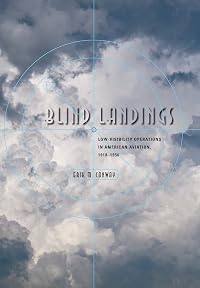
Blind Landings: Low-Visibility Operations in American Aviation, 1918-1958
by Erik M. Conway
On This Page
Description
When darkness falls, storms rage, fog settles, or lights fail, pilots are forced to make "instrument landings," relying on technology and training to guide them through typically the most dangerous part of any flight. In this original study, Erik M. Conway recounts one of the most important stories in aviation history: the evolution of aircraft landing aids that make landing safe and routine in almost all weather conditions. Discussing technologies such as the Loth leader-cable system, the show more American National Bureau of Standards system, and, its descendants, the Instrument Landing System, the MIT-Army-Sperry Gyroscope microwave blind landing system, and the MIT Radiation Lab's radar-based Ground Controlled Approach system, Conway interweaves technological change, training innovation, and pilots' experiences to examine the evolution of blind landing technologies. He shows how systems originally intended to produce routine, all-weather blind landings gradually developed into routine instrument-guided approaches. Even so, after two decades of development and experience, pilots still did not want to place the most critical phase of flight, the landing, entirely in technology's invisible hand. By the end of World War II, the very concept of landing blind therefore had disappeared from the trade literature, a victim of human limitations. show lessTags
Members
- Recently Added By
Author Information

8+ Works 1,793 Members
Erik M. Conway serves as historian, Jet Propulsion Laboratory, Pasadena, California
Classifications
- Genres
- Nonfiction, History
- DDC/MDS
- 629.132 — Applied science & technology Engineering Transportation Vehicles Airplanes, Helicopters, and other aircrafts Aviation engineering Main Principles of Flying
- LCC
- TL711 .B6 .C66 — Technology Motor vehicles. Aeronautics. Astronautics Motor vehicles. Aeronautics. Astronautics Aeronautics. Aeronautical engineering
- BISAC
Statistics
- Members
- 9
- Popularity
- 2,303,255
- Languages
- English
- Media
- Paper, Ebook
- ISBNs
- 3