On This Page
Description
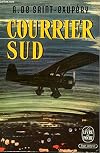
In his first novel, Saint-Exupéry pays homage to “those elemental divinities-night, day, mountain, sea, and storm,” turning an account of a routine mail flight from France to North Africa into an epic rendering of the pioneer days of commercial aviation. The book is also a poignant reminiscence of a tragic affair, in which the uncertainties of love and flight enhance the mystery of one another. Translated by Curtis Cate.Tags
Recommendations















































Member Reviews
In my youth I tried to cross the Western Sahara alone by motorcycle. It turned out to be impossible. In Tarfaya, Morocco, I had to wait for a truck to transport me northward. The monument in honor of Saint-Ex at the beach was my first contact with the writer. It is just this second novel, his second, which expresses the same dreadful solitude I felt during the waiting time in hostile surroundings.
A rare book; this subtly shows the male point of view without posturing. St. Ex writes a novel that reminds me of Hemingway at his finest, say, Old Man and the Sea. But St. Ex is more understated and, therefore, more powerful. For English language, it's worth the effort to scout around and find the Stuart Gilbert translation.
Après la parution de sa nouvelle L'Aviateur, Saint-Exupéry reprend sa nouvelle et en tire ce premier roman. Il y raconte, depuis des notes de vol, l'épopée du courrier à destination de l'hémisphère sud via l'Espagne, le Maroc, la Mauritanie jusqu'à Dakar où ce courrier embarque sur un bateau pour l'autre continent. Jacques Bernis est pilote sur les lignes Latécoère qui transporte le courrier de Toulouse à Casablanca et Dakar. Solitaire, il se réfugie à l'intérieur de sa carlingue pour fuir la vie monotone de ces années d'après-guerre. Un jour il rencontre Geneviève, celle-ci est mariée. Bernis décide alors de sortir de son cocon, il part avec elle à l'aventure mais l'existence qu'il lui propose ne peut pas lui show more convenir aussi la ramène-t-il auprès de son mari. Le roman est parsemé du récit fragmentaire et tragique de cet amour.
C'est à la fois un récit autobiographique de pilote et un documentaire lyrique de ses réflexions sur l'héroïsme et la solitude compagne fidèle de l'aviateur des débuts de l'aéronautique. Il faut en effet se rappeler ces débuts ; l'homme est seul dans des machines rétives, peu fiables, et il est balloté par des éléments souvent déchaînés et dont les comportements étaient mal connus le tout sans radio, survolant des contrées inhospitalières, avec des cartes où les taches blanches étaient encore innombrables où chaque panne pouvait signifier la mort par un mauvais atterrissage ou par le fusil ou le sabre des hommes des tribus bédouines. show less
C'est à la fois un récit autobiographique de pilote et un documentaire lyrique de ses réflexions sur l'héroïsme et la solitude compagne fidèle de l'aviateur des débuts de l'aéronautique. Il faut en effet se rappeler ces débuts ; l'homme est seul dans des machines rétives, peu fiables, et il est balloté par des éléments souvent déchaînés et dont les comportements étaient mal connus le tout sans radio, survolant des contrées inhospitalières, avec des cartes où les taches blanches étaient encore innombrables où chaque panne pouvait signifier la mort par un mauvais atterrissage ou par le fusil ou le sabre des hommes des tribus bédouines. show less
Dec 20, 2010French
Ratings
Members
- Recently Added By
Author Information

Antoine de Saint-Exupery, 1900 - 1944 Antoine de Saint-Exupery was born in Lyon, France on June 29, 1900. Saint-Exupery was educated in Jesuit schools. He later attended a Catholic boarding school in Switzerland before entering the Ecole de Beaux-Arts as an architecture student. de Saint-Exupery began his military service in 1921 and was sent to show more Strasbourgh to be trained as a pilot. He received his pilot's license in 1922 and, after a few dead end jobs as a bookkeeper and an automobile salesman, he began flying mail for a commercial airline company. His route over North Africa was the basis for his first novel, Southern Mail, in 1929. His second novel, Night Flight, became an international bestseller and was made into a film in 1933. By that time, de Saint-Exupery was married to Consuelo Gomez Castillo and was working as a test pilot for Air France. He was also working as a foreign correspondent covering May Day events in Moscow and writing a series on the Spanish Civil War. His book, Wind, Sand and Stars won the French Academy's 1939 Grand Prix du Roman and the National Book Award in the United States. He came to the United States after France fell in World War II, but rejoined the French Air Force in North Africa in 1943. That same year he published The Little Prince, a children's story of such universal appeal that it has been translated into close to fifty languages. Antoine de Saint-Exupery took off on a flight over Southern France on July 31, 1944 and was never seen again. In 1998, a fisherman found a bracelet with his name and his wife's name engraved on it, 150 kilometers west of Marseilles. (Bowker Author Biography) After escaping death in several accidents while flying as a pilot over the most dangerous sections of the French airmail service in South America, Africa, and the South Atlantic, Saint-Exupery was reported missing over southern France in 1944. Night Flight (1931) was introduced by Andre Gide and was at once proclaimed a masterpiece. Wind, Sand and Stars (1939) is a series of tales, interspersed with philosophical reflections on earth as a planet and on the nobility of the common people. Flight to Arras (1942) is the author's own account of a hopeless reconnaissance sortie during the tragic days of May 1940. (Bowker Author Biography) show less
Some Editions
Series


Belongs to Publisher Series
Work Relationships
Common Knowledge
- Canonical title
- Southern Mail
- Original title
- Courrier Sud
- Original publication date
- 1929
- Original language
- French
Classifications
Statistics
- Members
- 548
- Popularity
- 54,356
- Reviews
- 3
- Rating
- (3.51)
- Languages
- 18 — Bulgarian, Czech, Danish, Dutch, English, Estonian, French, German, Hungarian, Italian, Japanese, Korean, Polish, Portuguese, Russian, Spanish, Swedish, Turkish
- Media
- Paper, Ebook
- ISBNs
- 39
- ASINs
- 26