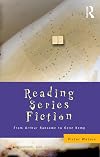
Reading Series Fiction: From Arthur Ransome to Gene Kemp
by Victor Watson
28 Members (4.21)
On This Page
Description
This work investigates series in children's literature. The works of several well-known children's authors are analyzed, and using these examples, the book explores the special nature and appeal of series' writing for children.Tags
Recommendations




















Member Reviews
Members
- Recently Added By
Author Information

14+ Works 144 Members
Common Knowledge
- Original publication date
- 2000
- People/Characters
- Arthur Ransome (Swallows and Amazons series); Enid Blyton (Famous Five series); Malcolm Saville (Lone Pine seies); William Mayne (Choir School series); C. S. Lewis (Narnia series); Mary Norton (The Borrowers series) (show all 10); Lucy Boston (Green Knowe series); Susan Cooper (The Dark is Rising series); Antonia Forest (Marlow series); Gene Kemp (Cricklepit School series)
- Epigraph
- [None]
- Dedication
- [None]
- First words
- There is often a chanciness in choosing to read a single novel.
Introduction : a room full of friends. - Quotations
- Since the First World War the young had left the countryside in their thousands, leaving a beautiful and rather run-down rural landscape. This was infinitely appealing to the middle classes, who could see it as a lovely playg... (show all)round full of history and mystery, and suitable for hiking, boating and all manner of adventures for children. The rural background to all those friendly and welcoming farmers was, in reality, one of economic and social stagnation in which farmers had to supplement their incomes in any way they could. When farmers began to prosper and agriculture became intensive, an entire genre of children's fiction was effectively wiped out by Common Market farming subsidies. (p. 82).
For we should be quite clear about this: the adult critic or teacher who sees in The Borrowers only a cosy story about tiny people in a miniature world knows less about it than the young reader. And it is diffic... (show all)ult to see how adult commentators can contribute much to any discussion, let alone develop the responses of young readers, if they know less about a children's book or series than young readers who have read it - perhaps more than once - from beginning to end. (p. 134).
Antonia Forest wrote ten Marlow novels (twelve, if we include two related historical novels). If her work were in print she would be acknowledged as at least one of the best writers for children in English, and - in my... (show all) view - the only writer of a sustained series who can be measured seriously alongside Arthur Ransome. (p. 174).
In seeking to find new ways of representing the inner and outer lives of children, Gene Kemp is a great innovator, bringing children's fiction closer than it has ever been to the literacies of actual classrooms. At a period i... (show all)n which the dangerous place of children is so centrally and problematically urgent in British culture, these novels provide a complete account of childhood in contemporary society; the fact that they are given in the words of children amounts to a challenge, for the closer these novels come to resembling the developing literacies of children, the harder it is for adults to see them as literary. (pp. 203-204). - Last words
- (Click to show. Warning: May contain spoilers.)It has been the purpose of this book to show that series fiction has played an enormous and unregarded part in the reading of twentieth-century children and, indeed, should be seen as central to what we usually think of as children's literature.
- Original language
- English
Classifications
Statistics
- Members
- 28
- Popularity
- 978,253
- Rating
- (4.21)
- Languages
- English
- Media
- Paper, Ebook
- ISBNs
- 5