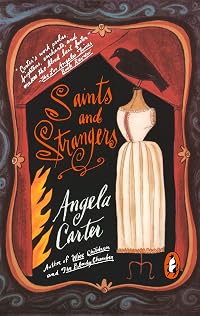
Black Venus
by Angela Carter
On This Page
Description
A collection of short stories- 'BLACK VENUS' displays the superbly witchy Angela Carter at her best. Her fabulous fables all speak for themselves in tones so commanding you feel this must be Baudelaire's mistress, ageing, remembering, still spreading syphilis, or Lizzie Borden restless in the fatal and hot Massachusetts summer. Whatever her subject Miss Carter writes like a dream - sometimes a nightmare. And as the voices call out, the images blaze, one is saved from an excess of fantasy by show more earthy realism, a sudden bark of humour' - SUNDAY TELEGRAPH show lessTags
Recommendations



















Member Recommendations
Member Reviews
Every word drips off the pages like some kind of vaudeville gothic play, in particular the opening story of Jeanne Duval, the sensual Haitian mistress of Baudelaire who in the tale triumphs back on her island (instead of rotting from syphillis). Potent stuff.
I would like to shout from the rooftop: Angela Carter is a genius! I am beside myself with enthusiasm for her imaginative, quirky, amazing stories. Most of the eight stories in this collection deal with a familiar topic but with either an odd twist or from an offbeat point of view. For example, the story called "The Fall River Axe Murders" concerns itself with the week leading up to that fatal day when
Lizzie Borden with an axe
Gave her father forty whacks
When she saw what she had done
She gave her mother forty one.
—Children's rhyme
No blood and gore here. Just an exploration of the life of the Borden family before Lizzie went on her rampage.
Carter has a unique way of setting the reader up with preconceptions of what a story might be show more about. The magic of this is that the title sets the synapses to work conjuring up a series of associated mental images. Some of these actually turn out to be relevant, but it's a marvelous trick to create an imaginary tapestry of sorts before you have even read a word.
For example, one story is called "Peter and the Wolf," and indeed it is a story about a boy named Peter and there are wolves, but this is not the story. But one files it away in a compartment of memory labeled "stories about Peter and wolves."
Another story is called "The Cabinet of Edgar Allan Poe," which weaves an imaginative tale about his birth and youth and his mother's short life. Immediately one thinks of The Cabinet of Dr. Caligari, but that's just one of Carter's tricks. It has been too many years since I saw the movie, so I cannot say for certain whether there is any real connection, but that is almost beside the point.
Another story is a strange dreamlike reworking of parts of A Midsummer Night's Dream, which again is quite audacious in its ingenuity. And the final story is entitled "Black Venus," which is about Baudelaire and his mistress Jeanne Duval.
My favorite story is called "The Kitchen Child," which is about nobody in particular, but is told in first person by a boy who was born "downstairs" to the cook at the country house of an Edwardian couple. The story of how the boy is conceived right there in the kitchen while the cook was in the midst of whipping up a lobster souffle is masterful in its conception and delivery:
Then, just as she bent over the range to stir the flour into the butter, a pair of hands clasped tight around her waist. Thinking, at first, it was but kitchen horseplay, she twitched her ample hips to put him off as she slid the egg yolks into the roux. But as she mixed in the lobster meat, diced up, all nice, she felt those hands stray higher.
That was when too much cayenne went in. She always regretted that.
And as she was folding in the toppling contents of the bowl of beaten egg-white, God knows what it was he got up to but so much so she flings all into the white dish with abandon and:
'To hell with it!'
Into the oven goes the souffle; the oven door slams shut.
I draw a veil.
This collection of short stories is not to be missed, even if we are twenty-five years late! Five stars! show less
Lizzie Borden with an axe
Gave her father forty whacks
When she saw what she had done
She gave her mother forty one.
—Children's rhyme
No blood and gore here. Just an exploration of the life of the Borden family before Lizzie went on her rampage.
Carter has a unique way of setting the reader up with preconceptions of what a story might be show more about. The magic of this is that the title sets the synapses to work conjuring up a series of associated mental images. Some of these actually turn out to be relevant, but it's a marvelous trick to create an imaginary tapestry of sorts before you have even read a word.
For example, one story is called "Peter and the Wolf," and indeed it is a story about a boy named Peter and there are wolves, but this is not the story. But one files it away in a compartment of memory labeled "stories about Peter and wolves."
Another story is called "The Cabinet of Edgar Allan Poe," which weaves an imaginative tale about his birth and youth and his mother's short life. Immediately one thinks of The Cabinet of Dr. Caligari, but that's just one of Carter's tricks. It has been too many years since I saw the movie, so I cannot say for certain whether there is any real connection, but that is almost beside the point.
Another story is a strange dreamlike reworking of parts of A Midsummer Night's Dream, which again is quite audacious in its ingenuity. And the final story is entitled "Black Venus," which is about Baudelaire and his mistress Jeanne Duval.
My favorite story is called "The Kitchen Child," which is about nobody in particular, but is told in first person by a boy who was born "downstairs" to the cook at the country house of an Edwardian couple. The story of how the boy is conceived right there in the kitchen while the cook was in the midst of whipping up a lobster souffle is masterful in its conception and delivery:
Then, just as she bent over the range to stir the flour into the butter, a pair of hands clasped tight around her waist. Thinking, at first, it was but kitchen horseplay, she twitched her ample hips to put him off as she slid the egg yolks into the roux. But as she mixed in the lobster meat, diced up, all nice, she felt those hands stray higher.
That was when too much cayenne went in. She always regretted that.
And as she was folding in the toppling contents of the bowl of beaten egg-white, God knows what it was he got up to but so much so she flings all into the white dish with abandon and:
'To hell with it!'
Into the oven goes the souffle; the oven door slams shut.
I draw a veil.
This collection of short stories is not to be missed, even if we are twenty-five years late! Five stars! show less
Almost all of these stories serve as some indecent amendment to history that will forever be left out of textbooks. These are histories I want to believe. They seem to belong to another time, not the 20th Century, and they are all somewhat cruel, indeed making strangers out of saints and vice versa. I give five stars to the stories I loved the most--"Our Lady of the Massacre," "The Cabinet of Edgar Allan Poe," and "Black Venus" in particular. As a whole, this collection didn't read as cleanly for me, but Carter's got some lines that bring me to my knees.
Angela Carter's prose is mesmerising... an absolute pleasure to read. She straddles the dreamworld between myth and reality, and her writing matches her imagination. Apart from that, all the eight "pieces" (one cannot call them stories, I think) in this slim volume are delightfully unconventional: subversive, if you like.
The title story, written from the POV of Baudelier's mistress, portrays her as a simple girl, out to make a living on the mean streets. Whatever persona the poet imposes on her is his fantasy, a typical male fantasy which objectifies the female for the satisfaction of his desire. Similarly, in "Our Lady of the Massacre", a "victim" of Indian captivity provides a captivity narrative significantly different from the show more conventional ones.
But I think the gem of the collection is the last story, which delves into the mind of Lizzie Borden. It is almost like a script, and the story unfolds like a movie in the reader's mind.
If you love the English language, this is the book for you. show less
The title story, written from the POV of Baudelier's mistress, portrays her as a simple girl, out to make a living on the mean streets. Whatever persona the poet imposes on her is his fantasy, a typical male fantasy which objectifies the female for the satisfaction of his desire. Similarly, in "Our Lady of the Massacre", a "victim" of Indian captivity provides a captivity narrative significantly different from the show more conventional ones.
But I think the gem of the collection is the last story, which delves into the mind of Lizzie Borden. It is almost like a script, and the story unfolds like a movie in the reader's mind.
If you love the English language, this is the book for you. show less
Carter's short stories demand a certain amount of complicity; they echo and reverberate for the reader who has some knowledge of Edgar Allan Poe, of Baudelaire, of Lizzie Borden, of myth and folktale. In "The Fall River Axe Murders" the reader must remember that Lizzie Borden murdered her father and stepmother. Carter's story, which covers Lizzie's life in the few weeks preceding her bloody act, meticulously reproduces life in Fall River: the clothes Lizzie wore, the house she lived in, relationships in the doomed family. "The Kiss" takes us to Samarkand and the myth of Tamburlaine and his wife; "Peter and the Wolf" deals in an original way with the folktale of a human child raised by wolves. Carter's smooth, silky stories are rich with show more sensuous detail. The reader feels the heat, sees the fabric of clothes, walks the streets of the cities Carter recreates. show less
A couple of these stories just miss for me but most are little gems. A wonderful use of language to create evocative scenes, some of them surreal and dream-like; others read like snippets of history; rambling and succinct at the same time. Four stars.
Nice collection of short stories by the journalis Angela Carter with deliriously delicious complex language and each story engaging in one or other form. Shows the power of female authors.
The strongest story is the titular one 'Black Venus' its a small personal history about Charles Baudelaires muse. An ingenious tale in which Carter masterfully weaves poems of Baudelaires 'les Fleurs du Mal.'
Favorite passage by this muse:
'Down there, far below, where the buttocks of the world slim down again, if you go far south enough you reach again the realm of perpetual cold that begins and ends our experience of this earth, those ranges of ice mountains where the bull-roaring winds bay and bellow and no people are, only the stately penguin in his show more frock coat not unlike yours, Daddy, the estimable but, unlike you uxorious penguin who balances the precious egg on his feet while his dear wife goes out and has a good time as the Antartic may afford.
If Daddy where like a penguin, how much more happy we should be, there isn't room for two albatrosses in this house.' show less
The strongest story is the titular one 'Black Venus' its a small personal history about Charles Baudelaires muse. An ingenious tale in which Carter masterfully weaves poems of Baudelaires 'les Fleurs du Mal.'
Favorite passage by this muse:
'Down there, far below, where the buttocks of the world slim down again, if you go far south enough you reach again the realm of perpetual cold that begins and ends our experience of this earth, those ranges of ice mountains where the bull-roaring winds bay and bellow and no people are, only the stately penguin in his show more frock coat not unlike yours, Daddy, the estimable but, unlike you uxorious penguin who balances the precious egg on his feet while his dear wife goes out and has a good time as the Antartic may afford.
If Daddy where like a penguin, how much more happy we should be, there isn't room for two albatrosses in this house.' show less
Members
- Recently Added By
Lists

500 Great Books by Women
507 works; 60 members

Books Read in 2014
2,344 works; 86 members
Author Information

101+ Works 25,484 Members
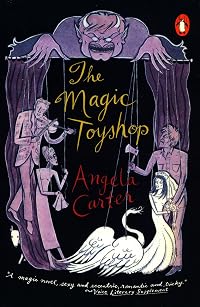
A powerful and disturbing writer, Angela Carter created haunting fiction about travelers surviving their passage through a disintegrating universe. Often based on myth or fairy tale-borrowed or invented for the occasion-her work evokes the most powerful aspects of sexuality and selfhood, of life and death, of apocalypse. Carter's most successful show more novels include The Magic Toyshop (1967), which received the John Llewellyn Rhys Prize and Several Perceptions (1968), winner of the Somerset Maugham Award. The Passion of New Eve (1977), a story of the end of the world and its possible new beginning with failed mankind replaced by a self-generating womankind. She translated many fairy tales and wrote several collections of short stories, including The Bloody Chamber (1979) which won the Cheltenham Festival of Literature Award and was the basis for the powerful movie A Company of Wolves. She worked as a journalist and as a professor at Brown and the University of Texas. She published two nonfiction books of interest: Nothing Sacred, selected writings, and The Sadeian Woman (1979). (Bowker Author Biography) show less
Some Editions
Awards and Honors
Awards
Distinctions
Notable Lists
Series
Belongs to Publisher Series
Work Relationships
Is contained in
Contains
Is abridged in
Common Knowledge
- Canonical title
- Black Venus
- Original title
- Black Venus
- Alternate titles
- Saints and Strangers
- Original publication date
- 1986
- First words
- Acknowledgements (Picador edition) 'Black Venus' was originally published in 1980 in a series, 'Next Editions'. 'The Kiss' first appeared in Harper's and Queen (1977). 'Overture and Incidental Music to a Midsummer Nigh... (show all)t's Deam' and 'The Cabinet of Edgar Allan Poe' both first appeared in Interzone (1982). A version of 'The Kitchen Child' was published on Vogue (1979) and of 'Peter and the Wolf' in Firebird I (1982). 'The Fall River Axe Murders' first appeared in The London Review of Books (1981) under a different title, as did 'Our Lady of the Massacre' in the anthology, The Saturday Night Reader (1979).
Sad; so sad, those smoky-rose, smoky-mauve evenings of late Autumn, sad enough to pierce the heart. The sun depart the sky in winding sheets of gaudy cloud; anguish enters the city, a sense of the bitterest regret, a nostalgi... (show all)a for things we never knew, anguish of the turn of the year, the time of impotent yearnings, the inconsolable season. In America, they call it, 'the Fall', bringing to mind the Fall of Man, as if the fatal drama of the primal fruit-theft must recur again and again, with cyclic regularity, at the same time of every year that schoolboys set out to rob orchards, invoking, in the most everyday image, any child, every child, who, offered the choice between virtue and knowledge, will always choose knowledge, always the hard way. Although she does not know the meaning of the word, 'regret', the woman sighs, without any precise reason. -Black Venus - Canonical DDC/MDS
- 823.914
- Canonical LCC
- PR6053.A73 S24
Classifications
Statistics
- Members
- 844
- Popularity
- 32,674
- Reviews
- 17
- Rating
- (3.97)
- Languages
- 8 — Czech, English, French, German, Galician, Italian, Polish, Spanish
- Media
- Paper, Audiobook, Ebook
- ISBNs
- 16
- ASINs
- 7