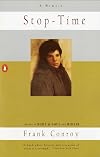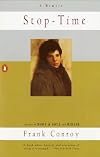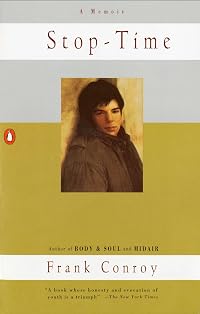
Stop-Time: A Memoir
by Frank Conroy
On This Page
Description
First published in 1967, Stop-Time was immediately recognized as a masterpiece of modern American autobiography, a brilliant portrayal of one boy's passage from childhood to adolescence and beyond. Here is Frank Conroy's wry, sad, beautiful tale of life on the road; of odd jobs and lost friendships, brutal schools and first loves; of a father's early death and a son's exhilarating escape into manhood.Tags
Recommendations




Member Reviews
_Stop-Time_ belongs on the top shelf of memoirs, on the top shelf any prose. Masterful work on every page, but Conroy is so humble he forgets himself and allows you to forget him also. This is not a memoir where you feel the author constantly leaning over your shoulder. The book read more like a novel. Completely un-selfconscious. It was that rare book that felt "true" ultimately. I can't recommend it strongly enough.
Ranging from Conroy's earliest memories until nearly his twentieth birthday when he began college (years spent for the most part between Florida and New York, penniles, with little in the way of parents) _Stop-Time_ covers a lot of ground. But Conroy has a knack for finding those crystaline scenes that embody the ways we show more "grow up" and he does it without ever dipping into cliche. The scene at the Florida state fair, the yo-yo competition, Ligget's beating, the Elsinore chapter... so many flawless moments in this short, extremely readable book.
A wonderful book about growing up male. A five-star book, for any son or father, or for anyone who knows or has ever met a son or a father. show less
Ranging from Conroy's earliest memories until nearly his twentieth birthday when he began college (years spent for the most part between Florida and New York, penniles, with little in the way of parents) _Stop-Time_ covers a lot of ground. But Conroy has a knack for finding those crystaline scenes that embody the ways we show more "grow up" and he does it without ever dipping into cliche. The scene at the Florida state fair, the yo-yo competition, Ligget's beating, the Elsinore chapter... so many flawless moments in this short, extremely readable book.
A wonderful book about growing up male. A five-star book, for any son or father, or for anyone who knows or has ever met a son or a father. show less
I saw this on my shelf and thought I should read it because it was shelf-worn and deteriorating. I don't know how it came into my possession; why I ever wanted to read it. Looking at, I actually thought it was a novel--fiction. However, it is a compelling autobiography a dream-like memoir of youth fumbling toward adulthood out of a dysfunctional family. Like life remembered, it scuds along abruptly from scene to scene chronologically with abrupt changes and incomplete context. All this is related skillfully and naturally, like the writings of Kurt Vonnegut Jr.. I put this up there with The Glass Castle and Low Down: Junk, Jazz, and Other Fairy Tales from Childhood for reconstructing the youthful view of a fractured world of damaged adults.
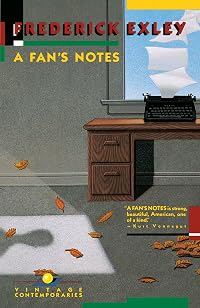
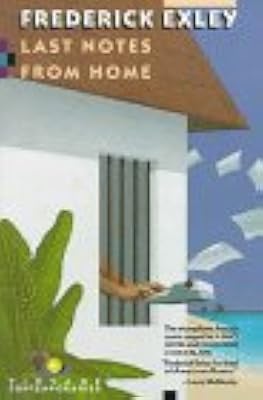
Well-crafted, highly influential coming-of-age tale that nonetheless struck me as slightly anticlimactic and faintly stuffy. It was difficult not to make mental comparisons to Frederick Exley's A FAN'S NOTES, which was published only one year later (1968) than STOP-TIME but in its passion and emotional violence feels vastly more vital.
The young Frank Conroy in Stop-Time is a heady mix of Holden Caulfield and George Orwell of Down and Out in Paris and London. It's the story of the son of an alcoholic, raised by a clueless mom and flighty stepfather, who frankly admits to his own cluelessless. He wanders in the backwoods of Florida, the streets of New York, and the halls of various institutions, without any guidance but his own inner energy and fierce desire to survive by observing and learning from the world around him -- which he does. You'll shake your head in wonder and awe at his recklessness and tenacity. I'm so glad he survived his haphazard childhood to write this book.
I came to this because they were talking about it on the Literary Disco podcast a while back. It's a remarkable book that works as a memoir but also a coming of age novel. By the end I was seeing it as a direct forerunner of Knausgaard's epic collection which is as high praise as I can imagine. Wonderful reading.
This is a memoir that reads like a novel and undoubtedly contains some fiction scattered among the exhilarating stories of Frank Conroy's youth. Covering the period up to his entrance into Haverford University this memoir creates a world pain and joy and the often awkward encounters of a young boy with real life. I was drawn back into the memoir upon reading a reference to it in David Ulin's wonderful extended essay, The Lost Art of Reading, where Ulin comments on young Conroy's reading habits. After cataloging some of the authors he was reading in the winter of his seventeenth year Conroy writes:
"I read very fast, uncritically, and without retention, seeking only to escape from my own life through the imaginative plunge into another. . show more . It was around this time that I first thought of becoming a writer."
Conroy was not much a student so he probably retained more of his reading than he claims for, after a year in school in Paris, he was accepted into Haverford University. The memoir is filled with flights of imagination that demonstrate the potential author hidden in a young boy whose exploits and adventures are as exciting as most fiction that I have encountered. The memoir succeeds in bringing you, the reader, into that life as a co-conspirator in the adventure. show less
"I read very fast, uncritically, and without retention, seeking only to escape from my own life through the imaginative plunge into another. . show more . It was around this time that I first thought of becoming a writer."
Conroy was not much a student so he probably retained more of his reading than he claims for, after a year in school in Paris, he was accepted into Haverford University. The memoir is filled with flights of imagination that demonstrate the potential author hidden in a young boy whose exploits and adventures are as exciting as most fiction that I have encountered. The memoir succeeds in bringing you, the reader, into that life as a co-conspirator in the adventure. show less
First published in 1967, Stop-Time was immediately recognized as a masterpiece of modern American autobiography, a brilliant portrayal of one boy's passage from childhood to adolescence and beyond. Here is Frank Conroy's wry, sad, beautiful tale of life on the road; of odd jobs and lost friendships, brutal schools and first loves; of a father's early death and a son's exhilarating escape into manhood.
Members
- Recently Added By
Lists

Best Biographies, Autobiographies and Memoirs
465 works; 160 members

Memoirs - Mary Karr
14 works; 1 member

Books Read in 2026
1,930 works; 66 members
Author Information

13+ Works 1,879 Members
Frank Conroy is the longtime director of the prestigious Iowa Writers' Workshop
Awards and Honors
Series
Belongs to Publisher Series
Gallimard, Folio (4542)
Work Relationships
Is abridged in
Has as a student's study guide
Common Knowledge
- Canonical title*
- Un cri dans le désert
- Original title
- Stop-time
- Dedication
- To Danny and Will
- First words
- My father stopped living with us when I was three or four.
- Blurbers
- Styron, William; Mailer, Norman
*Some information comes from Common Knowledge in other languages. Click "Edit" for more information.
Classifications
Statistics
- Members
- 603
- Popularity
- 48,500
- Reviews
- 16
- Rating
- (3.90)
- Languages
- 5 — English, French, German, Italian, Spanish
- Media
- Paper, Audiobook, Ebook
- ISBNs
- 15
- ASINs
- 11