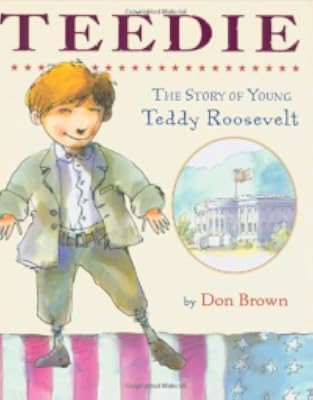
Teedie: The Story of Young Teddy Roosevelt
by Don Brown
On This Page
Description
As a young boy, Theodore "Teedie" Roosevelt was small, had weak eyes, and frail muscles. But Teedie was also inquisitive, brave, and self-sufficient. Determined to overcome his childhood ailments, Teedie changed from a timid homebody into an adventurous man. He explored the Wild West, fought in the Spanish-American War, served as president of the United States, and helped build the Panama Canal.Tags
Recommendations



Member Reviews
We all know about TR, right? Rough Riders, teddy bear, once was shot in the middle of a speech and kept on talking for a whole HOUR AND A HALF, using his bleeding arm to gesture with? Made of pure, 110% unadulturated awesome? Also a conservationist and, you know, president? (One of the big ones, not like Polk or Fillmore or somebody.)
Well, you may not believe it, but back before he was awesome Teddy Roosevelt was a puny, weak, asthmatic little boy. (Apparently he never recovered from the asthma, he just lived around it. Fair enough.) No, it's true! So here is this whole book about TR as a kid and young adult and how he triumphed over his weaknesses through sheer force of will. He rides horses (and doesn't even notice his arm is broken show more once until several jumps had gone by, as a well-timed quote from the man himself indicates), he learns to box, he becomes a cowboy to recover from the death of his wife and his mother on the same day... well, the list goes on and on.
One note - "inspirational" tales about disability abound. Not everybody who is asthmatic or physically weak or disabled is going to be able to overcome these problems by "trying hard", and neither will all of them especially want to. This is a great book, and pretty accurate, but if you're giving it to inspire a disabled/weak/asthmatic friend, reconsider your motives. Then, when you're back to viewing this as a great true story, give it with an open heart. It's a great book. (It's a pity I even have to say this, but if you've ever been disabled you'll know how annoying it is to be told, in alternating breaths, both that you could get out of your wheelchair and walk if you wanted to/tried harder/prayed better and then that you're brave and inspirational for venturing out of the house at all.)
Also, please note that this is a lengthy book. Your younger children might not sit still long enough to get through it all. Save it for reading alone or for reading to an older crowd. show less
Well, you may not believe it, but back before he was awesome Teddy Roosevelt was a puny, weak, asthmatic little boy. (Apparently he never recovered from the asthma, he just lived around it. Fair enough.) No, it's true! So here is this whole book about TR as a kid and young adult and how he triumphed over his weaknesses through sheer force of will. He rides horses (and doesn't even notice his arm is broken show more once until several jumps had gone by, as a well-timed quote from the man himself indicates), he learns to box, he becomes a cowboy to recover from the death of his wife and his mother on the same day... well, the list goes on and on.
One note - "inspirational" tales about disability abound. Not everybody who is asthmatic or physically weak or disabled is going to be able to overcome these problems by "trying hard", and neither will all of them especially want to. This is a great book, and pretty accurate, but if you're giving it to inspire a disabled/weak/asthmatic friend, reconsider your motives. Then, when you're back to viewing this as a great true story, give it with an open heart. It's a great book. (It's a pity I even have to say this, but if you've ever been disabled you'll know how annoying it is to be told, in alternating breaths, both that you could get out of your wheelchair and walk if you wanted to/tried harder/prayed better and then that you're brave and inspirational for venturing out of the house at all.)
Also, please note that this is a lengthy book. Your younger children might not sit still long enough to get through it all. Save it for reading alone or for reading to an older crowd. show less
Through this biography of Teddy Roosevelt's life, I learned a significant amount. I will admit that I am not big on biographies and rarely (if ever) read them. However, I enjoyed this book, probably because I while I learned new things, it felt as if I was just reading a children's book about someones life. Teddy went through a few difficulties as a child; asthma, needing glasses, being small for his age, all which lead him to be bullied. He rose about it all and became the second youngest president of the United States. I'm glad this is the first picture biography book that I read because I'm now interested to read more.
This book contains a wonderful quote: "I do not believe a child's book is really good unless grown-ups get something out of it." This was Roosevelt's philosophy on children's reading. I can say that I agree, after having read some quality nonfiction children's books of late that I have profited from, both in learning and enjoyment.This book, "Teedie," is a good overview of Teddy Roosevelt's life. I use the word overview in a purposeful manner, as it feels like less of a story than a list. In the beginning of the text, we get some detail about Roosevelt's early life--his challenges and his family are a part of the narrative. But by the end of the book, the story devolves into something of a laundry list of his accomplishments. I think an show more incredible story such as his could have been better represented by adding a bit more detail throughout, and organizing it a bit differently. Perhaps the book could have focused on his early life alone, and his adult accomplishments could have been an addendum. Although the story was informative for young students, I felt that the pull of his story started to be lost by the end. show less
I would say that I knew a decent amount about Teddy Roosevelt before reading this biography; most of what I knew was about his presidency and nature conservation. Through reading this biography, I would say I learned much more about Roosevelt's life. As a child, Teddy (called Teedie at the time) was extremely frail and sickly. He had frequent asthma attacks that would leave him gasping for air. His wealthy parents would take him to the country and on trips around the world frequently in an attempt to lessen his asthma attacks, but this only managed to help a small amount. Teddy and his siblings loved visits to the country, however, and this was where Teddy explored his love for nature. He wanted to learn about every animal, insect, and show more plant he found, and he read many books on nature to expand his knowledge. Eventually, his father recommended that Teddy take up exercising regularly to strengthen his body and hopefully lessen his asthma. After suffering at the hands of bullies, Teddy begged his parents to let him take boxing classes, and they agreed to let him attend. He eventually entered a boxing competition and won, to the surprise of everyone, Teddy included. By 1876, he began his schooling at Harvard, after which he considered careers in science, writing, history, law, and politics- he decided politics was his best choice, and was elected to the New York Assembly. After his first wife died, he traveled to Dakota, where he lived the life of a cowboy; he eventually returned to New York in 1886. There, he remarried and had five children, and was appointed New York City police commissioner. His work here caught the eye of the president, who made Teddy assistant secretary of the navy. During the war between America and Spain in 1898, he formed a volunteer cavalry called the Rough Riders; his efforts during this war made him famous and he was recommended for the Medal of Honor. Once the war ended, he was elected governor of New York, and then vice president of the United States. Finally, in 1901, he was elected president of the United States at the age of 42. During his presidency, he policed corporations, protected the environment, built the Panama Canal, and ended the Russo-Japanese war, which won him the Nobel Peace Prize. He died on January 6, 1919, at the age of 60. Needless to say, I learned quite a bit from this book. I had no idea about half of his accomplishments, and it was very interesting to learn about his life. Compared to the other picture book biography I read on Theodore Roosevelt, this book seems geared toward slightly younger children due to the writing and illustrations. It doesn't go as in-depth to Teddy's childhood as the other biography, but it includes much more about his adulthood, which I really enjoyed learning about. show less
This biography is very informative about the young life of Theodore Roosevelt. The author, Don Brown, does a wonderful job giving details about the former President's childhood. One fact that stuck out to me was, his nickname was Teedie. Until reading this, I thought everyone had always called him Teddy. The illsutrations in this book were very colorful also. I would read this to my students when talking about history and past Presidents.
As a child Teddy Roosevelt was a weak little boy. But he had a large mind! I really enjoy the quote in the story that the author added in "I do not believe a child's book is really good unless grown-ups get something out of it." I can relate to this because i always find myself picking up new facts here and there. I especially liked this book because I did not know much about Teddy Roosevelt. Teddy was know for being gallant and courageous. He became known for that during the war between America and Spain. I also learned that at the time of his election he was the youngest president we have ever had. He was only 42!
Don Brown’s portrayal of a young Theodore Roosevelt brings the reader into the life a young child that becomes a distinguished American. The book provides copious amounts of information regardless of age and level of the young intended audience. Perhaps, this is a result of the subject himself. The book quotes Roosevelt as remember his father stating that a children’s book is not good unless an adult gets something out of it. Brown must have considered this point as he wrote the book.
Brown’s credentials, as listed in the book, are an intriguing refutation of his personal aptitude. He criticizes his ability in his initial course of university study. Then, he suggests his turn to history as a type of last resort. Interestingly show more enough, he went on to write “[m]ore than a dozen and a half” children’s books. However, Brown’s credibility is significantly enhanced by his choice of references in the bibliography. Three of the five references are primary documents. Two were written by Roosevelt.
The book is written in a chronological format from the point that Roosevelt was age ten. The illustrations and text are set up and placed in a flow that compliments each other. This author included limited reference materials as the story is in a picture book format which does not allow for chapter, a table of contents, or an index. However, the Author’s Note provides additional information not explained or provided in the text. The most interesting reference tool in this book is the timeline. The author uses an illustration of an adult Roosevelt as the timeline. Details about his life are listed starting at his head on the left-hand page and continue down and continuing at the top of the right-hand page.
Overall, the organization, language patterns, and format are appropriate for the Kindergarten to third grade age level. show less
Brown’s credentials, as listed in the book, are an intriguing refutation of his personal aptitude. He criticizes his ability in his initial course of university study. Then, he suggests his turn to history as a type of last resort. Interestingly show more enough, he went on to write “[m]ore than a dozen and a half” children’s books. However, Brown’s credibility is significantly enhanced by his choice of references in the bibliography. Three of the five references are primary documents. Two were written by Roosevelt.
The book is written in a chronological format from the point that Roosevelt was age ten. The illustrations and text are set up and placed in a flow that compliments each other. This author included limited reference materials as the story is in a picture book format which does not allow for chapter, a table of contents, or an index. However, the Author’s Note provides additional information not explained or provided in the text. The most interesting reference tool in this book is the timeline. The author uses an illustration of an adult Roosevelt as the timeline. Details about his life are listed starting at his head on the left-hand page and continue down and continuing at the top of the right-hand page.
Overall, the organization, language patterns, and format are appropriate for the Kindergarten to third grade age level. show less
Members
- Recently Added By
Author Information

40+ Works 6,654 Members
Awards and Honors
Notable Lists
Common Knowledge
- People/Characters
- Theodore Roosevelt
Classifications
Statistics
- Members
- 168
- Popularity
- 195,701
- Reviews
- 20
- Rating
- (3.94)
- Languages
- English
- Media
- Paper, Ebook
- ISBNs
- 4
- UPCs
- 1
- ASINs
- 1