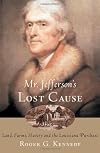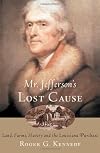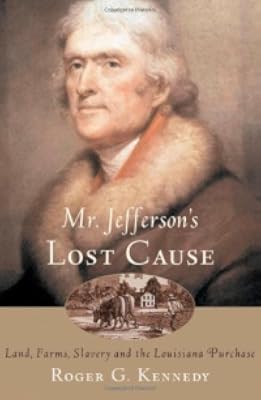
Mr. Jefferson's Lost Cause: Land, Farmers, Slavery, and the Louisiana Purchase
by Roger G. Kennedy
On This Page
Description
Thomas Jefferson advocated a republic of small farmers--free and independent yeomen. And yet as president he presided over a massive expansion of the slaveholding plantation system--particularly with the Louisiana Purchase--squeezing the yeomanry to the fringes and to less desirable farmland. Now Roger Kennedy conducts an eye-opening examination of that gap between Jefferson's stated aspirations and what actually happened. Kennedy reveals how the Louisiana Purchase had a major impact on land show more use and the growth of slavery. He examines the great financial interests that beat down slavery's many opponents in the South itself (Native Americans, African Americans, Appalachian farmers, and conscientious opponents of slavery). He describes how slaveholders' cash crops (first tobacco, then cotton) sickened the soil and how the planters moved from one desolated tract to the next. Soon the dominant culture of the entire region--from Maryland to Florida, from Carolina to Texas--was that of owners and slaves producing staple crops for international markets. The earth itself was impoverished, in many places beyond redemption. None of this, Kennedy argues, was inevitable. He focuses on the character, ideas, and ambitions of Thomas Jefferson to show how he and other Southerners struggled with the moral dilemmas presented by the presence of Indian farmers on land they coveted, by the enslavement of their workforce, by the betrayal of their stated hopes, and by the manifest damage being done to the earth itself. show lessTags
Recommendations








Member Reviews
The plantation system is Kennedy's bete noir in this wide ranging account of the economy and politics of the south during Jefferson's political ascendancy. He is critical of the plantation mentality of Jefferson's class, who felt it was cheaper to move on to new lands than to use good farming practices. That mentality led to a dependence on foreign markets, single crops, the expansion of slavery and ultimately, to civil war. He is unsparing in his criticism of what he calls Jefferson's persistent and deep anti-black animus, which he feels in turn affected Jefferson's dislike of industrialization and of cities in general. "Throughout most of his career, Jefferson was too constrained by prejudice against artisans and multiracial towns to show more give support to urbanization in the South" (with the exception of Eli Whitney's cotton gin and the manufacturers in Richmond) . . . "The slaves seemed ungrateful and the yeoman unworthy". Kennedy's reading is broad and deep, as it is in his other books, but he makes frequent assertions about Jefferson's motives and psychic needs which I find are often unsupported. I have no argument with his characterization of the effects of the plantation system, but the overriding impression I take away is one of regret for what might have been for blacks, Indians, and the early republic. show less
While making some points of interest, particularly in regards to the conditions at Monticello, this book is flawed by the basic problem that Roger Kennedy never learned the aphorism that one man's conspiracy is another man's affinity group. The "lost cause" of the title is Jefferson's concept of the United States becoming an agrarian republic of yeoman farmers, an aspiration crippled (in Kennedy's view) by Jefferson compromising his vision by being unwilling to break with his planter brethern on any significant issue. Thus leading to the spread of the plantation system with all its ills of ethnic cleansing, slavery and environmental degradations; rather a large onus to put on one man, no matter how influential.
Where Kennedy really goes show more off the deep end is with his interpretation of the Louisiana Purchase, which has all the hallmarks of a conspiracy theory in that it's not capable of being falsified. This is not to mention that Kennedy gives every indication of not understanding international trade and politics. When Kennedy coined the prolix phrase "textile imperial-colonialism," instead of using the perfectly applicable term "neo-colonialism" to the Anglo-American commercial realtionship I should have put this book aside. show less
Where Kennedy really goes show more off the deep end is with his interpretation of the Louisiana Purchase, which has all the hallmarks of a conspiracy theory in that it's not capable of being falsified. This is not to mention that Kennedy gives every indication of not understanding international trade and politics. When Kennedy coined the prolix phrase "textile imperial-colonialism," instead of using the perfectly applicable term "neo-colonialism" to the Anglo-American commercial realtionship I should have put this book aside. show less
Kennedy gives a totally different, critical slant on the world of Jefferson that is at times funny yet insightful, Kirkus reviews Kennedy as "penchant for unsubstantiated psychobabble"
Ratings
Members
- Recently Added By
Author Information

19 Works 984 Members
Roger G. Kennedy is Director Emeritus of the National Museum of American History, Smithsonian Institution, and a past director of the National Park Service. He has had a long and distinguished career in public service, during which he served six presidents
Common Knowledge
- Canonical title
- Mr. Jefferson's Lost Cause: Land, Farmers, Slavery, and the Louisiana Purchase
Classifications
- Genres
- History, Nonfiction, General Nonfiction, Biography & Memoir, Politics and Government
- DDC/MDS
- 973.4 — History & geography History of North America United States Constitutional period (1789-1809)
- LCC
- E333 .K46 — History of the United States United States Revolution to the Civil War, 1775/1783-1861 By period 1789-1809. Constitutional period Jefferson's administrations, 1801-1809 Purchase of Louisiana, 1803
- BISAC
Statistics
- Members
- 230
- Popularity
- 142,193
- Reviews
- 3
- Rating
- (3.00)
- Languages
- English
- Media
- Paper, Ebook
- ISBNs
- 4
- ASINs
- 4