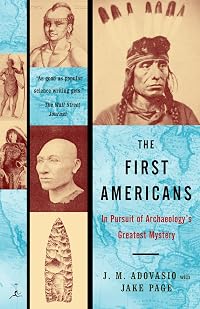
The First Americans: In Pursuit of Archaeology's Greatest Mystery (Modern Library Paperbacks)
by James Adovasio, Jake Page
On This Page
Description
J. M. Adovasio has spent the last thirty years at the center of one of our most fiery scientific debates: Who were the first humans in the Americas, and how and when did they get there? At its heart, The First Americans is the story of the revolution in thinking that Adovasio and his fellow archaeologists have brought about, and the firestorm it has ignited. As he writes, “The work of lifetimes has been put at risk, reputations have been damaged, an astounding amount of silliness and even show more profound stupidity has been taken as serious thought, and always lurking in the background of all the argumentation and gnashing of tenets has been the question of whether the field of archaeology can ever be pursued as a science.” show lessTags
Recommendations













Member Reviews
So, a while back I read 1491 which dipped into new findings in various aspects of pre-columbian American history. It was very interesting. This was kind of a follow-up. It deals with one of the areas covered in 1491, namely the question of when humans arrived in the Americas. Adovasio is an archaeologist who was responsible for the dig at Meadowcroft, an incredibly important site that provided the first solid evidence that humans inhabited N. America before 'Clovis man', i.e. prior to about 11,000 years ago. This book is his version of American archaeology leading up to this discovery, and how it and other similar digs has changed how we look at American pre-history.
This is Adovasio's personal story, as his and other recent finds show more generated a lot of controversy and heat from 'Clovis first' nay-sayers who firmly believed that humans could not been here prior to 11,000 years ago, and Adovasio doesn't mince many words in his opinions of them. Not that he should; I think it's clear that a lot of criticism of him and his work was very much undeserved and rooted in dogma rather than good science. And from this point of view it's a successful book. In between his obvious irritation, which is really only present in a couple of chapters, he successfully describes the history of American archaeology over the last two centuries and traces what it is we know, and how we got to knowing it. And he discusses the controversies that have raged over this entire time and how they eventually became resolved, including the one he was personally involved in.
A book for those with an interest in pre-history and in finding out how science is really done. show less
This is Adovasio's personal story, as his and other recent finds show more generated a lot of controversy and heat from 'Clovis first' nay-sayers who firmly believed that humans could not been here prior to 11,000 years ago, and Adovasio doesn't mince many words in his opinions of them. Not that he should; I think it's clear that a lot of criticism of him and his work was very much undeserved and rooted in dogma rather than good science. And from this point of view it's a successful book. In between his obvious irritation, which is really only present in a couple of chapters, he successfully describes the history of American archaeology over the last two centuries and traces what it is we know, and how we got to knowing it. And he discusses the controversies that have raged over this entire time and how they eventually became resolved, including the one he was personally involved in.
A book for those with an interest in pre-history and in finding out how science is really done. show less
The first bit was intriguing, when he mentioned Clovis Woman as a missing piece. But then she appears in the index never again, and, skimming, is only briefly mentioned in the last chapter. Mostly the book is about people and the history of archaeology, focus on the author's ego. I want more science. Then again, it is quite old, relatively speaking. Maybe I'll find something more up-to-date and more about the actual First Americans.
Btw, there were plenty of pictures - of artifacts and sites. I'd like more diagrams and charts to illustrate the differences between the different current theories and that sort of helpful data.
Btw, there were plenty of pictures - of artifacts and sites. I'd like more diagrams and charts to illustrate the differences between the different current theories and that sort of helpful data.
Ratings
Members
- Recently Added By
Author Information

13+ Works 441 Members

52+ Works 2,738 Members
Jake Page was born in Boston, Massachusetts on January 24, 1936. He received a bachelor's degree from Princeton University in 1958 and a master's degree from the Graduate Institute of Book Publishing at New York University in 1960. He worked for Doubleday as an editor of Anchor Books. In 1962, he was put in charge of Natural History Press, which show more also gave him responsibility for Natural History magazine. He eventually took the job of science content editor for Smithsonian magazine. He also wrote a monthly science column for the magazine entitled Phenomena, Comment and Notes. His columns for Smithsonian and Science were collected in Pastorale: A Natural History of Sorts and Songs to Birds. He wrote dozens of books on the wonders of science including earthquakes, dinosaurs, arctic exploration, zoos, and the languages of cats and dogs. He then turned his attention to the Indians of the American Southwest. He retired from Smithsonian magazine in the late 1970s to help photographer Susanne Anderson on a book documenting the Hopi tribe. Hopi was published in 1982 and followed by Navajo in 1995. His other books include Lords of the Air: The Smithsonian Book of Birds written with Eugene S. Morton, The Big One: The Earthquake That Rocked Early America and Helped Create a Science written with Charles B. Officer, The First Americans: In Pursuit of Archaeology's Greatest Mystery written with J. M. Adovasio, In the Hands of the Great Spirit: The 20,000-Year History of American Indians, and Uprising: The Pueblo Indians and the First American War for Religious Freedom. He also wrote five mystery novels including The Stolen Gods and The Lethal Partner. He died from vascular disease on February 10, 2016 at the age of 80. (Bowker Author Biography) show less
Common Knowledge
- First words
- Few dictionary definitions are ever wholly satisfactory in capturing the substance and meaning of complex subjects.
Classifications
Statistics
- Members
- 198
- Popularity
- 164,145
- Reviews
- 2
- Rating
- (3.90)
- Languages
- English, Portuguese
- Media
- Paper, Audiobook, Ebook
- ISBNs
- 6
- ASINs
- 3