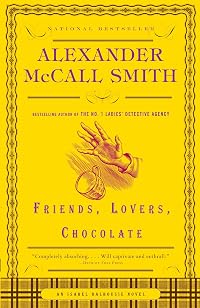
Friends, Lovers, Chocolate
by Alexander McCall Smith
Isabel Dalhousie (2), No. 1 Ladies' Detective Agency (24)
On This Page
Description
ISABEL DALHOUSIE - Book 2Nothing captures the charm of Edinburgh like the bestselling Isabel Dalhousie series of novels featuring the insatiably curious philosopher and woman detective. Whether investigating a case or a problem of philosophy, the indefatigable Isabel Dalhousie, one of fiction’s most richly developed amateur detectives, is always ready to pursue the answers to all of life’s questions, large and small.
In this delightful second installment in Alexander McCall Smith’s show more bestselling detective series, the irrepressibly curious Isabel Dalhousie gets caught up in a highly unusual affair of the heart. When Isabel is asked to cover for vacationing Cat at her delicatessen, Isabel meets a man with a most interesting problem. He recently had a heart transplant and is suddenly haunted by memories of events that never happened to him.The situation piques her insatiable curiosity: Could the memories be connected with the donor’s demise? Naturally, Isabel’s friend Jamie thinks it is none of Isabel’s business. Meanwhile, Grace, Isabel’s housekeeper, has become infatuated with a man at her spiritualist meeting, and Cat brings home an Italian lothario. That makes for some particularly tricky problems–both practical and philosophical–for Isabel to unravel in this enormously engaging and highly unusual mystery.
. show less
Tags
Recommendations





Member Recommendations
Member Reviews
I enjoyed Friends, Lovers, Chocolate more than the first book in the series. Its wonderful that Isabel is a busy professional, self-assured and means well in wanting to help people. At times she can be judgmental and self-righteous in her thoughts and actions.
But she is also honorable and caring. With help from friends she faces her mistakes and makes amends to those she may have underestimated and hurt.
I believe McCall-Smith is telling us that we are all human, and make mistakes. We need to forgive each other and ourselves by continuously striving to do better.
Good read.
But she is also honorable and caring. With help from friends she faces her mistakes and makes amends to those she may have underestimated and hurt.
I believe McCall-Smith is telling us that we are all human, and make mistakes. We need to forgive each other and ourselves by continuously striving to do better.
Good read.
If you don’t mind living in someone’s head for a whole book, this may be the book for you. Isabel Dalhousie is the editor of the Journal for Applied Ethics, so she debates the pros and cons of the public morality of practically everything. To the point of ridiculousness and sometimes hilarity. And she really cannot mind her own business. In a casual meeting, she learns the recipient of a heart transplant is possibly having cellular memory. And, he wants to thank the family of the donor. Isabel decides she should find this family, even though they’ve asked for privacy. Her escapades end in some very cringy situations. This series is an acquired taste. Once I got to know the characters, I wanted to see what happens to them. I’m show more glad I’ve kept going because the next book has a jaw-dropping surprise. show less
Alexander McCall Smith proved his genius with the The Sunday Philosophy Club, the debut novel in a second mystery series. The novel was as different from his Precious Ramotswe series as could be: Isabel Dalhousie is an extremely educated editor of an ethical journal in urban Edinburgh, while the kindly, clever but less sophisticated Mma Ramotswe labors in a smallish town in Botswana. Yet, you sense that the two women would get along like a house on fire if, by some miracle, they ever met.
This second novel featuring Isabel Dalhousie is even slower than the first. Unlike the first novel, there's no death. The mysteries are sort of un-mysteries. Nothing much happens, actually. Yet, although I couldn't tell you why, I really enjoyed show more Friends, Lovers, Chocolate. It revealed a great deal more about Isabel, her niece Cat and Cat's former lover Jamie. It's a character study rather than a mystery. Perhaps it is because Isabel and I are both the same age -- suddenly noticing that we're uncomfortably wedged into middle age -- but I really enjoyed the novel despite its meandering pace. It seemed like a leisurely stroll with a treasured aunt -- one like Isabel Dalhousie herself -- rather than an interminable evening with tiresome company. While I didn't enjoy this book as much as the first, it left me eager for the next Isabel Dalhousie book. show less
This second novel featuring Isabel Dalhousie is even slower than the first. Unlike the first novel, there's no death. The mysteries are sort of un-mysteries. Nothing much happens, actually. Yet, although I couldn't tell you why, I really enjoyed show more Friends, Lovers, Chocolate. It revealed a great deal more about Isabel, her niece Cat and Cat's former lover Jamie. It's a character study rather than a mystery. Perhaps it is because Isabel and I are both the same age -- suddenly noticing that we're uncomfortably wedged into middle age -- but I really enjoyed the novel despite its meandering pace. It seemed like a leisurely stroll with a treasured aunt -- one like Isabel Dalhousie herself -- rather than an interminable evening with tiresome company. While I didn't enjoy this book as much as the first, it left me eager for the next Isabel Dalhousie book. show less
The title of this book might just as well have been “”The Heart of the Matter,” but unfortunately that one was taken. But one can picture Isabel Dalhousie, the main protagonist, pondering: “well, but would it be unethical to use the title also if it were apt?” Isabel, editor of the “Review of Applied Ethics,” ponders everything. As this late-thirties-early-forties-ish attractive woman roams the streets of Edinburgh, we are privy to many of her thoughts and observations. Smith is a very pleasing writer, and Isabel is an entertaining companion.
The “mystery” occupying Isabel isn’t much of one; I think of this book more as a way to spend a diverting day or two with lovely Scottish friends, rather than a nail-biting book show more you rocket through to solve the crime. Here we are dealing with matters of the heart: Isabel’s, her niece Cat’s, Cat’s ex-boyfriend Jamie’s, her housekeeper Grace’s, and Isabel’s new friend Ian’s. Ian has just had a heart transplant, and is suffering consequences that are perhaps mysterious, perhaps psychological. Isabel feels an ethical obligation to help him figure it out. The influence of the Scottish national poet Robert Burns has been deep in her life and in her culture, and thus she feels bound to her fellows: “a man’s a man, for a’ that.” But in all of these battles of the heart versus the brain, the characters confront the age-old dilemma: is it in fact “only with the heart that one can see rightly” (as per Antoine de Saint-Exupery) or should the brain be accorded hegemony? show less
The “mystery” occupying Isabel isn’t much of one; I think of this book more as a way to spend a diverting day or two with lovely Scottish friends, rather than a nail-biting book show more you rocket through to solve the crime. Here we are dealing with matters of the heart: Isabel’s, her niece Cat’s, Cat’s ex-boyfriend Jamie’s, her housekeeper Grace’s, and Isabel’s new friend Ian’s. Ian has just had a heart transplant, and is suffering consequences that are perhaps mysterious, perhaps psychological. Isabel feels an ethical obligation to help him figure it out. The influence of the Scottish national poet Robert Burns has been deep in her life and in her culture, and thus she feels bound to her fellows: “a man’s a man, for a’ that.” But in all of these battles of the heart versus the brain, the characters confront the age-old dilemma: is it in fact “only with the heart that one can see rightly” (as per Antoine de Saint-Exupery) or should the brain be accorded hegemony? show less
The eponymous first book in Alexander McCall Smith's Sunday Philosophy Club series humbled me.
The second installment in the series, Friends, Lovers, Chocolate, expanded my musical horizons by introducing me to Many Waters Cannot Quench Love and John Ireland, for which I will be eternally grateful.
More than that, however, once again I found myself happily mentally noshing on the philosophical and ethical conundrums presented to Isabel throughout the book. Although Isabel certainly meddles, this time a a man with a heart transplant asks her for help when he begins to have visions of what he may believe may be his donor's murderer. Questions of cellular memory, the afterlife (and being open-minded enough to grant at least the possibility show more of an afterlife legitimacy), and even romance arise as Isabel finds herself drawn into her new friend's problem. Meanwhile, Isabel is forced to confront her feelings for Jamie (at least to some degree) and even indulges her less philosophical and ethical side, deftly preventing from becoming a boring Mary Sue and nicely shading in some depth to her character.
Once again, McCall Smith has given us a Scottish cozy that I enjoyed like a delicious, but messy pastry. At the end, there were some crumbs left, and like so many of Life's philosophical questions, the answer wasn't neat and tidy. But the path to finding it was satisfying as ever. From her niece Kat's shop to a rural bookstore, McCall's talent for drawing a reader into an environment with wholly believable characters makes this another successful installment.
I am beginning to love these books for what they are. Often, I pause reading to Google a word (few books challenge my vocabulary, but both of these installments have), a song, even an instrument (in this case, the contrabasoon). I always learn something and, because the ethical questions presented are interesting (even when they're the "fake" ones Isabel reviews for The Journal of Applied Ethics), just getting to mull those over is a bit like being able to continue to read while doing something else like the dishes.
The books are also a welcome respite when I need a break from many of the darker authors I read such as Denise Mina, Charles Todd, Tana French or Alex Grecian. The are cozies, a sub-genre I admit with chagrin I likely would still be snobbishly dismissing were it not for this series.
I was planning to read these around Christmas time every year, since my husband gifted himself into that tradition, but I already have the third installment and highly doubt I'll be able to wait that long this time.
You can find this review (with hyperlinks) and reviews of many other character series mysteries, primarily by British and Irish authors, on my blog at bodyonthefloor.blogspot.com show less
The second installment in the series, Friends, Lovers, Chocolate, expanded my musical horizons by introducing me to Many Waters Cannot Quench Love and John Ireland, for which I will be eternally grateful.
More than that, however, once again I found myself happily mentally noshing on the philosophical and ethical conundrums presented to Isabel throughout the book. Although Isabel certainly meddles, this time a a man with a heart transplant asks her for help when he begins to have visions of what he may believe may be his donor's murderer. Questions of cellular memory, the afterlife (and being open-minded enough to grant at least the possibility show more of an afterlife legitimacy), and even romance arise as Isabel finds herself drawn into her new friend's problem. Meanwhile, Isabel is forced to confront her feelings for Jamie (at least to some degree) and even indulges her less philosophical and ethical side, deftly preventing from becoming a boring Mary Sue and nicely shading in some depth to her character.
Once again, McCall Smith has given us a Scottish cozy that I enjoyed like a delicious, but messy pastry. At the end, there were some crumbs left, and like so many of Life's philosophical questions, the answer wasn't neat and tidy. But the path to finding it was satisfying as ever. From her niece Kat's shop to a rural bookstore, McCall's talent for drawing a reader into an environment with wholly believable characters makes this another successful installment.
I am beginning to love these books for what they are. Often, I pause reading to Google a word (few books challenge my vocabulary, but both of these installments have), a song, even an instrument (in this case, the contrabasoon). I always learn something and, because the ethical questions presented are interesting (even when they're the "fake" ones Isabel reviews for The Journal of Applied Ethics), just getting to mull those over is a bit like being able to continue to read while doing something else like the dishes.
The books are also a welcome respite when I need a break from many of the darker authors I read such as Denise Mina, Charles Todd, Tana French or Alex Grecian. The are cozies, a sub-genre I admit with chagrin I likely would still be snobbishly dismissing were it not for this series.
I was planning to read these around Christmas time every year, since my husband gifted himself into that tradition, but I already have the third installment and highly doubt I'll be able to wait that long this time.
You can find this review (with hyperlinks) and reviews of many other character series mysteries, primarily by British and Irish authors, on my blog at bodyonthefloor.blogspot.com show less
I didn't think I was going to try any more Isabel Dalhousie books, after not enjoying the first one too much... but when book bingo calls for me to read a book "set somewhere you have been"... let's be real, I'm always going to want it to be Edinburgh. And Alexander McCall Smith's writing style is a sort of siren call for me. So I decided to give the second book in the series a try.
I liked a lot of it. But ultimately, I guess I am still warming up to Isabel, and I'm not sure if I'll come to like her more in future books or not. She's a bit too ivory-tower for me. A bit unrelatable, a bit aimless? Although I've gotten used to AMC's philosophical, meandering style (and I relish it!), it just feels cranked up to a very high level with show more Isabel. And, so far, I do feel like she meddles too much in other people's quandaries, from purely philosophical motives. It just doesn't quite land for me. But I'm more willing to try another book in the series, just because I do enjoy the writing so much! show less
I liked a lot of it. But ultimately, I guess I am still warming up to Isabel, and I'm not sure if I'll come to like her more in future books or not. She's a bit too ivory-tower for me. A bit unrelatable, a bit aimless? Although I've gotten used to AMC's philosophical, meandering style (and I relish it!), it just feels cranked up to a very high level with show more Isabel. And, so far, I do feel like she meddles too much in other people's quandaries, from purely philosophical motives. It just doesn't quite land for me. But I'm more willing to try another book in the series, just because I do enjoy the writing so much! show less
Members
- Recently Added By
Lists

Stories set in The British Isles
51 works; 1 member

Books tagged "feel good"
129 works; 20 members

Books About Older People
50 works; 11 members

Books About Candy
13 works; 5 members

Most Popular Books Tagged Scotland
35 works; 2 members

Books Read in 2016
4,666 works; 199 members
Author Information

314+ Works 125,746 Members
Alexander McCall Smith was born on August 24, 1948 in Zimbabwe. He was a professor of medical law at the University of Edinburgh, but he left in 2005 to focus on his writing. He has written over 60 books, including specialist academic titles including Forensic Aspects of Sleep and The Criminal Law of Botswana, short story collections including show more Portuguese Irregular Verbs, and children's books including The Perfect Hamburger. He is best known for the No. 1 Ladies' Detective Agency series. He also writes the Corduroy Mansions, Isabel Dalhousie and 44 Scotland Street series. He has received numerous awards, including The Crime Writers' Association Dagger in the Library Award and the 2004 United Kingdom's Author of the Year Award. His book, The Full Cupboard of Life, received the Saga Award for Wit in the United Kingdom. In 2007, he received a CBE for his services in literature. (Bowker Author Biography) show less
Some Editions
Awards and Honors
Distinctions
Series


Work Relationships
Is contained in
Common Knowledge
- Canonical title
- Friends, Lovers, Chocolate
- Original title
- Friends, Lovers, Chocolate
- Original publication date
- 2005-09-20
- People/Characters
- Isabel Dalhousie; Cat; Jamie; Grace; Ian
- Important places
- Edinburgh, Scotland, UK
- Dedication
- For Angus and Fiona Foster
- First words
- The man in the brown Harris tweed overcoat ... made his way slowly along the street that led down the spine of Edinburgh
- Last words
- (Click to show. Warning: May contain spoilers.)I understand. Yes, I understand
Classifications
Statistics
- Members
- 2,780
- Popularity
- 6,635
- Reviews
- 67
- Rating
- (3.54)
- Languages
- 12 — English, Estonian, French, German, Italian, Polish, Portuguese, Russian, Serbian, Spanish, Swedish, Turkish
- Media
- Paper, Audiobook, Ebook
- ISBNs
- 57
- UPCs
- 2
- ASINs
- 20