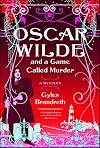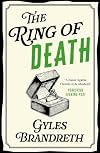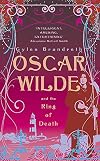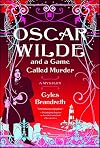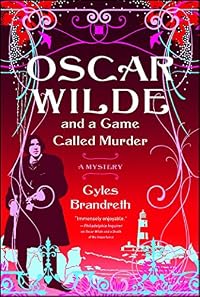
Oscar Wilde and the Ring of Death
by Gyles Brandreth
Oscar Wilde Murder Mysteries: Publication Order (2), Oscar Wilde Murder Mysteries: Chronological Order (1892)
On This Page
Description
I see murder in this unhappy hand... When Mrs. Robinson, palmist to the Prince of Wales, reads Oscar Wilde's hand, she cannot know what she has predicted. Nor can Oscar know what he has set in motion when, that same evening, he proposes a game of "murder" in which each of his Sunday Supper Club guests must write down those whom they would like to kill. The fourteen "victims" begin to die mysteriously, one by one, and in the order in which their names were drawn from the bag. With growing show more horror Wilde and his confidants, Robert Sherard and Arthur Conan Doyle, realize that one of their guests that evening must be the murderer. In a race against time, Wilde will need all his powers of deduction and knowledge of human behavior before he himself-the thirteenth name on the list-becomes the killer's next victim. show lessTags
Recommendations








Member Reviews
It was fun to follow Oscar and his friends around England. Obviously, the book was very well researched, even including a few historical footnotes. Amusing innuendos and witticisms are on every page. As a mystery though, it lacked tension and there weren't enough clues to keep the reader engaged in unraveling the puzzle. The evidence, once the answer is unveiled, so it is "fair" by mystery terms but the mystery still feels dilute in a way.
What's not to like, Oscar Wilde as detective! Wonderfully read by Bill Wallis all characters come to life. You'll find yourself immersed in life in London in the late 1880's. A lot of information and none of it boring or distracting from the story and a good story it is. It keeps meandering on and before you know it, you know whodunit... Read this, you won't regret it!
Another in the series of Oscar Wilde as a detective. Sir Arthur Conan Doyle is again in it and also Bram Stoker, Walter Sickert and the Marquess of Queensbury.
During a dinner of the Socrates Club, Wilde proposes a game of Murder with the question of "Who would you kill?" Each attendee writes their choice on a slip of paper which are then drawn randomly and read. All is done in fun and games until the names on that list start turning up dead in the sequence they appear on the list. Who is the murderer? Are the deaths related or are they chance events?
Wilde and the amateur detectives find themselves searching in the realms of politics, theatre and hidden secrets while trying to solve the murders before the next one happens. Relationships show more and personal histories are revealed in their search for the solutions.
Once again I enjoyed the feeling of being in Victorian London. A not so proper period. The descriptions of the characters and their actions; the scenes of the events all contribute to the enjoyment. There is action and also puzzlement as the pieces of the puzzle start to fit in an order that will give the whole picture. show less
During a dinner of the Socrates Club, Wilde proposes a game of Murder with the question of "Who would you kill?" Each attendee writes their choice on a slip of paper which are then drawn randomly and read. All is done in fun and games until the names on that list start turning up dead in the sequence they appear on the list. Who is the murderer? Are the deaths related or are they chance events?
Wilde and the amateur detectives find themselves searching in the realms of politics, theatre and hidden secrets while trying to solve the murders before the next one happens. Relationships show more and personal histories are revealed in their search for the solutions.
Once again I enjoyed the feeling of being in Victorian London. A not so proper period. The descriptions of the characters and their actions; the scenes of the events all contribute to the enjoyment. There is action and also puzzlement as the pieces of the puzzle start to fit in an order that will give the whole picture. show less
This book gets points for being a murder mystery about Oscar Wilde; I enjoyed the setting and writing. However, it didn't totally live up to its premise. Particularly, I thought the large cast of characters was established clunkily, the first-person Watson-like narrator was rather irritatingly non-present in his own life, and the murder mystery itself not particularly elegant. It also really bothered me that none of the characters, including Wilde, were particularly proactive about what appeared to be a serial killer on the loose, and kept chalking things up to coincidence.
It's possible that some of the problems I had with the characters are due to the fac that I couldn't get hold of the first book in the series; mystery novels are show more usually meant to stand alone, but possibly we got to know the narrator, for instance, better in the first volume. show less
It's possible that some of the problems I had with the characters are due to the fac that I couldn't get hold of the first book in the series; mystery novels are show more usually meant to stand alone, but possibly we got to know the narrator, for instance, better in the first volume. show less
Oscar Wilde nei panni di Sherlock Holmes è davvero simpatico: in questo secondo lavoro, per fortuna l'autore ci risparmia l'apologia di Oscar accusato-inquisito-condannato ingiustamente.
La rassegna di personaggi dell'epoca lo rende ancora più simpatico, tra Conan Doyle, Bram Stoker e amici vari.
La rassegna di personaggi dell'epoca lo rende ancora più simpatico, tra Conan Doyle, Bram Stoker e amici vari.
Oscar Wilde and a circle of his friends,famous and not so famous,meet at a club invented by Wilde. On this particular occasion,the "Socrates Club" play a game thought out by Wilde called quite simple 'Murder'. Each member writes the name of someone he would like to kill he then places the slip of paper in a hat . The name is then drawn out by someone else and members attempt to discover who wishes to murder whom. When people begin to die in reality Oscar Wilde in his role of detective,sets out to discover just who is the killer.
This is the second in this series of books by Gyles Brandreth and they are certainly clever and enjoyable reads. I am always a little uncertain when real characters and fictional ones are mixed as it doesn't show more always work. Here however it seems to gel fairly happily. It is not too difficult a task to discover the killer but that doesn't spoil the overall enjoyment. show less
This is the second in this series of books by Gyles Brandreth and they are certainly clever and enjoyable reads. I am always a little uncertain when real characters and fictional ones are mixed as it doesn't show more always work. Here however it seems to gel fairly happily. It is not too difficult a task to discover the killer but that doesn't spoil the overall enjoyment. show less
Terrific fun. Even better than the first in the series. I'm generally uncomfortable with creating fictional events involving real historic characters, but these books are so good that I willing put aside such scruples.
Members
- Recently Added By
Lists

Fiction with Men's Given Names in the Title
302 works; 10 members

Books Read in 2008
335 works; 7 members
Author Information

291+ Works 5,538 Members
Gyles Brandreth worked in theatre, television and publishing before becoming MP for the City of Chester and a Lord Commissioner of the Treasury in John Major's government. He is now a London correspondent for CBS television, presents LBC's weekly arts review for ITN radio, and is editor-at-large of the Sunday Telegraph Review. Brandreth first show more worked with Sir John Gielgud in the 1970s at the Oxford Playhouse (where Gielgud originally appeared in 1924) and wrote his first celebration of Gielgud's life and work to mark the actor's eightieth birthday in 1984 show less
Series


Common Knowledge
- Canonical title
- Oscar Wilde and the Ring of Death
- Original title
- Oscar Wilde and the ring of death
- Alternate titles
- Oscar Wilde and a Game Called Murder
- Original publication date
- 2008-05-01
- People/Characters
- Oscar Wilde; Constance Lloyd Wilde; Robert Sherard; Arthur Conan Doyle; Edward Heron-Allen; E. W. Hornung (show all 19); Hon. Rev. George Daubeney; Charles Brookfield; Alphonse Byrd; Lord Alfred Douglas; Francis Douglas, Lord Drumlanrig; John Sholto Douglas, Marquess of Queensberry; Bram Stoker; Bradford Pearse; Walter Sickert; David McMuirtree; Inspector Archy Gilmour; Inspector Roger Ferris; Archibald Primrose, 5th Earl of Rosebery
- Important places
- London, England, UK
- Important events
- 1892
- Epigraph
- Would you like to know the great drama of my life? It is that I have put my genius into my life ... I have put only my talent into my works. - Oscar Wilde (1854-1900)
- Dedication
- To Merlin and Emma
- First words
- It was Sunday 1 May 1892, a cold day, though the sun was bright.
- Quotations
- The truth is: I love superstitions, Robert. They are the colour element of thought and imagination. They are the opponents of common sense. Common sense is the enemy of romance. Leave us some unreality. Do not make us of... (show all)fensively sane.
- Original language
- English
- Disambiguation notice
- Published in US as "Oscar Wilde and a Game Called Murder"
Classifications
Statistics
- Members
- 394
- Popularity
- 78,830
- Reviews
- 16
- Rating
- (3.58)
- Languages
- English, French, Italian, Spanish
- Media
- Paper, Audiobook, Ebook
- ISBNs
- 25
- ASINs
- 7