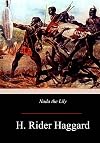
Nada the Lily
by H. Rider Haggard
On This Page
Description
Another of Henry Rider Haggard's renowned action-adventure tales, Nada the Lily tells the story of revered warrior Umslopogaas, an illegitimate son of the Zulu monarch Chaka, who is forced into exile and must fight to defend his honor -- as well as to win the love of the sought-after and seemingly unattainable beauty Nada. With plenty of battlefield action and stirring romance, this rollicking tale has something to offer every reader..
Tags
Recommendations









Member Reviews
Nada the Liily seems such a quaint, albeit subtly ominous, title for a book given over to war, bloodlust, incest, murder, torture, and what would today be called genocide. Not to mention that more than half of the book describes the rule of Chaka (Shaka), the Zulu king whose paranoia and craving for killing resembles totalitarians such as Stalin, Mao, and Hitler. Published in 1892, Haggard likely had little idea about Freud's theories, although Freud was mildly influenced by Haggard's King Solomon's Mines--no doubt the journey into the cave where were kept the diamonds and gold echoed his theories. But Haggard anticipates the crowning achievement of the twentieth century, when he describes and, in fact, analyzes Chaka as what can only show more be termed a psychopath.
The structure of Nada the Lily is not so ordered as in Haggard's earlier works. The story of Umslopogaas, his sister/cousin Lily, and foster father Mopo rambles across a wide sweep of Zululand. It's epic in it telling but a bit of a mess in its execution. Nonetheless, it's also an enveloping story of intrigue, personal failing, and the cost of pursuing glory and fulfilling vain desires.
That its perspective is told entirely from the point of view of its Zulu protagonists seems a shock to many, who can not imagine such a thing emanating from the pen of a Victorian era author. But not so shocking if you look at the lineage of such stories. I haven't investigated Haggard, but he must have been aware of the work of James Fenimore Cooper and Cooper's Leatherstocking Tales. For Haggard's Quatermain, Umslopogaas, and Zulus much resemble the exploits of Cooper's Natty Bumppo, Chingachgook, and Mohicans. show less
The structure of Nada the Lily is not so ordered as in Haggard's earlier works. The story of Umslopogaas, his sister/cousin Lily, and foster father Mopo rambles across a wide sweep of Zululand. It's epic in it telling but a bit of a mess in its execution. Nonetheless, it's also an enveloping story of intrigue, personal failing, and the cost of pursuing glory and fulfilling vain desires.
That its perspective is told entirely from the point of view of its Zulu protagonists seems a shock to many, who can not imagine such a thing emanating from the pen of a Victorian era author. But not so shocking if you look at the lineage of such stories. I haven't investigated Haggard, but he must have been aware of the work of James Fenimore Cooper and Cooper's Leatherstocking Tales. For Haggard's Quatermain, Umslopogaas, and Zulus much resemble the exploits of Cooper's Natty Bumppo, Chingachgook, and Mohicans. show less
I enjoyed this story, much as I enjoy all the stories written in and of those times.
This is a back-story of the youth of Umslopogaas, who later became a companion of Allen Quartermain and died a heroic death in the novel Allen Quatermain. It is the tragic story of how Umslopogaas lost his great love Nada the Lily. It also tells of the career of the great Zulu king Chaka (Shaka). It is dedicated to Sir Theophilus Shepstone, under whom Haggard served in southern Africa. Haggard has a more positive view of Shepstone's dealings with Zulus and Boers than some modern historians do.
Ratings
Members
- Recently Added By
Author Information

287+ Works 18,993 Members
Sir Henry Rider Haggard (1856-1925) is best remembered for his 34 adventure fantasy novels set in exotic locations. As a child, Haggard, whose father was an English barrister, was considered dim-witted and was inclined to daydreaming. His parents ended his formal education when he was seventeen, and he was sent to work in South Africa, where his show more imagination was inspired by the people, animals, and jungle. He became close friends with authors Rudyard Kipling and Andrew Lang. Haggard's most popular books are King Solomon's Mines (1886) and She (1887). He also wrote short stories, as well as nonfiction on topics such as gardening, English farming, and rural life, interests which led to duties on government commissions concerned with land maintenance. For his literary contributions and his government service, Haggard was knighted in 1912. Several of Haggard's novels have been filmed. She was filmed in 1965, starring Ursula Andress. King Solomon's Mines was filmed with Stewart Granger and Deborah Kerr in 1950, and again with Richard Chamberlain and Sharon Stone in 1985. Also, the novel Allan Quatermain was filmed as Allan Quatermain and the Lost City of Gold with Richard Chamberlain and Sharon Stone in 1986. (Bowker Author Biography) show less
Some Editions
Series
Belongs to Publisher Series
Work Relationships
Common Knowledge
- Canonical title*
- Nada die Lilie
- Original title
- Nada the Lily
- Original publication date
- 1892
- People/Characters
- Umslopogaas
*Some information comes from Common Knowledge in other languages. Click "Edit" for more information.
Classifications
Statistics
- Members
- 139
- Popularity
- 236,278
- Reviews
- 3
- Rating
- (4.00)
- Languages
- English, German, Spanish
- Media
- Paper, Audiobook, Ebook
- ISBNs
- 51
- ASINs
- 17