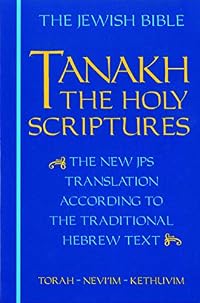
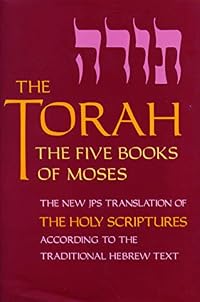
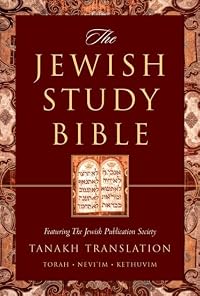
Tanakh : a new translation of the Holy Scriptures according to the traditional Hebrew text
by Jewish Publication Society of America
On This Page
Description
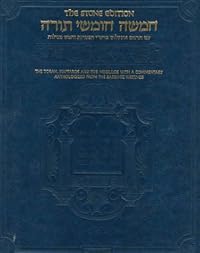
The Tanakh is an entirely original translation of the Holy Scriptures into contemporary English, based on the Masoretic--the traditional Hebrew--text. It is the culmination of three decades of collaboration by academic scholars and rabbis representing the three largest branches of organized Judaism in America. Not since the third century B.C.E., when seventy-two elders of the tribes of Israel created the Greek translation of Scriptures known as the Septuagint, has such a broad-based show more committee of Jewish scholars produced a major Bible translation. In executing this monumental task, the translators made use of the entire range of biblical interpretation, ancient and modern, Jewish and non-Jewish. They drew upon the latest findings in linguistics and archaeology as well as the work of early rabbinic and medieval commentators, grammarians, and philologians. The resulting text is a triumph of literary style and biblical scholarship, unsurpassed in accuracy and clarity. show lessTags
Recommendations











Member Reviews
5 stars for the readily understandable translation and comprehensive notes indicating alternative meanings and doubt. The poetry isn't super lyrical but it errs toward the most accurate wording, which is what I wanted.
Reading this alongside Persian and "biblical world" history of the same period was an incredibly rewarding experience.
Understanding the Bible demands context, which is thin on the ground outside of academia. Be fruitful and multiply because we need soldiers and farmers. Men must not fornicate with men because we need babies to turn into soldiers and farmers. Stop fornicating all of you because drought, plague, disaster, we cannot feed these kids. Oh crap another war.
So many contradictory commands, so much violence, so show more many anonymous women. I enjoyed The Shahnameh far more as a mythic-history-morality guide that tells some of the same history from the Assyrian point of view. Also, the women get to speak their own lines and there are far more of them (apart from Chronicles' royal census lists). But it was cool to understand so much more this time. Isaiah was a trip and I've always loved Daniel. Going to see about an interpretation of the Quran at some point, probably after I get through more in the history stack. show less
Reading this alongside Persian and "biblical world" history of the same period was an incredibly rewarding experience.
Understanding the Bible demands context, which is thin on the ground outside of academia. Be fruitful and multiply because we need soldiers and farmers. Men must not fornicate with men because we need babies to turn into soldiers and farmers. Stop fornicating all of you because drought, plague, disaster, we cannot feed these kids. Oh crap another war.
So many contradictory commands, so much violence, so show more many anonymous women. I enjoyed The Shahnameh far more as a mythic-history-morality guide that tells some of the same history from the Assyrian point of view. Also, the women get to speak their own lines and there are far more of them (apart from Chronicles' royal census lists). But it was cool to understand so much more this time. Isaiah was a trip and I've always loved Daniel. Going to see about an interpretation of the Quran at some point, probably after I get through more in the history stack. show less
If anyone quotes me any more crap from the Old Testament (which this essentially is) purporting to tell me or anyone else how to live, I'm going to quiz them about the last time they sacrificed a calf or a goat or something to God because He seems pretty big on that stuff. If you're going to try to run other people's lives by this stuff, I suggest you start running your own by ALL of it, not just selected passages, first. Some decent stories in parts, some decent poetry in Psalms some wiggy proverbs in Proverbs and lots of lists (especially in Kings and Numbers and especially of people to displeased the Lord -- a lot).
The newest JPS translation of the Tanach has two wonderful forwards explaining the various translations and texts used to verify the translations. The maps in the back are also nice, though I found myself wishing for a more complete map of the Abrahamic period.
Love,
ShiraDestinie
MEOW Date Saturday, May 18. 12014 H.E. (Holocene Era)
Love,
ShiraDestinie
MEOW Date Saturday, May 18. 12014 H.E. (Holocene Era)
This is my preferred English translation of the Hebrew Bible. You're still better off going directly from the Hebrew, but in general I find this translation to be most excellent.
The newest JPS translation of the Tanach has two wonderful forwards explaining the various translations and texts used to verify the translations. The maps in the back are also nice, though I found myself wishing for a more complete map of the Abrahamic period.
Love,
ShiraDestinie
MEOW Date Saturday, May 18. 12014 H.E. (Holocene Era)
Love,
ShiraDestinie
MEOW Date Saturday, May 18. 12014 H.E. (Holocene Era)
Great read of the Hebrew Scriptures for a Christian particularly as the translation is not Christianized in the least. Fresh translation.
The newest JPS translation of the Tanach has two wonderful forwards explaining the various translations and texts used to verify the translations. The maps in the back are also nice, though I found myself wishing for a more complete map of the Abrahamic period.
Love,
ShiraDestinie
MEOW Date Saturday, May 18. 12014 H.E. (Holocene Era)
Love,
ShiraDestinie
MEOW Date Saturday, May 18. 12014 H.E. (Holocene Era)
Members
- Recently Added By
Lists

100 Books to Read in a Lifetime (That Are Older Than 200 Years)
415 works; 173 members

Jewish Books
367 works; 24 members

Bible Translations
15 works; 2 members

The Great Courses: The Old Testament
78 works; 1 member

How to Read a Book's Recommended Reading List
309 works; 10 members
Author Information

76 Works 5,669 Members
Awards and Honors
Work Relationships
Has the adaptation
Common Knowledge
- Canonical title
- Tanakh : a new translation of the Holy Scriptures according to the traditional Hebrew text
- Original publication date
- 1917
- Important places
- Israel
- First words
- When God began to create heave and earth--the earth being unformed and void, with darkness over the surface of the deep and a wind from God sweeping over the water--God said, "Let there be light"; and there was light.
In the Beginning, God created the Heaven and the Earth.
1. When God began to create heaven and earth -- the earth being unformed and void, with darkness over the surface of the deep and a wind from God sweeping over the water -- God said, "Let there be light", and there was light.
Preface to the 1999 Hebrew-English Edition: A court of law relies on witnesses to establish the facts of a case.
In the beginning God created the heaven and the earth.
Preface
This translation of Tanakh, the Holy Scriptures, produced by the Jewish Publication Society, was made directly from the traditional Hebrew text into the idiom of modern English. - Last words
- (Click to show. Warning: May contain spoilers.)"Any one of you of all His people, the Lord his God be with him and let him go up."
(Click to show. Warning: May contain spoilers.)The LORD His God be with him, and let him go up.
-II Chronicles 36:23
(Click to show. Warning: May contain spoilers.)II Chronicles: "...Any one of you of all His People, the Lord his God be with him and let him go up."
(Click to show. Warning: May contain spoilers.)Whosoever there is among you of all His people -- the Lord his God be with him -- Let him go up.
Classifications
Statistics
- Members
- 2,833
- Popularity
- 6,378
- Reviews
- 21
- Rating
- (4.29)
- Languages
- English, German, Hebrew, Latin
- Media
- Paper, Audiobook, Ebook
- ISBNs
- 25
- ASINs
- 55