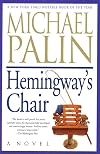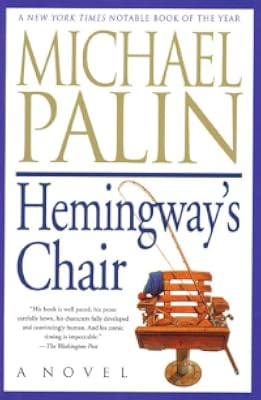
Hemingway's Chair
by Michael Palin
On This Page
Description
Martin Sproale is an assistant postmaster obsessed with Ernest Hemingway. Martin lives in a small English village, where he studies his hero and putters about harmlessly--until an ambitious outsider, Nick Marshall, is appointed postmaster instead of Martin. Slick and self-assured, Nick steals Martin's girlfriend and decides to modernize the friendly local office by firing dedicated but elderly employees and privatizing the business. Suddenly, gentle Martin is faced with a choice: meedly show more accept defeat as he always has, or fight for what he believes in, as his hero, Hemingway, would.Filled with Michael Palin's trademark wit and good humor, this novel is for anyone who has ever dreamed of triumphing over the technocrats and backstabbers of the world. Hilarious, touching, and ultimately inspirational, Hemingway's Chair will make readers stand up and cheer. show lessTags
Recommendations





























Member Reviews
Amiable, inoffensive and light rather than funny, Hemingway's Chair, the first novel by Michael Palin, had a 3-star rating written all over it. But the book has a few surprises up its sleeve, and it took me on a bit of a journey before I ultimately rested on that 3-star rating. As a fan of Ernest Hemingway myself, I was already sold on the story of Martin, a mild-mannered everyman who works at a post office and is an aficionado of 'Papa'. He reads the stories, memorises the trivia and collects the memorabilia, including the titular 'Hemingway's chair'. Martin is "unspectacular" but "careful and thorough and conscientious and demanded little of others" (pg. 28), and when his post office is taken over by a slick, 'modernizing' manager – show more who wants to tear out the heart of the community to deploy "the Proactive Selling Technique to maximise customer potential" (pg. 170), among other godawful things – Martin decides to look to his larger-than-life literary hero for guidance.
Once the Hemingway itch was scratched, I found myself surprisingly engaged by Palin's story. The characters are all well-drawn; Martin's character development over the course of the novel is particularly deft. The coastal town of Theston is portrayed as warm and provincial, like a slightly offbeat episode of Emmerdale, and the threats of privatization, foreign takeovers and business-over-community priorities speak to the sort of painful, desperate decline that will be familiar to many English towns. The book is heartfelt and doesn't shy away from the human element: the dignified, ageing post office worker who had "once been taught to strip down a machine gun blindfold" yet is now trying to laugh off his inability to learn computers (pg. 87), and the other worker who is let go to 'make economies' and comes in days later to sign on the dole (pg. 74). Just the worthless, forgotten emissions of a spluttering British engine that abandoned its courage decades ago.
The book is quietly impressive in this respect, even if it's not the book you would expect. As I said, it's light rather than comic, and there's something warm about returning to the Nineties (Palin wrote the book in 1995), when the 'management seminars' and 'role-play' stuff (pg. 11) could be laughed off and a salary of £11,500 per year could pay a mortgage (pg. 133). Hemingway's Chair is a book that should be cherished, because if you tried to write it today it would necessarily be a much more brutal book.
Indeed, such a surprise was Hemingway's Chair that it was inching towards a 4-star rating from me, despite its innate 3-star-ness. Unfortunately, the final third of the book became rather strange and hasty, with the ending unexpectedly bleak. For such an unassuming and compassionate book, it was difficult to lurch towards where Palin takes it. But ultimately, though Hemingway and rural England are strange bedfellows, as one character acknowledges (pg. 54), the result is rather unique and successful. Hemingway's Chair is nice to read for what it is, but it's not what you would think it is. show less
Once the Hemingway itch was scratched, I found myself surprisingly engaged by Palin's story. The characters are all well-drawn; Martin's character development over the course of the novel is particularly deft. The coastal town of Theston is portrayed as warm and provincial, like a slightly offbeat episode of Emmerdale, and the threats of privatization, foreign takeovers and business-over-community priorities speak to the sort of painful, desperate decline that will be familiar to many English towns. The book is heartfelt and doesn't shy away from the human element: the dignified, ageing post office worker who had "once been taught to strip down a machine gun blindfold" yet is now trying to laugh off his inability to learn computers (pg. 87), and the other worker who is let go to 'make economies' and comes in days later to sign on the dole (pg. 74). Just the worthless, forgotten emissions of a spluttering British engine that abandoned its courage decades ago.
The book is quietly impressive in this respect, even if it's not the book you would expect. As I said, it's light rather than comic, and there's something warm about returning to the Nineties (Palin wrote the book in 1995), when the 'management seminars' and 'role-play' stuff (pg. 11) could be laughed off and a salary of £11,500 per year could pay a mortgage (pg. 133). Hemingway's Chair is a book that should be cherished, because if you tried to write it today it would necessarily be a much more brutal book.
Indeed, such a surprise was Hemingway's Chair that it was inching towards a 4-star rating from me, despite its innate 3-star-ness. Unfortunately, the final third of the book became rather strange and hasty, with the ending unexpectedly bleak. For such an unassuming and compassionate book, it was difficult to lurch towards where Palin takes it. But ultimately, though Hemingway and rural England are strange bedfellows, as one character acknowledges (pg. 54), the result is rather unique and successful. Hemingway's Chair is nice to read for what it is, but it's not what you would think it is. show less
Hemingway's Chair was the New York Times Notable Book of the Year in 1998. Ten years hence, I saw the book at a knocked-down price, and considering that I am a fan of New York Times' recommendations, the book moved through the sale, and on to my bedside table faster than Hemingway could write.
Hilarious at times, the book has a dry British humor, a play on words, and oddly lovable characters. All except one. The hero of the book, the main character, Martin Sproale. Engaging at first, there is something about the ordinary in him, and I don't mean to criticize that. He is meant to be Everyman. With his own strange quirk - his love and adoration for Hemingway. Martin is devoted to his post office, but is just as susceptible to the odd show more greediness as any of us. His life begins to unravel when young, unscrupulous Nick Marshall is appointed Manager denying Martin what was rightfully his. Nick is all for modernizing the post office, and that means an end to tradition as we know. Righto. The story was interesting till now, and would have continued to be so if it had stuck to its plot.
But no. Suddenly, there is a bizarre sub-element -Nick, surprise surprise, is two-timing the post office, and in some complicated way is out to implement a networking system that will revolutionize the world. In the middle we have Ruth, an American novelist who is writing a book on Hemingway's women, flashing the proverbial apple to poor Martin in the form of Hemingway's chair up for sale. It costs a 1000 quid, and Martin has not the money. So what does he do? Well, he falls in with Nick. The old post office goes. The new one comes up. Martin takes up the cause of getting back the post office, and loses his girlfriend to Nick, gains another one in Ruth, loses his mental balance completely, and somehow apparently obtains his revenge...or does he?
The language is superb, but the plot is a bit too thin. I could not understand why not one, but two women would fall in love with Martin, who is not I assure, you, likely to capture your imagination. I mean, he walks around talking of "Papa" (Hemingway), collects Papa's knick knacks, and lives more in Papa's world than this own and I am not sure that is fact enough to love him. In the end, I was a tad disappointed. For a novel that started so well, it unfortunately didn't quite have Hemingway's own characteristic punch in the end. show less
Hilarious at times, the book has a dry British humor, a play on words, and oddly lovable characters. All except one. The hero of the book, the main character, Martin Sproale. Engaging at first, there is something about the ordinary in him, and I don't mean to criticize that. He is meant to be Everyman. With his own strange quirk - his love and adoration for Hemingway. Martin is devoted to his post office, but is just as susceptible to the odd show more greediness as any of us. His life begins to unravel when young, unscrupulous Nick Marshall is appointed Manager denying Martin what was rightfully his. Nick is all for modernizing the post office, and that means an end to tradition as we know. Righto. The story was interesting till now, and would have continued to be so if it had stuck to its plot.
But no. Suddenly, there is a bizarre sub-element -Nick, surprise surprise, is two-timing the post office, and in some complicated way is out to implement a networking system that will revolutionize the world. In the middle we have Ruth, an American novelist who is writing a book on Hemingway's women, flashing the proverbial apple to poor Martin in the form of Hemingway's chair up for sale. It costs a 1000 quid, and Martin has not the money. So what does he do? Well, he falls in with Nick. The old post office goes. The new one comes up. Martin takes up the cause of getting back the post office, and loses his girlfriend to Nick, gains another one in Ruth, loses his mental balance completely, and somehow apparently obtains his revenge...or does he?
The language is superb, but the plot is a bit too thin. I could not understand why not one, but two women would fall in love with Martin, who is not I assure, you, likely to capture your imagination. I mean, he walks around talking of "Papa" (Hemingway), collects Papa's knick knacks, and lives more in Papa's world than this own and I am not sure that is fact enough to love him. In the end, I was a tad disappointed. For a novel that started so well, it unfortunately didn't quite have Hemingway's own characteristic punch in the end. show less
A Michael Palin novel should be a wonder of the modern world, filled with belly laughs aplenty. So, "Hemingway's Chair" is quite the disappointment.
The protagonist Martin is a staid post office worker in a small English town opposed to the new post office manager and what he has planned for the post office. Martin is also a mad keen Ernest Hemingway fan and collects everything he can of the man and his work. He gets up to all manner of minor levels of shenanigans trying to save the post office and gets not one but two women and Hemingway's Chair. The biggest issue with "Hemingway's Chair" though is the lead character, for whom I could find no sympathy for, and was astonished at his success with the ladies.
The protagonist Martin is a staid post office worker in a small English town opposed to the new post office manager and what he has planned for the post office. Martin is also a mad keen Ernest Hemingway fan and collects everything he can of the man and his work. He gets up to all manner of minor levels of shenanigans trying to save the post office and gets not one but two women and Hemingway's Chair. The biggest issue with "Hemingway's Chair" though is the lead character, for whom I could find no sympathy for, and was astonished at his success with the ladies.
Michael Palin writes well, his prose is clear and concise and he draws his characters well, he seems to think through each of the people who appear in the book and how they would respond. Martin Sproale is the main character and we almost, but not quite, get inside his head. Martin is an Assistant Postmaster at the point of post office privatisation and we meet Nick Marshall, privatisation in human form. Martin has a relationship with Elaine but we are shown Martin as an awkward geeky individual with an obsession for Ernest Hemingway. All this action occurs in a small Suffolk town where everyone knows everyone.
The novel is gentle and mildly comic, rather than laugh out loud. The comedy is in the situations and small incidents. There is show more also a dark and unsettling side to the novel in true Hemingway style. Mostly an easy and entertaining read. show less
The novel is gentle and mildly comic, rather than laugh out loud. The comedy is in the situations and small incidents. There is show more also a dark and unsettling side to the novel in true Hemingway style. Mostly an easy and entertaining read. show less
Martin's staid life as post office worker is threatened when he is passed over for promotion and a new manager wants to modernize the community hub that is the post office. Martin is obsessed with everything to do with Hemingway, and he meets his match when an American professor moves to the village to write a book about Hemingway's women.
This should have been to my liking,small English town setting ,an obsession with an author and praise of post offices....
But no ,none of characters lived for me and it was bit silly or dull all the way.
Micheal P voice and reading were good but could not make it worthwhile...
But no ,none of characters lived for me and it was bit silly or dull all the way.
Micheal P voice and reading were good but could not make it worthwhile...
Martin Sproal's obsession with Hemingway leads him into a series of activities worthy of his idol.
Members
- Recently Added By
Lists

Films
217 works; 1 member
Author Information

105+ Works 21,095 Members
Common Knowledge
- Canonical title
- Hemingway's Chair
- Original publication date
- 1995
- Epigraph
- 'Neither snow, nor rain, nor heat nor gloom of night, stays these couriers from the swift completion of their appointed round.'
On the facade of the General Post Office, New York City - Dedication
- For Helen
- First words
- Marsh Cottage stood a little way back from a road that led to a cliff top and then stopped.
- Last words
- (Click to show. Warning: May contain spoilers.)'Ruthie,' it read simply, 'Legends never die!'
Classifications
Statistics
- Members
- 782
- Popularity
- 35,868
- Reviews
- 14
- Rating
- (3.15)
- Languages
- 5 — Danish, Dutch, English, German, Swedish
- Media
- Paper, Audiobook, Ebook
- ISBNs
- 26
- ASINs
- 11