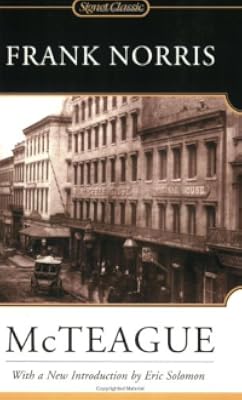
McTeague: A Story of San Francisco
by Frank Norris
On This Page
Description
Inspired by an actual crime sensationalized in the San Francisco press at the turn of the century, this riveting tale of avarice, degeneration, and death chronicles the demise of an ignorant charlatan and his avaricious wife. A compelling, realistic view of human nature at its most basic level.Tags
Recommendations
















Member Recommendations

Member Reviews
This book lends itself to examination and an interesting exchange of views in a classroom setting, but it is not one that I recommend for pleasure reading. Norris created a world in which working class San Franciscans lived under the conditions he set up in his "literary laboratory" where the inside forces of biological instinct battled with the outside forces of poverty and social persecution. His unrelenting attention to detail and repetition of descriptions of the narrowly constructed characters made this book increasingly unpleasant for me to read.
There was much stereotyping of ethnic groups and emphasis on greed leading to revenge. The emasculation of the brawny McTeague diminished his humanity to the point where I knew there could show more be nothing hopeful about the end of this book. Let's just say that I ended up caring more for the canary in the cage than I did for any of the characters. show less
There was much stereotyping of ethnic groups and emphasis on greed leading to revenge. The emasculation of the brawny McTeague diminished his humanity to the point where I knew there could show more be nothing hopeful about the end of this book. Let's just say that I ended up caring more for the canary in the cage than I did for any of the characters. show less
There was such a waste of life presented here. At many moments I wanted to speak omnisciently to the community and direct that somebody intervene to help the characters, but it would have already been too late. There was a point early in the presentation of each character in which another path could have been chosen, but an early choice led inevitably to a journey down the path of personal doom. Some of these choices were made even before the novel began. What makes these early choices so important is that characters have no safety net. It is not just the impact of a single choice, but the impact of a single choice in the social context in which the most basic human need to be loved and understood is not met. Characters are not capable show more of full introspection and Norris does not directly address this but instead shows their internal lives from external description of their appearance and behavior.
A fundamental point of this book is that people make choices within the limits of their human understanding, and that there are times and places in which the world is very hostile. Individuals do not have the support they need to make better choices when things go wrong. Instead, the world sort of falls apart for the individual, they can't see a way out, and the larger world is too wrapped up in its own day to day affairs to see or care that someone is individually suffering.
This sort of brutal realism is difficult, but people continue to live in this construct now. It is easy to say that individuals have free will in their personal actions, but how free is the will of someone who is truly not capable of seeing a larger view of his or her actions? How can we blame the individual who not only is stuck in the reality of a systemically brutal world but also has had no one who can help to cause greater understanding? This highlights the need for connecting individuals in some meaningful way to other individuals who can actually assist, through familial, religious, or educational guidance. There has to be some realistic way to expand what is possible for individuals to make better choices and when we choose to ignore the need for this there are societal consequences.
This book constructs a world with similarities to those presented in Sister Carrie (Dreiser) and Burmese Days (Orwell). As is consistent with its genre, it presents the flaws and prejudices of its time and requires an eye for context. It has a lot to offer for an interested reader. show less
A fundamental point of this book is that people make choices within the limits of their human understanding, and that there are times and places in which the world is very hostile. Individuals do not have the support they need to make better choices when things go wrong. Instead, the world sort of falls apart for the individual, they can't see a way out, and the larger world is too wrapped up in its own day to day affairs to see or care that someone is individually suffering.
This sort of brutal realism is difficult, but people continue to live in this construct now. It is easy to say that individuals have free will in their personal actions, but how free is the will of someone who is truly not capable of seeing a larger view of his or her actions? How can we blame the individual who not only is stuck in the reality of a systemically brutal world but also has had no one who can help to cause greater understanding? This highlights the need for connecting individuals in some meaningful way to other individuals who can actually assist, through familial, religious, or educational guidance. There has to be some realistic way to expand what is possible for individuals to make better choices and when we choose to ignore the need for this there are societal consequences.
This book constructs a world with similarities to those presented in Sister Carrie (Dreiser) and Burmese Days (Orwell). As is consistent with its genre, it presents the flaws and prejudices of its time and requires an eye for context. It has a lot to offer for an interested reader. show less
A Book About the Gilded Age*
The only reason this book doesn't rate zero stars is becauseeveryone gets the death they deserve by the end of the book. McTeague is a book filled with stupid, detestable characters who serve as caricatures for the evils Frank Norris sees in the world. The main character, McTeague, is too stupid to be believed, a hulking beast whose most memorable statements are "What? What?" and "I don't know. I don't know." If those two phrases don't hold your attention, don't read this book, because there's an unhealthy dose of them littered throughout the novel.
McTeague lacks a single likable character. His wife hordes money, going so far as to swindle McTeague out of his nickels and dimes and quarters, which, instead of show more spending, she hides in her trunk. There is a maid who constantly discusses a set of gold dishes her family once might have possessed (we never discover the truth or falsity of the claim), and a junk dealer who marries her solely for his lust to obtain the mythical dishes. There are an old dressmaker and a veterinarian who live next to each other and spend every night sitting alone listening to the other person through the wall. The worst is Marcus, cousin of McTeague's wife, Trina, who feels cheated when Trina wins five thousand dollars after they have stopped dating; Marcus determines to exact his revenge on her beau, McTeague. Add to these characters the unbelievability of the events (e.g. a dentist so strong he pulls teeth with his fingers, a man and a mule trekking through Death Valley for three days on a single canteen of water) and you have an unpleasant narrative about greed and stupidity that is frustratingly dull and long-winded. If you don't have to read this book for school (as I did), don't read it at all.
* - I've had to set my themed reading list aside for now, as I'm taking a couple literature classes this summer through a state program that provides free tuition for Texas residents over 55. This novel is assigned for my 19th Century American Literature class focused on the Gilded Age. show less
The only reason this book doesn't rate zero stars is because
McTeague lacks a single likable character. His wife hordes money, going so far as to swindle McTeague out of his nickels and dimes and quarters, which, instead of show more spending, she hides in her trunk. There is a maid who constantly discusses a set of gold dishes her family once might have possessed (we never discover the truth or falsity of the claim), and a junk dealer who marries her solely for his lust to obtain the mythical dishes. There are an old dressmaker and a veterinarian who live next to each other and spend every night sitting alone listening to the other person through the wall. The worst is Marcus, cousin of McTeague's wife, Trina, who feels cheated when Trina wins five thousand dollars after they have stopped dating; Marcus determines to exact his revenge on her beau, McTeague. Add to these characters the unbelievability of the events (e.g. a dentist so strong he pulls teeth with his fingers, a man and a mule trekking through Death Valley for three days on a single canteen of water) and you have an unpleasant narrative about greed and stupidity that is frustratingly dull and long-winded. If you don't have to read this book for school (as I did), don't read it at all.
* - I've had to set my themed reading list aside for now, as I'm taking a couple literature classes this summer through a state program that provides free tuition for Texas residents over 55. This novel is assigned for my 19th Century American Literature class focused on the Gilded Age. show less
The tale is a bracing immersion in the language and material culture of turn of the 20th C. San Francisco. I would normally have trouble understanding how much of a windfall Trina Sieppe's 5,000$ would be in current dollars, but Norris' close attention to the acquisition and selling off of possessions kept me well up on the value of a dollar at the time.
The whole thing is sort of Zola in America, and maybe a touch of Hermann Broch in mood. Heck--it's a weird little book, and Jack London always seems just out of frame, only to come into full view at the end. Setting is as much foreground as the characters and story that begins in a world of melodeons, steel portraits and lace curtains, only to end in Landscape; the kind that is itself show more and crushes people, which I guess is a relief after watching people crush people.
In America, there was a lot of landscape between a melodeon on the west coast and a melodeon on the east coast. I alway enjoy that distance in American literature and love best those books which brood as this distance moves west and gets filled up. show less
The whole thing is sort of Zola in America, and maybe a touch of Hermann Broch in mood. Heck--it's a weird little book, and Jack London always seems just out of frame, only to come into full view at the end. Setting is as much foreground as the characters and story that begins in a world of melodeons, steel portraits and lace curtains, only to end in Landscape; the kind that is itself show more and crushes people, which I guess is a relief after watching people crush people.
In America, there was a lot of landscape between a melodeon on the west coast and a melodeon on the east coast. I alway enjoy that distance in American literature and love best those books which brood as this distance moves west and gets filled up. show less
I went into this blind but right from the start i had a prescience of evil, i could practically smell "The Dram Shop by Emile Zola", which is not the sort of thing one wants reminders of as that was GRIM! (but excellent) And i was not wrong, the two stories do share some common ground, what i was mistaken about however was thinking that its similarities would be a problem, were as it turned out it was quite the reverse.
The writing isn't bad, its nicely descriptive if a little overly detailed at times, and all the characters are well... Characters.
It took me some time to figure out why it was such work to get through and i finally pinned down the problem. While you occasionally hear the protagonists thoughts you still never feel like show more your in their head. The author constantly keeps them at arms length which makes it very hard to empathize or care about their struggles.
This actually seems to get progressively worse throughout the novel. The longer it goes on the further i felt removed from the characters.
I actually had to resort to LibriVox to help me through some of it as it became such a chore to read.
Things pick up somewhat towards the end when the author completely gives up on the story he was writing and decides to change it into a western, 'Seraphrim Falls' to be precise, with some of 'Treasure of the Sierra Madre' thrown in, and just a dash of Spider-Man (one of the characters unaccountably develops spidey-sense :P ). show less
The writing isn't bad, its nicely descriptive if a little overly detailed at times, and all the characters are well... Characters.
It took me some time to figure out why it was such work to get through and i finally pinned down the problem. While you occasionally hear the protagonists thoughts you still never feel like show more your in their head. The author constantly keeps them at arms length which makes it very hard to empathize or care about their struggles.
This actually seems to get progressively worse throughout the novel. The longer it goes on the further i felt removed from the characters.
I actually had to resort to LibriVox to help me through some of it as it became such a chore to read.
Things pick up somewhat towards the end when the author completely gives up on the story he was writing and decides to change it into a western, 'Seraphrim Falls' to be precise, with some of 'Treasure of the Sierra Madre' thrown in, and just a dash of Spider-Man (one of the characters unaccountably develops spidey-sense :P ). show less
If you've not seen Greed, the story is that of a stupid giant of a dentist who is taken with a woman whom his best friend has been half-heartedly courting. The dentist, McTeague, wins her over. Shortly before the marriage, Trina wins a lottery; the friend convinces himself that McTeague had taken Trina--and, much more important, her windfall--from him and a few years later takes revenge. It all comes to a bad end, of course.
Halfway through McTeague it occurred to me that were I to write about the book here, it woeuld be to recommend it as fit only for students of American Realism and Eric von Stroheim completists. Norris is much too fond of the epithet, the melodramatic, the repetitious, the cod dialect. Moreover he seems to filch from show more rather than take as an influence the Continental Naturalists. A couple of scenes at least and major themes are very close to those in L'Assomoir, but where Zola makes the reader smell and taste a wedding breakfast, Norris just writes a lot of words about one. Where Zola describes how gold chains are made and integrates this into the story, Norris writes about dentistry in a way that simply makes the reader aware that he had researched the topic. Moreover, Norris was a child of privilege and his attitudes reflect his status and his times.
But details in the book are of great historical interest: I had thought that 'outta sight' as 'wonderful' and the nasty custom of displaying wedding presents were only a few decades old. What constitued meals, what times the streets came alive, what was considered respectable in the period all interested me a good deal. (And I'm terribly glad the wallpaper in the McTeagues' rooms has long since been outmoded.)
Moreover, the book has, especially in the second half, a certain power that I can't explain. I finished it not with a sigh of relief but with the feeling that it would stay with me for some time. Perhaps it's because I'm so taken with desolate places and McTeague ends in Death Valley, but possibly it's because despite its gross shortcomings Mcteague is something more than simply 4th-rate Zola. show less
Halfway through McTeague it occurred to me that were I to write about the book here, it woeuld be to recommend it as fit only for students of American Realism and Eric von Stroheim completists. Norris is much too fond of the epithet, the melodramatic, the repetitious, the cod dialect. Moreover he seems to filch from show more rather than take as an influence the Continental Naturalists. A couple of scenes at least and major themes are very close to those in L'Assomoir, but where Zola makes the reader smell and taste a wedding breakfast, Norris just writes a lot of words about one. Where Zola describes how gold chains are made and integrates this into the story, Norris writes about dentistry in a way that simply makes the reader aware that he had researched the topic. Moreover, Norris was a child of privilege and his attitudes reflect his status and his times.
But details in the book are of great historical interest: I had thought that 'outta sight' as 'wonderful' and the nasty custom of displaying wedding presents were only a few decades old. What constitued meals, what times the streets came alive, what was considered respectable in the period all interested me a good deal. (And I'm terribly glad the wallpaper in the McTeagues' rooms has long since been outmoded.)
Moreover, the book has, especially in the second half, a certain power that I can't explain. I finished it not with a sigh of relief but with the feeling that it would stay with me for some time. Perhaps it's because I'm so taken with desolate places and McTeague ends in Death Valley, but possibly it's because despite its gross shortcomings Mcteague is something more than simply 4th-rate Zola. show less
This classic novel by Frank Norris is a rather complex one to review. I read it for research purposes, as I'm writing a novel set in 1906 in San Francisco, and McTeague takes place there in 1900. In that regard, it was an invaluable resource on the details of the day--what people did for fun, what they drank (steam beer!), the structure of a full-day picnic outing, the racial demographics on a common street, etc. The book is also highly readable. It's smooth and very straightforward, much more so than Norris's The Octopus which I read last year.
The back cover description notes this is a work of "American realism," and the introduction by Kevin Starr goes into greater detail on that subject. This book was highly controversial when it was show more released. At heart, it's a story revolving around the American dream and its corruption by greed. The main characters are the dentist, McTeague, and his wife, Trina. By "realism," it means the characters are mostly unlikeable, and are designed to be so. From the start, McTeague is described as rather dense, a big man with few brains. In the course of the book, he becomes a depressed, abusive drunk. The scenes of domestic abuse are disturbing even by today's standards, as McTeague bites his wife's fingers to the point of infection and amputation, even as he steals her horde of money and abandons her.
Gold is really the theme of the book. McTeague in his younger days mined in the Sierras, and in middle age is a non-licensed dentist in San Francisco. He yearns for a massive gold tooth for his sign. His fiancee, Trina, wins $5,000 in a lottery jackpot, and is a complete miser about the winnings. Trina is really a likeable character until she becomes more twisted as the book goes on and her frugality turns to avarice. By the end, she's lost many of her fingers, is abandoned by her lout of a husband, and lives in abject poverty, but finally pulls all of her gold coins from the bank and strips down naked to sleep with her money pressed to her skin.
Many of the other residents described on Polk Street are also obsessed with money, including the stereotypical Jew obsessed with finding gold. The book is very much a product of its time period, and even includes a reference to a stove shining like a Negro's skin. Starr's introduction notes, though, that the biggest controversy when the book came out wasn't the horrid abuses committed by McTeague, but a small scene towards the beginning where a little boy wets his pants in public. This was regarded as so outrageous that it was removed in later editions, though the Penguin Classics version stays with the original text.
So on one hand, the book was very useful for my purposes, and on the other it's filled with foul characters and period racism that makes me wince. It's not a book I ever want to read again--and I'm relieved to be done with it! It will stay on my shelf for period references only. show less
The back cover description notes this is a work of "American realism," and the introduction by Kevin Starr goes into greater detail on that subject. This book was highly controversial when it was show more released. At heart, it's a story revolving around the American dream and its corruption by greed. The main characters are the dentist, McTeague, and his wife, Trina. By "realism," it means the characters are mostly unlikeable, and are designed to be so. From the start, McTeague is described as rather dense, a big man with few brains. In the course of the book, he becomes a depressed, abusive drunk. The scenes of domestic abuse are disturbing even by today's standards, as McTeague bites his wife's fingers to the point of infection and amputation, even as he steals her horde of money and abandons her.
Gold is really the theme of the book. McTeague in his younger days mined in the Sierras, and in middle age is a non-licensed dentist in San Francisco. He yearns for a massive gold tooth for his sign. His fiancee, Trina, wins $5,000 in a lottery jackpot, and is a complete miser about the winnings. Trina is really a likeable character until she becomes more twisted as the book goes on and her frugality turns to avarice. By the end, she's lost many of her fingers, is abandoned by her lout of a husband, and lives in abject poverty, but finally pulls all of her gold coins from the bank and strips down naked to sleep with her money pressed to her skin.
Many of the other residents described on Polk Street are also obsessed with money, including the stereotypical Jew obsessed with finding gold. The book is very much a product of its time period, and even includes a reference to a stove shining like a Negro's skin. Starr's introduction notes, though, that the biggest controversy when the book came out wasn't the horrid abuses committed by McTeague, but a small scene towards the beginning where a little boy wets his pants in public. This was regarded as so outrageous that it was removed in later editions, though the Penguin Classics version stays with the original text.
So on one hand, the book was very useful for my purposes, and on the other it's filled with foul characters and period racism that makes me wince. It's not a book I ever want to read again--and I'm relieved to be done with it! It will stay on my shelf for period references only. show less
Members
- Recently Added By
Lists

The Guardian's 1000 Novels Everyone Must Read
1,005 works; 552 members

David Bowie's Top 100
97 works; 23 members

The Top Ten: Writers Pick Their Favorite Books
240 works; 33 members

Best medical fiction
26 works; 17 members

David Bowie's List of Top 100 Books
94 works; 6 members

Trinity College Booklist (1951): Class Ten, English Literature
358 works; 5 members

Fiction (Mostly) in Selective Bibliography of American Literature 1775-1900
431 works; 3 members

Libros Californianos: The Other Books
51 works; 1 member

AP Lit
363 works; 6 members
David Bowie’s Top 100 Favourite Reads
100 works; 3 members
Author Information

Considered one of the leading pioneers in American Naturalism, Frank Norris is read and studied for his vivid and honest depiction of life at the beginning of a lusty and developing new century. Born in Chicago, he moved to San Francisco with his well-to-do family when he was 14 and went on to attend the University of California and Harvard show more University before becoming a war correspondent in South Africa and Cuba. His early apprentice work consisted mostly of rather unremarkable adventure stories, but with the long-gestating McTeague: A Story of San Francisco (1899), he struck a new note. That powerful study of avarice in a seedy section of the Bay Area may well be Norris's masterpiece. The Octopus (1901), the first of Norris's projected Epic of the Wheat series, deals with the raising of wheat in California and the struggle of ranchers against the railroads, while The Pit (1903) is a novel about speculation on the Chicago wheat exchange. Unfortunately, Norris died suddenly after an operation for appendicitis. Like Stephen Crane, a writer with whom Norris is frequently compared, Norris died too young to fulfill his considerable promise, but he has more than held his own ground among turn-of-the-century writers whose works have lived. One reason may be that he took his craft as a writer seriously, as is shown by his posthumously published Responsibilities of the Novelist and Other Literary Essays (1903) and The Literary Criticism of Frank Norris, edited by Donald Pizer. (Bowker Author Biography) show less
Some Editions
Awards and Honors
Awards
Series
Belongs to Publisher Series
Work Relationships
Is contained in
Has the adaptation
Has as a reference guide/companion
Common Knowledge
- Canonical title
- McTeague: A Story of San Francisco
- Original publication date
- 1899
- People/Characters
- McTeague; Marcus Schouler; Trina Sieppe; Maria Macapa; Zerkow; Old Grannis (show all 11); Anastasia Baker; Heise; Joe Frenna; Owgoost; The Terwins
- Important places
- San Francisco, California, USA; Mojave Desert, California, USA; California, USA; Schutzen Park; Oakland, California, USA; Polk Street, San Francisco, USA (show all 7); Frenna's Saloon
- Related movies
- Desert Gold (1914 | IMDb); McTeague (1916 | IMDb); Greed (1924 | IMDb); McTeague (1992 | IMDb); The Real McTeague (1993 | IMDb)
- Dedication
- Dedicated to L. E. Gates of Harvard University
- First words
- It was Sunday, and, according to his custom on that day, McTeague took his dinner at two in the afternoon at the car conductors' coffee-joint on Polk Street.
- Last words
- (Click to show. Warning: May contain spoilers.)McTeague remained stupidly looking around him, now at the distant horizon, now at the ground, now at the half-dead canary chittering feebly in its little gilt prison.
- Original language
- English
Classifications
Statistics
- Members
- 1,654
- Popularity
- 13,627
- Reviews
- 31
- Rating
- (3.66)
- Languages
- 7 — English, French, German, Greek, Italian, Russian, Spanish
- Media
- Paper, Audiobook, Ebook
- ISBNs
- 120
- UPCs
- 1
- ASINs
- 49