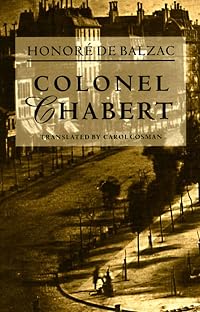
Colonel Chabert
by Honoré de Balzac
The Human Comedy (Études de Moeurs - Scènes de la vie parisienne II | 38)
On This Page
Description
Part of the epic series of historical novels known as The Human Comedy, Honore de Balzac's Colonel Chabert delves into the roots of the upheaval that came to a head during the Restoration period in the early nineteenth century. In the novel, Balzac mercilessly skewers the social problems of the era, contrasting the honor and courage that Napoleon's soldiers exhibited on the battlefield to the decadence and excess that were displayed in the era's upper-crust conventions.Tags
Recommendations

























Member Reviews
Chabert, a soldier of humble origins who has risen to become a distinguished colonel in Napoleon's army, is presumed dead after being seriously wounded at the battle of Eylau. He is thrown, unconscious, into a mass grave with other casualties, and survives only as a result of a string of gruesome chances that Balzac relates with some relish. His recovery in Prussia takes a long time, and accidents of war (and a spell in the madhouse when he tries to assert his real identity) prevent him getting back to France for even longer. When he does get back, his beloved emperor has long gone, the monarchy is restored, and of course he is officially dead, his wife has profitably (and fraudulently) settled his affairs, has married an aristocrat and show more has two children with her new husband. And no-one has the least interest in recognising him as anything other than an annoying and probably mad old vagrant.
With the help of a lawyer who's prepared to enter into an early version of a "no win no fee" deal, the colonel manages to get his wife to the negotiating table, but this is Balzac's Paris where everyone is out for what they can get: we know perfectly well what's likely to happen to an honourable old soldier thrown into this cesspit. And it does...
An elegant, economical satire on the values of Restoration France and the morality of the legal profession, in which Balzac uses absolutely every detail killingly. Javier Marías is quite right to keep banging on about this book. show less
With the help of a lawyer who's prepared to enter into an early version of a "no win no fee" deal, the colonel manages to get his wife to the negotiating table, but this is Balzac's Paris where everyone is out for what they can get: we know perfectly well what's likely to happen to an honourable old soldier thrown into this cesspit. And it does...
An elegant, economical satire on the values of Restoration France and the morality of the legal profession, in which Balzac uses absolutely every detail killingly. Javier Marías is quite right to keep banging on about this book. show less
This was a lot shorter than I thought it was: my edition, slim though it may be, also contains extensive introductory essays and several appendices.
In Le colonel Chabert, the titular main character served under Napoleon and is believed dead at the battle of Eylau. As it happens, he survived, but he is in such bad health and finds himself without any credentials that he is reduced to vagrancy. By the time he has convalesced and returned to Paris to try and reclaim his name, several years have passed. His estate has been divided between the state and his widow, who has chosen to remarry a much wealthier man and who is a mother now, too. More generally, the political situation has changed drastically as well: in this post-Napoleonic era, show more France is once again a Kingdom, and few people of influence are willing to publicly support an Imperial claimant and his legal case for turning back time. It is much more convenient to pretend that the so-called Colonel Chabert is merely an impostor.
This is a very interesting situation to spin a story out of, and Balzac makes great use of it. There’s understandable emotional drama and ethical questions all-around, where (almost) every character has valid and above all just and even legal reasons for their behaviour: Chabert has been robbed of his estate, however legally binding the whole thing came about, and he is entitled to restitution; but the new situation has progressed so far that undoing it becomes itself a massive injustice to all involved. No surprise, then, that the main plot is concerned with finding a lawyer and with the legal intricacies of Restauration France.
I also liked the care that Balzac took to cite laws and governmental edicts (even though the footnotes point out where he confused dates) and to ground his work in actual fact: this novella is a great illustration of how day-to-day bureaucracy is run, and I don’t often get such a glimpse into a historical society. What I didn’t like, though, was the resolution, which I thought was a bit too facile. I won’t call it a cop-out, but I’m not really impressed, either.
Having said that: I enjoyed spending time in this bureaucratic universe, and I liked the way Balzac handled complex moral issues. I think I’ll read more by him. show less
In Le colonel Chabert, the titular main character served under Napoleon and is believed dead at the battle of Eylau. As it happens, he survived, but he is in such bad health and finds himself without any credentials that he is reduced to vagrancy. By the time he has convalesced and returned to Paris to try and reclaim his name, several years have passed. His estate has been divided between the state and his widow, who has chosen to remarry a much wealthier man and who is a mother now, too. More generally, the political situation has changed drastically as well: in this post-Napoleonic era, show more France is once again a Kingdom, and few people of influence are willing to publicly support an Imperial claimant and his legal case for turning back time. It is much more convenient to pretend that the so-called Colonel Chabert is merely an impostor.
This is a very interesting situation to spin a story out of, and Balzac makes great use of it. There’s understandable emotional drama and ethical questions all-around, where (almost) every character has valid and above all just and even legal reasons for their behaviour: Chabert has been robbed of his estate, however legally binding the whole thing came about, and he is entitled to restitution; but the new situation has progressed so far that undoing it becomes itself a massive injustice to all involved. No surprise, then, that the main plot is concerned with finding a lawyer and with the legal intricacies of Restauration France.
I also liked the care that Balzac took to cite laws and governmental edicts (even though the footnotes point out where he confused dates) and to ground his work in actual fact: this novella is a great illustration of how day-to-day bureaucracy is run, and I don’t often get such a glimpse into a historical society. What I didn’t like, though, was the resolution, which I thought was a bit too facile. I won’t call it a cop-out, but I’m not really impressed, either.
Having said that: I enjoyed spending time in this bureaucratic universe, and I liked the way Balzac handled complex moral issues. I think I’ll read more by him. show less
A short novel that tells the tragic story of Hyacinthe Chabert, a French colonel in Napoleon's army, who is wrongly left for dead during a battle in Prussia (now East Germany) in 1807 and only returns to Paris years later. His wife has since remarried with a wealthy earl, and has children from that marriage. The unfortunate colonel, now completely marginalized, wants his life back and hires a lawyer, but that proves more difficult than anticipated. The story's ending is of little consequence, as Balzac must have thought, as he takes the easy way out. But through Chabert, he paints, once again, a rather bleak portrait of France under the Restoration (1815-1830), where everyone is only interested in advancing, by any means necessary. show more There is clearly no room for an innocent victim of fate. In the words of Chabert: “I was burried under the dead; but now, I am burried under the living, under the acts, under the facts, under the whole society, which wants me to live under the earth!” Another socially realistic novel by Balzac, albeit with some melodramatic traits typical of Romanticism. Compared to Le Père Goriot this is a little more businesslike, with thanks heaven fewer aphorisms of wisdom. show less
Absolutely wonderful novella, the story of returning war hero Chabert; presumed dead, his wife has re-married - greatly to her advantage - and has no wish for his return. Nor does she want to give him any of the money she 'inherited' from him. A good hearted old soldier and a ruthless woman of fashion come together in the office of clever lawyer Derville...
Part of Balzac's Comedie Humaine, this narrative is unusual in that it is framed - both beginning and end- in the scenario of a lawyer's office. In the first chapter, the joking, discourteous clerks take centre stage, as Chabert seeks an appointment...at the end the lawyer himself debates events with a colleague; as he lists some of the dreadful scenarios he's encountered in his show more career, we see a list of plot lines of other Balzac novels..."wills burnt, mothers despoiling their children, husbands stealing from their wives..."
Superb writing. show less
Part of Balzac's Comedie Humaine, this narrative is unusual in that it is framed - both beginning and end- in the scenario of a lawyer's office. In the first chapter, the joking, discourteous clerks take centre stage, as Chabert seeks an appointment...at the end the lawyer himself debates events with a colleague; as he lists some of the dreadful scenarios he's encountered in his show more career, we see a list of plot lines of other Balzac novels..."wills burnt, mothers despoiling their children, husbands stealing from their wives..."
Superb writing. show less
Le colonel Chabert by Honoré de Balzac is a neglected masterpiece. The beginning of this short novel is a bit confusing as it starts in media res of clerks in a notary's office having lunch or supper and making fun of an old beggar in the street who apparently wants to see the notary. The old man, dressed in rags, is admitted and able to tell the notary his gruesome story. He relates how as a general he fought alongside Napoleon in the Battle of Eylau, in Prussia, and was slain so badly that, unconscious, with a gash over his skull, he was left for dead at the battlefield. He managed to escape from the mass grave into which he had been dumped and through the melting snow cry for help. Rescued, he was nursed back to health and after show more nine years returned to France to discover that his wife had remarried and disappeared and his dominions were sold off. The notary explains that his case is a difficult one, as officially colonel Chabert is dead, and to regain his possessions he must prove that he is who he claims to be, and not some impostor. The notary lends the colonel some money, to live on, while he agrees to represent him. A meeting with his (former) wife is arranged. She immediately recognizes him by his voice, but otherwise the colonel has unrecognizeably changed. The notary visits the colonel in his humble abode and explains that his fortune has dwindled, and that he could only hope to receive a fraction therof, if any at all.
Le colonel Chabert is a very pitiable story. As Chabert, the war hero, returns after nine years, he finds himself among the nouveau riche of the new society. Several times there is mention that there is a considerable difference in age between colonel Chabert and the other major players in the drama, notably his (ex-) wife,her new husband, the notary and the lawyer. While colonel Chabert still loves his former wife, and isn’t even attempting to regain his full possessions, he is met with coldly calculating cunning, to swindle him and deny him his rights. This cold-hearted society, in which money rules, is very reminiscent of our own times. show less
Le colonel Chabert is a very pitiable story. As Chabert, the war hero, returns after nine years, he finds himself among the nouveau riche of the new society. Several times there is mention that there is a considerable difference in age between colonel Chabert and the other major players in the drama, notably his (ex-) wife,her new husband, the notary and the lawyer. While colonel Chabert still loves his former wife, and isn’t even attempting to regain his full possessions, he is met with coldly calculating cunning, to swindle him and deny him his rights. This cold-hearted society, in which money rules, is very reminiscent of our own times. show less
“Colonel Chabert” is one of Honore de Balzac’s volumes from his omnibus work, "The Human Comedy." The Colonel is a comic figure in and old military great coat and a wig who is ridiculed by young legal workers at the beginning of the novel. But, the joke is on the clerks, because Chabert is a war hero of the Napoleonic era given up for dead on a battlefield at Eylau. This translation from the French by Carol Grosman tells the story of the old soldier’s resurrection in contemporary jargon. The novel is relevant today considering the service of soldiers in many wars continuing in our world. What happens to these heroes when wars end, or more accurately, shift to new fronts? Balzac paints the portrait of one old colonel who remains show more honorable and as a consequence seals his fate. The translation is very readable and the short novel is brief “scene from private life.” The work will stimulate further interest in the monumental work of Balzac who had a relatively short life (1799-1850). show less
Rich man leaves home in the war; gets amnesia; stays gone several years; remembers who he is; comes home; nobody believes him. Sound familiar? There's a reason for that.
Members
- Recently Added By
Lists

Books Read in 2022
5,166 works; 114 members

la comédie humaine
47 works; 1 member
Author Information

Born on May 20, 1799, Honore de Balzac is considered one of the greatest French writers of all time. Balzac studied in Paris and worked as a law clerk while pursuing an unsuccessful career as an author. He soon accumulated enormous debts that haunted him most of his life. A prolific writer, Balzac would often write for 14 to-16 hours at a time. show more His writing is marked by realistic portrayals of ordinary, but exaggerated characters and intricate detail. In 1834, Balzac began organizing his works into a collection called The Human Comedy, an attempt to group his novels to present a complete social history of France. Characters in this project reappeared throughout various volumes, which ultimately consisted of approximately 90 works. Some of his works include Cesar Birotteau, Le Cousin Pons, Seraphita, and Le Cousine Bette. Balzac wed his lifelong love, Eveline Hanska in March 1850 although he was gravely ill at the time. Balzac died in August of that year. (Bowker Author Biography) show less
Some Editions
Series

Belongs to Publisher Series
Work Relationships
Is contained in
Komedia ludzka - tom VI: Pukownik Habert; Msza Ateusza; Kuratela; Kontrakt ślubny; Drugie studium kobiety by Honoré de Balzac
La Comédie humaine, Tome 1 : Le père Goriot ; Le colonel Chabert : Et autres scènes de la vie privée by Honoré de Balzac
Le Colonel Chabert, Gobseck, La Bourse, La Grenadière, L'interdiction. Scènes de la Vie Privée by Honoré de Balzac
Les Grands romans historiques, Tome 2 : Le Colonel Chabert suivi de Une ténébreuse affaire by Honoré de Balzac
Le Colonel Chabert suivi de Trois Nouvelles (Folio Ser., No.593) (French Edition) by Honoré de Balzac
Common Knowledge
- Canonical title
- Colonel Chabert
- Original title
- Le colonel Chabert; Le Colonel Chabert
- Alternate titles*
- Överste Chabert, hjälten från Eylau
- Original publication date
- 1832
- People/Characters
- Colonel Chabert; Countess Rose Ferraud; Monsieur Derville
- Important places
- Paris, France
- Related movies
- Colonel Chabert (1994 | IMDb)
- Dedication*
- À Madame la comtesse Ida de Bocarmé
Née du Chasteler - First words
- « Allons ! encore notre vieux carrick ! »
"Ah! Our old greatcoat again!" - Last words
- (Click to show. Warning: May contain spoilers.)"I've already seen quite a few such cases at Desroches's office," replied Godeschal.
- Original language
- French
*Some information comes from Common Knowledge in other languages. Click "Edit" for more information.
Classifications
Statistics
- Members
- 941
- Popularity
- 28,218
- Reviews
- 22
- Rating
- (3.62)
- Languages
- 14 — Catalan, Danish, Dutch, English, Finnish, French, German, Greek, Italian, Portuguese, Russian, Spanish, Swedish, Turkish
- Media
- Paper, Audiobook, Ebook
- ISBNs
- 141
- ASINs
- 31