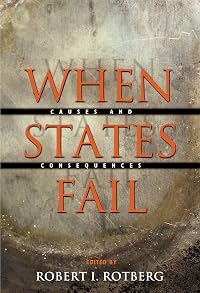
When States Fail: Causes and Consequences
by Robert I. Rotberg
On This Page
Description
Since 1990, more than 10 million people have been killed in the civil wars of failed states, and hundreds of millions more have been deprived of fundamental rights. The threat of terrorism has only heightened the problem posed by failed states. When States Fail is the first book to examine how and why states decay and what, if anything, can be done to prevent them from collapsing. It defines and categorizes strong, weak, failing, and collapsed nation-states according to political, social, show more and economic criteria. And it offers a comprehensive recipe for their reconstruction. The book comprises fourteen essays by leading scholars and practitioners who help structure this disparate field of research, provide useful empirical descriptions, and offer policy recommendations. Robert Rotberg's substantial opening chapter sets out a theory and taxonomy of state failure. It is followed by two sets of chapters, the first on the nature and correlates of failure, the second on methods of preventing state failure and reconstructing those states that do fail. Economic jump-starting, legal refurbishing, elections, the demobilizing of ex-combatants, and civil society are among the many topics discussed. All of the essays are previously unpublished. In addition to Rotberg, the contributors include David Carment, Christopher Clapham, Nat J. Colletta, Jeffrey Herbst, Nelson Kasfir, Michael T. Klare, Markus Kostner, Terrence Lyons, Jens Meierhenrich, Daniel N. Posner, Susan Rose-Ackerman, Donald R. Snodgrass, Nicolas van de Walle, Jennifer A. Widner, and Ingo Wiederhofer. show lessTags
Recommendations


















Members
- Recently Added By
Author Information
64 Works 739 Members
Robert Irwin Rotberg (born April 11, 1935) is an American who served as President emeritus of the World Peace Foundation (1993-2010). An American professor in governance and foreign affairs, he was director of the Program on Intrastate Conflict, Conflict Prevention, and Conflict Resolution at Harvard University's John F. Kennedy School of show more Government (1999-2010), and has served in administrative positions at Tufts University and Lafayette College. In 2003-2004, he served as a member of the Secretary of State's Advisory Panel on Africa, and was a Presidential appointee to the Council of the National Endowment for the Humanities. In 2013 Rotberg became the Fulbright Research Chair in Political Development at the Balsillie School of International Affairs in Waterloo, Canada. Rotberg attened Oberlin College for his undergraduate degree. He completed his graduate studies at Princeton University, and obtained his doctorate at St Antony's College, Oxford University while on a Rhodes Scholarship. He is the author of many books on US foreign policy. These include: Transformative Political Leadership: Making a Difference in the Developing World (2012); Governance and Leadership in Africa (2007); When States Fail: Causes and Consequences (2004); Truth v. Justice: The Morality of Truth Commissions (2000); and From Massacres to Genocide: The Media, Public Policy and Humanitarian Crises (1996). (Bowker Author Biography) show less
Classifications
- Genres
- Politics and Government, Nonfiction, Philosophy, General Nonfiction, Economics, History
- DDC/MDS
- 320.01 — Society, government, & culture Political science Types of Government Political Science Philosophy and Theory
- LCC
- JF60 .W46 — Political Science Political institutions and public administration Political institutions and public administration General. Comparative government
- BISAC
Statistics
- Members
- 35
- Popularity
- 818,265
- Languages
- English
- Media
- Paper, Ebook
- ISBNs
- 3