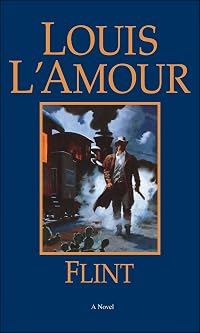
Flint
by Louis L'Amour
On This Page
Description
He left the West at the age of seventeen, leaving behind a rootless past and a bloody trail of violence. In the East he became one of the wealthiest financiers in America—and one of the most feared and hated.Now, suffering from incurable cancer, he has come back to New Mexico to die alone. But when an all-out range war erupts, Flint chooses to help Nancy Kerrigan, a local rancher. A cold-eyed speculator is setting up the land swindle of a lifetime, and Buckdun, a notorious assassin, is show more there to back his play.
Flint alone can help Nancy save her ranch…with his cash, his connections—and his gun. He still has his legendary will to fight. All he needs is time, and that’s fast running out….
. show less
Tags
Recommendations











Member Reviews
My favorite L'Amour book ever. I think I've read it 4 times. When I was a kid it appealed to my sense of adventure, the smart woman, the mysterious man who is wise and silent. Now I enjoy it because it showcases the many different types of people in the world all around us. And yes because of the awesomness of the man called Flint.
One of my favorite Louis L'Amour books, it is the quintessential Western. A brave and hunted man, a strong and intelligent woman, and a beautiful landscape. In my opinion, one of the best of its kind. Not War and Peace, but sometimes you just want a good story that checks all the boxes.
It's been a while since I read the story of the New York financier James T. Kettleman, a.k.a. Jim Flint. I might point out that there is a character named Nancy Kerrigan in the novel!
"Flint" seems to be considered one of L'Amour's top novels. I enjoyed the character Flint, who is a desperate wolf-like man. Not only has his wife hired a hit man to kill him, but a NY doctor has diagnosed him with stomach cancer. Flint leaves the big city in search of the place of his boyhood, where he was raised by a gunfighter, in the wild land of Kansas, in which the people there still remember the boy in gun-fighting legend.
L'Amour's is said to use actual locations that he is familiar with in his writings. Whether he does or not, the environments are show more vivid and well painted, and the story is extremely well written. However, the story itself may not be all that memorable.
I remember only a few details about the story. One—that Flint believes he is dying of cancer and "doesn't give a damn". Two—he is being hunted. Three—I believe eventually some dynamite comes into play. Four—a country doctor reveals to Flint at the end of the story that he does not have cancer, but an ulcer, and that beef broth should cure it.
Back in my alcoholic days, I took note of the good 'ole country doc's advice and stocked up on beef broth myself...
I remember that it was very exciting tracking Flint from his great fall through to his rise; in part because Flint, thinking he is terminal, does not have a care left in the world. His priorities become crystal clear. It's a bit like Howard described his Conan—Flint is as dangerous as a wounded leopard.
Try some beef broth today! Available at your local grocer! I add a dash of hot-sauce, pinch of white pepper, and chopped fresh chives to mine, though I don't need it now that I've stopped drinking... show less
"Flint" seems to be considered one of L'Amour's top novels. I enjoyed the character Flint, who is a desperate wolf-like man. Not only has his wife hired a hit man to kill him, but a NY doctor has diagnosed him with stomach cancer. Flint leaves the big city in search of the place of his boyhood, where he was raised by a gunfighter, in the wild land of Kansas, in which the people there still remember the boy in gun-fighting legend.
L'Amour's is said to use actual locations that he is familiar with in his writings. Whether he does or not, the environments are show more vivid and well painted, and the story is extremely well written. However, the story itself may not be all that memorable.
I remember only a few details about the story. One—that Flint believes he is dying of cancer and "doesn't give a damn". Two—he is being hunted. Three—I believe eventually some dynamite comes into play. Four—a country doctor reveals to Flint at the end of the story that he does not have cancer, but an ulcer, and that beef broth should cure it.
Back in my alcoholic days, I took note of the good 'ole country doc's advice and stocked up on beef broth myself...
I remember that it was very exciting tracking Flint from his great fall through to his rise; in part because Flint, thinking he is terminal, does not have a care left in the world. His priorities become crystal clear. It's a bit like Howard described his Conan—Flint is as dangerous as a wounded leopard.
Try some beef broth today! Available at your local grocer! I add a dash of hot-sauce, pinch of white pepper, and chopped fresh chives to mine, though I don't need it now that I've stopped drinking... show less
Forsaking a successful law career and a failing marriage, Flint has returned home to die. Cancer is eating away at his insides, and he's decided to crawl away back into the badlands like a wounded animal and not come out.
Only one small problem... he doesn't seem to by dying. And people are trying to kill him. Not something any of L'Amour's heroes are prone to take laying down.
No Sacketts in this one, but it's still a top-notch read.
Only one small problem... he doesn't seem to by dying. And people are trying to kill him. Not something any of L'Amour's heroes are prone to take laying down.
No Sacketts in this one, but it's still a top-notch read.
A man to whom life has given nothing expects nothing in return. Flint intends to die alone and in secret, leaving behind nothing but a murderous ex-wife and a lot of bad memories. He finds a reason to live, but it may be too late. One of my favorites.
Flint is not a masterpiece by any stretch, but it is an enjoyable read. Just some good old fashioned junk food for the mind. If you enjoy Westerns, give it a read.
Recently diagnosed with a terminal illness, our hero leaves his eastern home for a quiet end to his life in the West...so he thinks.
Good, solid story from L'Amour. Recommended.
Good, solid story from L'Amour. Recommended.
Members
- Recently Added By
Lists

25 Best Western Novels (Western Writers of America)
25 works; 1 member
Author Information

870+ Works 99,849 Members
Born in Jamestown, North Dakota on March 22, 1908, Louis L'Amour's adventurous life could have been the subject of one of his novels. Striking out on his own in 1923, at age 15, L'Amour began a peripatetic existence, taking whatever jobs were available, from skinning dead cattle to being a sailor. L'Amour knew early in life that he wanted to be a show more writer, and the experiences of those years serve as background for some of his later fiction. During the 1930s he published short stories and poetry; his career was interrupted by army service in World War II. After the war, L'Amour began writing for western pulp magazines and wrote several books in the Hopalong Cassidy series using the pseudonym Tex Burns. His first novel, Westward the Tide (1950), serves as an example of L'Amour's frontier fiction, for it is an action-packed adventure story containing the themes and motifs that he uses throughout his career. His fascination with history and his belief in the inevitability of manifest destiny are clear. Also present and typical of L'Amour's work are the strong, capable, beautiful heroine who is immediately attracted to the equally capable hero; a clear moral split between good and evil; reflections on the Native Americans, whose land and ways of life are being disrupted; and a happy ending. Although his work is somewhat less violent than that of other western writers, L'Amour's novels all contain their fair share of action, usually in the form of gunfights or fistfights. L'Amour's major contribution to the western genre is his attempt to create, in 40 or more books, the stories of three families whose histories intertwine as the generations advance across the American frontier. The novels of the Irish Chantry, English Sackett, and French Talon families are L'Amour's most ambitious project, and sadly were left unfinished at his death. Although L'Amour did not complete all of the novels, enough of the series exists to demonstrate his vision. L'Amour's strongest attribute is his ability to tell a compelling story; readers do not mind if the story is similar to one they have read before, for in the telling, L'Amour adds enough small twists of plot and detail to make it worth the reader's while. L'Amour fans also enjoy the bits of information he includes about everything from wilderness survival skills to finding the right person to marry. These lessons give readers the sense that they are getting their money's worth, that there is more to a L'Amour novel than sheer escapism. With over 200 million copies of his books in print worldwide, L'Amour must be counted as one of the most influential writers of westerns in this century. He died from lung cancer on June 10, 1988. (Bowker Author Biography) Louis L'Amour, truly America's favorite storyteller, was the first fiction writer ever to receive the Congressional Gold Medal from the United States Congress in honor of his life's work, & was also awarded the Medal of Freedom. There are over 260 million copies of his books in print worldwide. (Publisher Provided) show less
Some Editions
Series
Belongs to Publisher Series
Heyne Allgemeine Reihe (9113)
Work Relationships
Common Knowledge
- Canonical title*
- Sein Name war Flint
- Original title
- Flint
- Original publication date
- 1960
- People/Characters
- James Kettleman aka Jim Flint (The kid at The Crossing); Nancy Kerrigan; Buck Dunn "Buckdun"; Pete Gaddis; Port Baldwin; Lottie Kettleman (show all 22); Red Dolan; Ed Flynn; Thomas S. Nugent; Johnny Otero; Gladys Soper; Long-Haired Jim; Sulphur Tom Whalen; Hen Winkle; Julius Bent; Judge Hatfield; Jim Flint; Milt Ryan; Doc McGinnis; Manning Culberson; Street; Saxton
- Important places
- New York, New York, USA; Malpais, New Mexico, USA; Horse Springs, New Mexico, USA; Alamitos, New Mexico, USA; The Malpais Lava Beds, Alamitos, New Mexico, USA.; McCarty Station, New Mexico, USA.
- Epigraph
- [None]
- Dedication
- [None]
- First words
- It is given to few people in this world to disappear twice but, as he had succeeded once, the man known as James T. Kettleman was about to make his second attempt.
- Last words
- (Click to show. Warning: May contain spoilers.)"I think I owe him that," he said.
- Original language*
- Amerikanisch
*Some information comes from Common Knowledge in other languages. Click "Edit" for more information.
Classifications
Statistics
- Members
- 1,142
- Popularity
- 22,058
- Reviews
- 12
- Rating
- (4.03)
- Languages
- English, German
- Media
- Paper, Audiobook, Ebook
- ISBNs
- 25
- ASINs
- 20