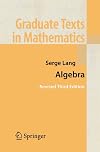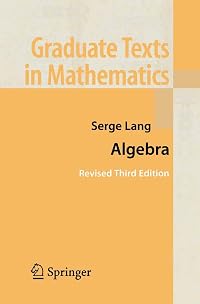
Algebra
by Serge Lang
On This Page
Description
This book is intended as a basic text for a one-year course in Algebra at the graduate level, or as a useful reference for mathematicians and professionals who use higher-level algebra. It successfully addresses the basic concepts of algebra. For the revised third edition, the author has added exercises and made numerous corrections to the text. Comments on Serge Lang's Algebra: Lang's Algebra changed the way graduate algebra is taught, retaining classical topics but introducing language and show more ways of thinking from category theory and homological algebra. It has affected all subsequent graduate-level algebra books. April 1999 Notices of the AMS, announcing that the author was awarded the Leroy P. Steele Prize for Mathematical Exposition for his many mathematics books. The author has an impressive knack for presenting the important and interesting ideas of algebra in just the "right" way, and he never gets bogged down in the dry formalism which pervades some parts of algebra. MathSciNet's review of the first edition. show lessTags
Recommendations



Member Reviews
This is certainly a classic - but is it any good? This (first) edition is full of typos, has a badly organised index, limited cross-references and very few examples (allegedly it was written entirely linearly by dictation with little editing, and this is wholly believable based only on the text). But it does have a little bit of everything.
Indeholder "Foreword", "Logical Prerequisites", "Bibliography", "Part One. Groups, Rings, and Modules", "Chapter I, Groups", " 1. Monoids", " 2. Groups", " 3. Cyclic groups", " 4. Normal subgroups", " 5. Operations of a group on a set", " 6. Sylow subgroups", " 7. Categories and functors", " 8. Free groups", " 9. Direct sums and free abelian groups", " 10. Finitely generated abelian groups", " 11. The dual group", "Chapter II, Rings", " 1. Rings and homomorphisms", " 2. Commutative rings", " 3. Localization", " 4. Principal rings", "Chapter III, Modules", " 1. Basic definitions", " 2. The group of homomorphisms", " 3. Direct products and sums of modules", " 4. Free modules", " 5. Vector spaces", " 6. The dual space", "Chapter IV, show more Homology", " 1. Complexes", " 2. Homology sequence", " 3. Euler characteristic", " 4. The Jordan-Hölder theorem", "Chapter V, Polynomials", " 1. Free algebras", " 2. Definition of polynomials", " 3. Elementary properties of polynomials", " 4. The Euclidian algorithm", " 5. Partial fractions", " 6. Unique factorization in several variables", " 7. Criteria for irreducibility", " 8. The derivative and multiple roots", " 9. Symmetric polynomials", " 10. The resultant", "Chapter VI, Noetherian Rings and Modules", " 1. Basic criteria", " 2. Hilbert's theorem", " 3. Power series", " 4. Associated primes", " 5. Primary decomposition", "Part Two, Field Theory", "Chapter VII, Algebraic Extensions", " 1. Finite and algebraic extensions", " 2. Algebraic closure", " 3. Splitting fields and normal extensions", " 4. Separable extensions", " 5. Finite fields", " 6. Primitive elements", " 7. Purely inseparable extensions", "Chapter VIII, Galois Theory", " 1. Galois extensions", " 2. Examples and applications", " 3. Roots of unity", " 4. Linear independence of characters", " 5. The norm and trace", " 6. Cyclic extensions", " 7. Solvable and radical extensions", " 8. Kummer theory", " 9. The equation X^n - a = 0", " 10. Galois cohomology", " 11. Algebraic independence of homomorphisms", " 12. The normal basis theorem", "Chapter IX, Extensions of Rings", " 1. Integral ring extensions", " 2. Integral Galois extensions", " 3. Extension of homomorphisms", "Chapter X, Transcendental Extensions", " 1. Transcendence bases", " 2. Hilbert's Nullstellensatz", " 3. Algebraic sets", " 4. Noether normalization theorem", " 5. Linearly disjoint extensions", " 6. Separable extensions", " 7. Derivations", "Chapter XI, Real Fields", " 1. Ordered fields", " 2. Real fields", " 3. Real zeros and homomorphisms", "Chapter XII, Absolute Values", " 1. Definitions, dependence, and independence", " 2. Completions", " 3. Finite extensions", " 4. Valuations", " 5. Completions and valuations", " 6. Discrete valuations", " 7. Zeros of polynomials overcomplete fields", "Part Three, Linear Algebra and Representations", "Chapter XIII, Matrices and Linear Maps", " 1. Matrices", " 2. The rank of a matrix", " 3. Matrices and linear maps", " 4. Determinants", " 5. Duality", " 6. Matrices and bilinear forms", " 7. Sesquilinear duality", "Chapter XIV, Structure of Bilinear Forms", " 1. Preliminaries, orthogonal sums", " 2. Quadratic maps", " 3. Symmetric forms, orthogonal bases", " 4. Hyperbolic spaces", " 5. Witt's theorem", " 6. The Witt group", " 7. Symmetric forms over ordered fields", " 8. The Clifford algebra", " 9. Alternating forms", " 10. The Pfaffian", " 11. Hermitian forms", " 12. The spectral theorem (hermitian case)", " 13. The spectral theorem (symmetric case)", "Chapter XV, Representation of One Endomorphism", " 1. Representations", " 2. Modules over principal rings", " 3. Decomposition over one endomorphism", " 4. The characteristic polynomial", "Chapter XVI, Multilinear Products", " 1. Tensor product", " 2. Basic properties", " 3. Extension of the base", " 4. Tensor product of algebras", " 5. The tensor algebra of a module", " 6. The Alternating Product", " 7. Symmetric products", " 8. The Euler-Grothendieck Ring", " 9. Some functorial isomorphisms", "Chapter XVII, Semisimplicity", " 1. Matrices and linear maps over non-commutative rings", " 2. Conditions defining semisimplicity", " 3. The density theorem", " 4. Semisimple rings", " 5. Simple rings", " 6. Balanced modules", "Chapter XVIII, Representations of Finite Groups", " 1. Semisimplicity of the group algebra", " 2. Characters", " 3. One-dimensional representations", " 4. The space of class functions", " 5. Orthogonality relations", " 6. Induced characters", " 7. Induced representations", " 8. Positive decomposition of the regular character", " 9. Supersolvable groups", " 10. Brauer's theorem", " 11. Field of definition of a representation", "Appendix. The Transcendence of e and π", "Index".
Meget kompakt gennemgang af algebra på universitetsniveau. Stort set ingen eksempler i denne udgave. show less
Meget kompakt gennemgang af algebra på universitetsniveau. Stort set ingen eksempler i denne udgave. show less
Aug 26, 2013 (Edited)Danish
1
Ratings
Members
- Recently Added By
Lists

Most Popular Books Targeted at Mathematicians
26 works; 1 member
Author Information

61 Works 1,731 Members
Series
Belongs to Publisher Series
Common Knowledge
- Original publication date
- 1965
Classifications
- Genres
- Nonfiction, Science & Nature, General Nonfiction
- DDC/MDS
- 512 — Natural sciences & mathematics Mathematics Algebra
- LCC
- QA154 .L35 — Science Mathematics Mathematics Algebra
- BISAC
Statistics
- Members
- 300
- Popularity
- 107,024
- Reviews
- 2
- Rating
- (3.96)
- Languages
- 5 — Chinese, English, Polish, Russian, Spanish
- Media
- Paper, Ebook
- ISBNs
- 12
- ASINs
- 4