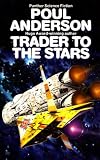
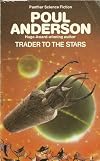
Trader to the Stars
by Poul Anderson
Chronicles of the Polesotechnical League (German numbering) (01), Polesotechnic League (2)
There is 1 current discussion about this work.
On This Page
Tags
Recommendations








Member Reviews
An easy-going and often amusing set of stories based around the exploits of Nicholas van Rijn, the 'Trader to the stars' of the book's title. Nicholas, perhaps best described as a lovable rogue, is a merchant who likes the good life (meaning beer, good wine, some genever before dinner, fine cigars, a pipe, and a young woman always at hand) and who always wants to spot an opportunity to make more money. He's painted as a caricature of the merchant guildsmen of The Netherlands golden age, down to his long, dark ringlets and his drooping moustache. He makes himself out to be uncultured and someone who made good from humble beginnings, but every story rests on him using his cunning and his knowledge of human nature (and science) to outwit show more his underlings and find a solution that makes everyone else happy, and Nicholas some more money. Much of the humour comes from the way Anderson gets his character to mangle spoken English, strewing it with malapropisms which may, or may not, be intentional on his character's part ("fumbly-diddlings" being a typical example.)
This is entertaining, undemanding and well-written SF. show less
This is entertaining, undemanding and well-written SF. show less
A bit of a mixed bag in this collection from Poul Anderson. What I liked about these stories was the setting and clever underlying concepts. This is a universe where instinct trumps logic, where idealists get eaten for breakfast, where id drives actions much more than ego. Anderson has populated it with planets and aliens which are varied and, well, alien. The stories shine when our protagonist Nicholas van Rijn has epiphany moments of understanding about how things work and why (and, importantly, "how things work" feels like an organic outcome of the setting Anderson has created). What I didn't like about these stories was the shallow and unsympathetic characters. Van Rijn is not your typical space opera protagonist. He's aging and show more obese and whiny, for a start. He starts off as insufferable and never really gets much better (the obvious comparison for me is Martin's Haviland Tuf, a character whom I found much more likeable). And don't even get me started about the female characters. show less
Technically the first omnibus collection of Poul Anderson's Polesotechnic League series (which is itself the first half of his Technic League series), although it's preceded by The Man Who Counts (originally published in a heavily-edited form as War of the Wing-Men by Ace Books in 1958), Trader to the Stars contains three long short stories featuring the memorable Nicholas Van Rijn, a "globular" merchant prince who can out-think, out-swindle, out-eat, out-drink, out-fight, out-scheme, and out-, uh, "romance" pretty much anybody, of any species, he encounters. (He also mangles his century's version of the English language more frequently, and more humorously, than anyone else present.)
Though not as strong a collection as The Earth Book show more of Stormgate (which was the debut publication of The Man Who Counts), Trader to the Stars is a decent, intelligent, old-school, short introduction to the wonders of Van Rijn in particular and libertarian sci-fi in general (indeed, Trader to the Stars won the Prometheus Hall of Fame Award in 1985, and Anderson himself was given a Lifetime Achievement Award in 2001, the year of his death ): this means that plot is king, wisecracks are not stinted, humorous ribaldry roughly comparable to Bob Hope's takes a turn for those who might appreciate it, and the female characters are developed even less than most of the male characters are.
The stories collected here are "Hiding Place" (originally published in Analog Science Fiction's March 1961 edition), "Territory" (first published in Analog's June 1963 issue), and "The Master Key" (whose debut was in Analog's July 1964 issue). My favorite was "Territory," which also has the closest to a fully developed female character here; "The Master Key" is the weakest piece overall -- it's a mostly flaccid attempt at a Marlow flashback narrative of Joseph Conrad's, and it's notable for giving Van Rijn the least amount of time on stage -- but it has a strong finish that strongly advocates Anderson's libertarian beliefs and manages to pack a certain poignant -- and pungent -- punch. (It also echoes the "equality vs. quality" dichotomy posited in Owen Wister's The Virginian; on a lighter note, readers of Robert Anton Wilson's & Robert Shea's The Illuminatus! Trilogy may get a chuckle from a character's declaring: "'Twenty-three...that number's going to haunt me for the rest of my life...'" [p. 138].)
Van Rijn provides the most concise summary of Anderson's libertarian principles at the end of "Territory," when he tells his current inamorata, "'You thought your government could do it. Bah! Governments is day-flies. Any change of ideology, of mood, even, and poof goes your project. But private action, where everybody concerned is needful to everybody's else's income, that's stable. Politics, they come and go, but greed goes on forever'" (p. 114). One can't help but wonder how Anderson would've distinguished this philosophy from the "Greed is good" mantra of Oliver Stone's Wall Street; they seem to this reader to be too close for comfort, particularly in the current economic and political climate.
Anderson gussies up Trader to the Stars a bit by inserting a felicitous phrase into Van Rijn's mouth ("'reason is just the lackey for instinct,'" also in "Territory" [ p. 100]), but also by quoting a page-and-a-half of his own "Margin of Profit" (collected in The Earth Book of Stormgate), between "Hiding Place" and "Territory," and by quoting a stanza of Shelley's "A New World" between "Territory" and "The Master Key." But perhaps the truest indicator of the appeal of Anderson's Polesotechnic League and Orson Wellesian Nicholas Van Rijn is not merely that the reader is apt to want read further in the series, but that he -- if he's any sort of a fan of science fiction at all -- is apt to daydream of a confrontation between Van Rijn and Star Trek's Captains Kirk and Picard; Van Rijn would likely make short work of Harcourt Fenton Mudd and the Ferengi from the respective series, but it would be fascinating to see a duel of wits between the Dutch-Indonesian space merchant and the Enterprise's two captains. show less
Though not as strong a collection as The Earth Book show more of Stormgate (which was the debut publication of The Man Who Counts), Trader to the Stars is a decent, intelligent, old-school, short introduction to the wonders of Van Rijn in particular and libertarian sci-fi in general (indeed, Trader to the Stars won the Prometheus Hall of Fame Award in 1985, and Anderson himself was given a Lifetime Achievement Award in 2001, the year of his death ): this means that plot is king, wisecracks are not stinted, humorous ribaldry roughly comparable to Bob Hope's takes a turn for those who might appreciate it, and the female characters are developed even less than most of the male characters are.
The stories collected here are "Hiding Place" (originally published in Analog Science Fiction's March 1961 edition), "Territory" (first published in Analog's June 1963 issue), and "The Master Key" (whose debut was in Analog's July 1964 issue). My favorite was "Territory," which also has the closest to a fully developed female character here; "The Master Key" is the weakest piece overall -- it's a mostly flaccid attempt at a Marlow flashback narrative of Joseph Conrad's, and it's notable for giving Van Rijn the least amount of time on stage -- but it has a strong finish that strongly advocates Anderson's libertarian beliefs and manages to pack a certain poignant -- and pungent -- punch. (It also echoes the "equality vs. quality" dichotomy posited in Owen Wister's The Virginian; on a lighter note, readers of Robert Anton Wilson's & Robert Shea's The Illuminatus! Trilogy may get a chuckle from a character's declaring: "'Twenty-three...that number's going to haunt me for the rest of my life...'" [p. 138].)
Van Rijn provides the most concise summary of Anderson's libertarian principles at the end of "Territory," when he tells his current inamorata, "'You thought your government could do it. Bah! Governments is day-flies. Any change of ideology, of mood, even, and poof goes your project. But private action, where everybody concerned is needful to everybody's else's income, that's stable. Politics, they come and go, but greed goes on forever'" (p. 114). One can't help but wonder how Anderson would've distinguished this philosophy from the "Greed is good" mantra of Oliver Stone's Wall Street; they seem to this reader to be too close for comfort, particularly in the current economic and political climate.
Anderson gussies up Trader to the Stars a bit by inserting a felicitous phrase into Van Rijn's mouth ("'reason is just the lackey for instinct,'" also in "Territory" [ p. 100]), but also by quoting a page-and-a-half of his own "Margin of Profit" (collected in The Earth Book of Stormgate), between "Hiding Place" and "Territory," and by quoting a stanza of Shelley's "A New World" between "Territory" and "The Master Key." But perhaps the truest indicator of the appeal of Anderson's Polesotechnic League and Orson Wellesian Nicholas Van Rijn is not merely that the reader is apt to want read further in the series, but that he -- if he's any sort of a fan of science fiction at all -- is apt to daydream of a confrontation between Van Rijn and Star Trek's Captains Kirk and Picard; Van Rijn would likely make short work of Harcourt Fenton Mudd and the Ferengi from the respective series, but it would be fascinating to see a duel of wits between the Dutch-Indonesian space merchant and the Enterprise's two captains. show less
Fat funny space merchant prince has three adventures that are oddly biologically focused. Each story revolves around discovering the true nature of an alien species which was interesting but lacked the focus on space mercantilism that I was expecting. Still, the titular trader is a quirky character worth meeting. Almost like reading the adventures of a more successful Harry Mudd.
Before he was the stay-at-home head of Solar Spice & Liquors, Nicholas Van Rjin travelled the stars himself as he grew his business against the depravations of fellow member of the Polesotechnic League and the natives he was trading with. These tales deal with accidents in space and hostile planets along with enemies who considered themselves wily
This contains three stories about NIchols van Rijn, merchant prince of the Polesotechnic League. In the first, using a motif Anderson reuses elsewhere, van Rijn has located the home planet of the "Adderkops" --pirate exiles from a human colony --but his own ship has broken down and the pirates are looking for him. He needs help,but the ship he stops turns out to be a zoo ship full of exotic animals, and the crew (whose only knowledge of humans is of the pirates) have hidden themselves among the specimens. Van Rijn has to figure out which of the "animals" are the crew. The answer turns out to be two symbiotic species, a concept Anderson expanded into three symbionts in a Flandry novel. The second story involves a well-meaning human show more scientific base trying to help reverse disastrous climate changes on a planet which now has one surviving city while the rest of the people have reverted to barbarism. The city people unexpectedly incite the local tribe into attacking the base while van Rijn is there, and he and one woman scientist are stranded when the rest flee, thinking them dead. Va Rijn manages to demonstrate his own toughness and win the tribe's respect, while figuring out why the city folk turned hostile. The third story also involves unexpected hostility to a trading party, this time not headed by Van Rijn but by a young protege (a forerunner of Falkayn in later stories). After the traders return, Van Rijn has to deduce why the natives suddenly turned hostile, and then suddenly change back to respectful, Van Rijn's answer is that the natives include two peoples, Yildivan and Lugals, the Yildivan are genetically programmed o be individuals the Lugals to be faithful "dogs" though of human-level intelligence. Spoiler: When a human mentioned the concept of God, the Yildivans thought it meant the humans were "mad dogs" who had killed their masters, but when the party leader's lieutenant disobeyed his leader's (dazed) orders they decided the humans were Yildivans after all. To me, it seems unlikely that "mad dogs" would have leaders or that one "mad dog" disobeying such a leader would prove he was a Yildivan. It might have made more sense if the humans had been thought to be the equivalent of feral rather than mad dogs -- feral dogs might well have a pack alpha. But even so, disobedience might not prove one was Yildivan. show less
I liked this science fiction book of space-faring traders. I especially liked the challenge in the first story of trying to determine who were the crew and the cultural misunderstandings depicted in the last story. I look forward to reading the first book in the series, War of the Wing-Men.
Members
- Recently Added By
Talk Discussions
Current Discussions
El Fabulosa the Laser Master in Good Show Sir! — bad science fiction and fantasy covers (March 22)
Author Information

693+ Works 53,497 Members
Poul Anderson, November 25, 1926 - July 31, 2001 Poul Anderson was born on November 25, 1926 in Bristol, Pennsylvania to parents Anton and Astrid. After his father's death, Poul's mother took them first to Denmark and then to Maryland and Minnesota. He earned his degree in Physics from the University of Minnesota, but chose instead to write show more stories for science fiction magazines, such as "Astounding." Anderson is considered a "hard science fiction" writer, meaning that his books have a basis in scientific fact. To attain this high level of scientific realism, Anderson spent many hours researching his topics with scientists and professors. He liked to write about individual liberty and free will, which was a well known theme in many of his books. He also liked to incorporate his love of Norse mythology into his stories, sometimes causing his modern day characters to find themselves in fantastical worlds, such as in "Three Hearts and Three Lions," published in 1961. Anderson has written over a hundred books, his last novel, "Genesis" won the John W. Campbell Award, one of the three major science fiction awards. He is a former president of the Science Fiction and Fantasy Writers of America and won three Nebula awards and nine Hugo Awards. In 1997, Anderson was named a Grandmaster by the Science Fiction and Fantasy Writers of America and was also inducted into the Science Fiction Fantasy Hall of Fame. Poul Anderson died on July 31, 2001 at the age of 74. (Bowker Author Biography) show less
Some Editions
Awards and Honors
Awards
Series

Chronicles of the Polesotechnical League (German numbering)
5 works (01)

Polesotechnic League
7 works (2)
Belongs to Publisher Series
Work Relationships
Common Knowledge
- Canonical title*
- Die Sternenhändler; Der Sternenhändler
- Original title
- Trader to the Stars
- Original publication date
- 1964
- People/Characters
- Nicholas Van Rijn
- Dedication
- To Gordon Dickson
- Original language
- English
- Disambiguation notice*
- Titel auf Cover, Backcover und Rücken: Der Sternenhändler; Titelseite: Die Sternenhändler
*Some information comes from Common Knowledge in other languages. Click "Edit" for more information.
Classifications
Statistics
- Members
- 666
- Popularity
- 43,227
- Reviews
- 11
- Rating
- (3.59)
- Languages
- 5 — Danish, English, German, Hebrew, Italian
- Media
- Paper, Ebook
- ISBNs
- 8
- ASINs
- 26