Trouble Twisters
by Poul Anderson
Chronicles of the Polesotechnical League (German numbering) (02), Polesotechnic League (3)
On This Page
Tags
Recommendations






Member Reviews
I've become wary of rereading Poul Anderson as his stories can come across as dated in both technical and social ways, and whilst that is true in these three tales, it's not too bad. We follow the rising career of David Falkayn from apprentice with Solar Spice & Liquor to free trader working on commission to the formidable Nicholas van Rjin, the legendary boss of SS&L. Alas, the cantankerous plutocrat doesn't get to make an in-book appearance but Falkayn makes an interesting character in his own right as he looks out for available girls, opportunities to better himself and SS&L, in that order. Although he does get the girl in two of the three tales, he is really put through the wringers in order to get her, and it's a fairly close thing show more in the last story as to who gets the worst of their encounter - that last tale is the title tale, 'The Trouble Twisters' and was quite funny as the advanced trade team are almost beaten by the 'primitive' ocals show less
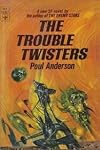
The Trouble Twisters is a fix-up containing "The Three-Cornered Wheel" (originally published in the Oct. 1963 issue of Analog Science Fiction and Fact); "A Sun Invisible" (first published in the Apr. 1966 issue of Analog Science Fiction and Fact; winner of 1967 Nebula Award for Best Novelette); and "The Trouble Twisters" (originally published as "Trader Team" in the July & Aug. 1965 issues of Analog Science Fiction and Fact). These stories concern the exploits of the young David Falkayn, who would eventually become the heir apparent and son-in-law of Anderson's "globular" trader, gourmand, spaceman and malapropist extraordinaire, Nicholas van Rijn: van Rijn was the main protagonist in two of the stories collected in Trader to the Stars show more (and the Marlow-like commentator of the third), but he only has a brief cameo, in flashback, in the titular novella here. The aggressively uninformative cover art is by Richard Powers.
The Trouble Twisters is more classic, solid science fiction from Anderson that is superficially concerned with hard science (which is probably what garnered "A Sun Invisible" its Nebula Award), but moreso with the squishy sciences of sociology and politics, as expressed in spacefaring humanity's dealings with various sentient alien lifeforms (or "sophonts," to use Anderson's terminology). The stories here hinge entirely upon the solving of various vexing problems to further the fortunes of van Rijn's company, Solar Spice & Liquors Company: Falkayn saves the day in "A Sun Invisible" and "The Trouble Twisters," and plays a large supporting role to a trader named Martin Schuster in "The Three-Cornered Wheel." The format entails lots of "As you know, Bob"-type of exposition, a few pithy lines (fewer than in either Trader to the Stars or The Earth Book of Stormgate), minimal character development, and a bone-deep sexism that has even fiercely competent, physically formidable, near genius-level females, human or extra-terrestrial, favoring such pursuits as reading "slushy love novels" (p. 139) and willing to be seduced even by the clumsy attempts of the young Falkayn. Readers looking for more substantive and profound entertainment should look elsewhere.
It's difficult to review or even summarize these stories without spoiling the surprise of their resolutions, but here goes: "The Three-Cornered Wheel" has Falkayn recalling a mathematical problem from his schooldays and Schuster recalling a bit of Earth's theological history to save their own lives, the lives of their shipmates, and, incidentally, further the fortunes of the League in general and van Rijn in particular; “A Sun Invisible” finds Falkayn making a counter-intuitive leap to solve a particularly thorny problem for the League (and, again, for van Rijn), and recalling other lessons from his formative years to woo a sheltered lass; while “The Trouble Twisters” sees Falkayn paired with his non-human chums Adzel, a Buddhist, meters-long, dragon-like being called a Wodenite (whose chronological first appearance was in “How to Be Ethnic in One Easy Lesson,” collected in The Earth Book of Stormgate), and a ninety centimeters long part cat-/part lemur-like being (p. 108) from a planet named Cynthia by the humans who stumbled across it named Chee Lan on a secret expedition to the planet Ikrananka to set up an exclusive trade agreement with the warring, paranoid natives and their human mercenaries (descended from humans who were stranded on Ikrananka several centuries prior); they also learn the considerable advantages and disadvantages of teaching their ship’s computer to play poker. This last story also has Falkyan citing, though not crediting, Millard Fillmore’s pronouncement on the Compromise of 1850 (“an equality of dissatisfaction”). “The Trouble Twisters” also had me speculating as to which refugee crisis of the day -- or of the then-recent past -- Anderson was commenting on.
My personal favorite here was “The Three-Cornered Wheel,” although the by-play between and individual exploits of Falkayn, Adzel and Chee (who also appear in the stories “Day of Burning” and “Lodestar,” also collected in The Earth Book of Stormgate) in “The Trouble Twisters” is amusing and engaging. If Falkayn is luckier in general and luckier with the ladies than he perhaps entirely deserves, at least he never quite develops the self-assured swagger of Captain Kirk or Commander Ryker (from Star Trek and Star Trek: Next Generation, respectively); on the other hand, he doesn’t have van Rijn’s larger-than-life Falstaff-in-space vibe, and I for one found myself missing the greedy, shrewd, lecherous, self-pitying, language-mangling scalawag, which means that I didn’t enjoy The Trouble Twisters quite as much as either Trader to the Stars or The Earth Book of Stormgate.
I can’t help but wonder if Chris Claremont and Dave Cockrum were at least partially inspired by Adzel and Chee Lan when they created the humanoid reptilian Ch’od and the humanoid skunk Mam’selle Hepzibah for their team of intergalactic pirates-cum-revolutionaries the Starjammers to serve as supporting characters in The X-Men; supposedly Hepzibah, who has been depicted as being more feline than skunk-like in recent years, was an homage to Miz Mam’selle Hepzibah from Walt Kelly’s Pogo comic strip, but in attitude, abilities and personality, she seems to owe a lot to Chee Lan. show less
The Trouble Twisters is more classic, solid science fiction from Anderson that is superficially concerned with hard science (which is probably what garnered "A Sun Invisible" its Nebula Award), but moreso with the squishy sciences of sociology and politics, as expressed in spacefaring humanity's dealings with various sentient alien lifeforms (or "sophonts," to use Anderson's terminology). The stories here hinge entirely upon the solving of various vexing problems to further the fortunes of van Rijn's company, Solar Spice & Liquors Company: Falkayn saves the day in "A Sun Invisible" and "The Trouble Twisters," and plays a large supporting role to a trader named Martin Schuster in "The Three-Cornered Wheel." The format entails lots of "As you know, Bob"-type of exposition, a few pithy lines (fewer than in either Trader to the Stars or The Earth Book of Stormgate), minimal character development, and a bone-deep sexism that has even fiercely competent, physically formidable, near genius-level females, human or extra-terrestrial, favoring such pursuits as reading "slushy love novels" (p. 139) and willing to be seduced even by the clumsy attempts of the young Falkayn. Readers looking for more substantive and profound entertainment should look elsewhere.
It's difficult to review or even summarize these stories without spoiling the surprise of their resolutions, but here goes: "The Three-Cornered Wheel" has Falkayn recalling a mathematical problem from his schooldays and Schuster recalling a bit of Earth's theological history to save their own lives, the lives of their shipmates, and, incidentally, further the fortunes of the League in general and van Rijn in particular; “A Sun Invisible” finds Falkayn making a counter-intuitive leap to solve a particularly thorny problem for the League (and, again, for van Rijn), and recalling other lessons from his formative years to woo a sheltered lass; while “The Trouble Twisters” sees Falkayn paired with his non-human chums Adzel, a Buddhist, meters-long, dragon-like being called a Wodenite (whose chronological first appearance was in “How to Be Ethnic in One Easy Lesson,” collected in The Earth Book of Stormgate), and a ninety centimeters long part cat-/part lemur-like being (p. 108) from a planet named Cynthia by the humans who stumbled across it named Chee Lan on a secret expedition to the planet Ikrananka to set up an exclusive trade agreement with the warring, paranoid natives and their human mercenaries (descended from humans who were stranded on Ikrananka several centuries prior); they also learn the considerable advantages and disadvantages of teaching their ship’s computer to play poker. This last story also has Falkyan citing, though not crediting, Millard Fillmore’s pronouncement on the Compromise of 1850 (“an equality of dissatisfaction”). “The Trouble Twisters” also had me speculating as to which refugee crisis of the day -- or of the then-recent past -- Anderson was commenting on.
My personal favorite here was “The Three-Cornered Wheel,” although the by-play between and individual exploits of Falkayn, Adzel and Chee (who also appear in the stories “Day of Burning” and “Lodestar,” also collected in The Earth Book of Stormgate) in “The Trouble Twisters” is amusing and engaging. If Falkayn is luckier in general and luckier with the ladies than he perhaps entirely deserves, at least he never quite develops the self-assured swagger of Captain Kirk or Commander Ryker (from Star Trek and Star Trek: Next Generation, respectively); on the other hand, he doesn’t have van Rijn’s larger-than-life Falstaff-in-space vibe, and I for one found myself missing the greedy, shrewd, lecherous, self-pitying, language-mangling scalawag, which means that I didn’t enjoy The Trouble Twisters quite as much as either Trader to the Stars or The Earth Book of Stormgate.
I can’t help but wonder if Chris Claremont and Dave Cockrum were at least partially inspired by Adzel and Chee Lan when they created the humanoid reptilian Ch’od and the humanoid skunk Mam’selle Hepzibah for their team of intergalactic pirates-cum-revolutionaries the Starjammers to serve as supporting characters in The X-Men; supposedly Hepzibah, who has been depicted as being more feline than skunk-like in recent years, was an homage to Miz Mam’selle Hepzibah from Walt Kelly’s Pogo comic strip, but in attitude, abilities and personality, she seems to owe a lot to Chee Lan. show less
A collection of related stories in the Polesotechnic League series, focusing on the young interstellar trader David Falkayn as he navigates complex alien cultures and political intrigue for the massive merchant organization, featuring tales: The Three-Cornered Wheel, A Sun Invisible, and The Trouble Twisters, where Falkayn uses wits, diplomacy, and sometimes force to overcome cultural barriers, establish trade, and outmaneuver rivals, often with his alien companions Adzel and Chee Lan.
This contains three stories in which the primary hero is not Nicholas van Rijn, though he makes a cameo appearance in the third story as the employer of the the primary hero, David Falkayn. Falkayn is a younger son of a noble in the Grand Duchy of Hermes (which comes to have a long-time continuing history going up into the late part of the Flandry/Terran Empire sequence in A Stone in Heaven) who has decided to become a League merchant. In "The Three Cornered Wheel" he is an apprentice, working under a Jewish Master Merchant. Martin Shuster (not unlike Abrams, Flandry's Jewish mentor) , as shrewd as van Rjn but not so colorful. He and Falkayn need to move a heavy generator from where it is stored on an alien planet to their ship, but the show more local religion forbids the use of wheels, rollers or anything circular/spheroidal, holding notions like the ancient/medieval philosophers (only more so) about the sacredness of the circle as the shape of the stars and their orbits Shuster works to undermine the religion intellectually by introducing Newtonian astronomy and the Kaballah, but Falkayn comes up with a faster answer by devising a shape that works like a round wheel but isn't. In the second book, Falkayn is a minor planetary factor called in by a vaguely comic alien master merchant do deal with an alien race trying to regain its lost interstellar empire with the aid of a group of human renegades, aristocratic Germanic types whose local representative happens to be blonde and beautiful. Falkayn figures out where the enemies' home system is and sends off the master to report, while he remains a prisoner of the blonde. The third story, one of Anderson's et to my mind, is The TroubleTwisters itself, which introduces Falkayn as a master merchant now working for van Rijn scouting for profitable new planets to trade with, in the ship Muddlin' Through with his partners Adzel (a dinosauroid Buddhist) and Chee Lan (a fluffy white catlike creature with a nasty tongue. (This partnership recurs in several later tales). In this case, it turns out a part of Earthfolk had been stranded on te planet 75 years before, and being larger than the natives had become the elite troops of the largest empire. However, some of then had just captured an advanced city state and decided to keep it for themselves, setting up tensions between the rest of the Ershokh as they are called and the empire. Falkayn'party originally intends to id the empire, as being the better trading partner,but he is kidnapped by Ershokh favorable to the rebels (notably another luscious blonde) and after great heroism by all three partners they succeed in imposing a mutually profitable peace on all factions. My favorite moment is when Chee Lan is facing down a mild-mannered imperial bureaucrat, expecting him to yield, and he says, "Did I fail to try, thy would read my ghost out of the phratry" and draws his sword, crucially distracting her. show less
Een boek met een aantal losse, op zich zelf staande verhalen. De enige overeenkomst die ze hebben is dat de hoofdrol in alle verhalen worst gespeeld door David Falkayn.
Eigenlijk alleen het eerste verhaal, het driekantige wiel, was iets wat me een beetje aansprak. In dit verhaal moet David proberen een oplossing te vinden voor het probleem dat een reserve-onderdeel van het ruimteschip op ongeveer 1000 kilometer afstand van het gestrande schip ligt. Probleem is, dat het geloof van de mensen op de planeet cirkels (en afgeleide) verbiedt. Het lukt de jonge David uiteindelijk door te komen met een driekantig wiel.
De overige verhalen zijn naar mijn idee veel minder. Zeer gedateerde science-fiction.
Eigenlijk alleen het eerste verhaal, het driekantige wiel, was iets wat me een beetje aansprak. In dit verhaal moet David proberen een oplossing te vinden voor het probleem dat een reserve-onderdeel van het ruimteschip op ongeveer 1000 kilometer afstand van het gestrande schip ligt. Probleem is, dat het geloof van de mensen op de planeet cirkels (en afgeleide) verbiedt. Het lukt de jonge David uiteindelijk door te komen met een driekantig wiel.
De overige verhalen zijn naar mijn idee veel minder. Zeer gedateerde science-fiction.
I found it rather boring. Falkayn's a young idiot, the alien societies are extremely cliched (two of the four stories in this book are about aliens socially frozen by religion, and how the heroic Earthmen break them out of their frozen patterns...sheesh). I don't much like the Merchant Traders anyway - I keep thinking I should, but...just not. van Rijn (who is not, physically at least, in this book) is even more annoying than Falkayn.
Sequel to Trader to the Stars
Members
- Recently Added By
Talk Discussions
Past Discussions
Sci-fi book with forbidden circles in Name that Book (March 2007)
Author Information

693+ Works 53,533 Members
Poul Anderson, November 25, 1926 - July 31, 2001 Poul Anderson was born on November 25, 1926 in Bristol, Pennsylvania to parents Anton and Astrid. After his father's death, Poul's mother took them first to Denmark and then to Maryland and Minnesota. He earned his degree in Physics from the University of Minnesota, but chose instead to write show more stories for science fiction magazines, such as "Astounding." Anderson is considered a "hard science fiction" writer, meaning that his books have a basis in scientific fact. To attain this high level of scientific realism, Anderson spent many hours researching his topics with scientists and professors. He liked to write about individual liberty and free will, which was a well known theme in many of his books. He also liked to incorporate his love of Norse mythology into his stories, sometimes causing his modern day characters to find themselves in fantastical worlds, such as in "Three Hearts and Three Lions," published in 1961. Anderson has written over a hundred books, his last novel, "Genesis" won the John W. Campbell Award, one of the three major science fiction awards. He is a former president of the Science Fiction and Fantasy Writers of America and won three Nebula awards and nine Hugo Awards. In 1997, Anderson was named a Grandmaster by the Science Fiction and Fantasy Writers of America and was also inducted into the Science Fiction Fantasy Hall of Fame. Poul Anderson died on July 31, 2001 at the age of 74. (Bowker Author Biography) show less
Some Editions
Series

Chronicles of the Polesotechnical League (German numbering)
5 works (02)

Polesotechnic League
7 works (3)
Belongs to Publisher Series
Bastei Science Fiction-Action (21166)
Work Relationships
Common Knowledge
- Canonical title*
- Die Friedensstifter
- Original title
- The Trouble Twisters
- Original publication date
- 1966
- Dedication
- To Manse and Jane Brackney
- First words
- "No!"
Rebo legnor's-Child, Marchwarden of Gilrigor, sprang back from the picture as if it had come alive. - Last words
- (Click to show. Warning: May contain spoilers.)"All right," she said grimly. "I'll win your stake the hard way."
- Original language*
- Englisch
*Some information comes from Common Knowledge in other languages. Click "Edit" for more information.
Classifications
Statistics
- Members
- 557
- Popularity
- 52,941
- Reviews
- 9
- Rating
- (3.44)
- Languages
- Dutch, English, German
- Media
- Paper, Ebook
- ISBNs
- 7
- ASINs
- 28