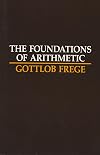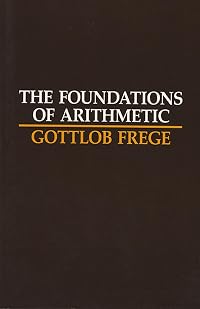
The Foundations of Arithmetic: A Logico-Mathematical Enquiry into the Concept of Number
by Gottlob Frege
フレーゲ著作集 (2)
On This Page
Description
Part of theLongman Library of Primary Sources in Philosophy, this edition of Frege's Foundations of Arithmetic is framed by a pedagogical structure designed to make this important work of philosophy more accessible and meaningful for undergraduates.Tags
Recommendations











Member Reviews
“The laws of numbers, therefore, are not really applicable to external things; they are not laws of nature. They are, however, applicable to judgements holding good of things in the external world: they are laws of the laws of nature” (99)
A deep dive into the concept of Number and an attempt to “prove” arithmetic functions to the same degree of rigor the Euclid brought to geometry. Frege spends the early part of the book examining various philosophical treatments of how we fix our idea of Number. Following Kant, Frege asks whether numbers are parts of analytic judgements where the meaning is contained in a definitions of itself or if they are parts of synthetic judgements where their meaning is grounded in the world. And are show more numbers known a priori (as a matter of reason) or a posteriori (known by experience). Eventually he decides that numbers are analytic judgements that we understand a priori (118).
Frege reaches this conclusion, interestingly, by focusing on language use and how numbers are deployed in how we talk about the world. In a statement like “There are three books on the table” the number “three” is used to add meaning to the concept “books on the table” where “books on the table” is something that we can conceive of conceptually, even in the absence of a context where this is true and there are three actual books on the table in front of you. Furthermore, it is a concept that allows for use of a number … in this case three. We would not say of the same of “There are lazy books on the table” because the idea of “laziness” does not belong to the concept of books in the same way. Numbers appearing in sentences with concepts make propositions about those concepts and allow us to formulate judgements about the world that then support claims, intuitions, and applications of those in the world.
In principle, following from Frege’s arguments, it seems possible to work from language and expressions that are allowed and sensible (as described in the Tractatus) to derive a sense of the rules of reason that are at work. However, as someone who works in language, I would say that what we say is at best an unreliable source from which to understand applicable analytic judgements or a priori acts of knowledge. People say things they don’t mean or say things imprecisely all the time. Our choices of grammar, which Frege is taking as an accurate and rule-governed way of determining the edges of the concepts at play, is more driven by intuitive internalization of rules rather than linguistic expressions of a priori rationality.
Still, I like the idea of looking at our choices in language to determine how they define the edges of concepts (via determiners, articles, and pronouns), identify properties about them (via adjectives), locate them in contexts (via prepositions), position interlocutors to them (via metadiscourse), and provide guidance for their uptake and understanding (via verbs). show less
A deep dive into the concept of Number and an attempt to “prove” arithmetic functions to the same degree of rigor the Euclid brought to geometry. Frege spends the early part of the book examining various philosophical treatments of how we fix our idea of Number. Following Kant, Frege asks whether numbers are parts of analytic judgements where the meaning is contained in a definitions of itself or if they are parts of synthetic judgements where their meaning is grounded in the world. And are show more numbers known a priori (as a matter of reason) or a posteriori (known by experience). Eventually he decides that numbers are analytic judgements that we understand a priori (118).
Frege reaches this conclusion, interestingly, by focusing on language use and how numbers are deployed in how we talk about the world. In a statement like “There are three books on the table” the number “three” is used to add meaning to the concept “books on the table” where “books on the table” is something that we can conceive of conceptually, even in the absence of a context where this is true and there are three actual books on the table in front of you. Furthermore, it is a concept that allows for use of a number … in this case three. We would not say of the same of “There are lazy books on the table” because the idea of “laziness” does not belong to the concept of books in the same way. Numbers appearing in sentences with concepts make propositions about those concepts and allow us to formulate judgements about the world that then support claims, intuitions, and applications of those in the world.
In principle, following from Frege’s arguments, it seems possible to work from language and expressions that are allowed and sensible (as described in the Tractatus) to derive a sense of the rules of reason that are at work. However, as someone who works in language, I would say that what we say is at best an unreliable source from which to understand applicable analytic judgements or a priori acts of knowledge. People say things they don’t mean or say things imprecisely all the time. Our choices of grammar, which Frege is taking as an accurate and rule-governed way of determining the edges of the concepts at play, is more driven by intuitive internalization of rules rather than linguistic expressions of a priori rationality.
Still, I like the idea of looking at our choices in language to determine how they define the edges of concepts (via determiners, articles, and pronouns), identify properties about them (via adjectives), locate them in contexts (via prepositions), position interlocutors to them (via metadiscourse), and provide guidance for their uptake and understanding (via verbs). show less
*Review coming soon*
*Review coming soon*
Ratings
Members
- Recently Added By
Lists

Filosofía - Clásicos
217 works; 1 member
Author Information

The creator of modern logic was born in the Pomeranian town of Wismar. His father was headmaster at a school for young ladies, which Frege's mother took over after her husband's early death. Frege studied mathematics at the University of Jena. His studies were encouraged by Ernst Abbe, who encouraged him to obtain a doctorate at Gottingen and then show more helped him secure a position as lecturer at Jena in 1874. Although trained as a mathematician, Frege also studied with Lotze at Gottingen, and his work shows the influence of both Leibniz and Kant. After the publication in 1879 of Frege's first important work, the Begriffschrift (Conceptual Notation), he was promoted to professor, and he remained at the University of Jena the rest of his life. The Begriffschrift was the basis of his new system of logic, which he then sought to apply to the task of deriving number theory entirely from logic, via the theory of classes. This he did in The Foundations of Arithmetic (1884). The next decade saw several of Frege's other important papers on the philosophy of logic and language, including "Function and Concept" (1891), "Concept and Object" (1892), and "Sense and Reference" (1892). Frege was an extreme critic of "psychologism" in logic, mathematics, and philosophy of language---that is, of any view that attempts to treat logic or other sciences pursuing necessary truth as sciences whose subject matter is the actual functioning of the human mind as it can be empirically observed. His critique of psychologism had a far-reaching impact on philosophy in the twentieth century, strongly influencing the development not only of logical positivism and analytical philosophy in English-speaking countries, but also of neo-Kantianism and the phenomenological movement on the continent. After the publication of the Foundations, Frege became aware of certain deficiencies in the logical basis of his theory, which he attempted to remedy in his two-volume Fundamental Laws of Arithmetic (1893--1903). Shortly thereafter, Frege received a letter from Bertrand Russell, which pointed out a contradiction in his theory, since it allowed classes to include themselves as members. Take the class of all classes that are not members of themselves, Russell said; if you assume it is a member of itself, then it follows that it is not, and if you assume it is not, then it follows that it is. Frege attempted to evade the Russell Paradox in a hastily composed appendix, but it was ad hoc and has generally been viewed as unsuccessful. Even apart from this, he later became convinced that the whole project of founding mathematics on logic was doomed to failure. (Bowker Author Biography) show less
Some Editions
Series

Belongs to Publisher Series
Work Relationships
Common Knowledge
- Original publication date
- 1884
- People/Characters
- Gottlob Frege
- First words*
- Auf die Frage, was die Zahl Eins sei, oder was das Zeichen 1 bedeute, wird man meistens die Antwort erhalten: nun, ein Ding. Und wenn man dann darauf aufmerksam macht, daß der Satz >Die Zahl eins ist ein Ding< eine Definiti... (show all)on, ist, weil auf der einen Seite der bestimmte Artikel, auf der anderen der unbestimmte steht, daß er nur besagt, die Zahl Eins gehöre zu den Dingen, aber nicht, welches Ding sie sei, so wird man vielleicht aufgefordert, sich irgendein Ding zu wählen, das man Eins nennen wolle.Wenn aber jeder das Recht hätte, unter diesem Namen zu verstehen, was er will, so würde derselbe Satz von der Eins für Verschiedene Verschiedenes bedeuten; es gäbe keinen gemeinsamen Inhalt solcher Sätze.
*Some information comes from Common Knowledge in other languages. Click "Edit" for more information.
Classifications
Statistics
- Members
- 587
- Popularity
- 50,074
- Reviews
- 4
- Rating
- (4.14)
- Languages
- 14 — Chinese, Dutch, English, Estonian, French, German, Greek, Hebrew, Italian, Japanese, Portuguese, Romanian, Russian, Swedish
- Media
- Paper, Ebook
- ISBNs
- 24
- ASINs
- 12