Collections of Nothing
by William Davies King
On This Page
Description
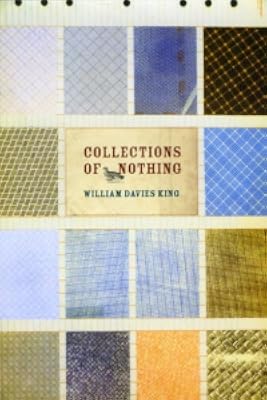
Nearly everyone collects something, even those who don't think of themselves as collectors. William Davies King, on the other hand, has devoted decades to collecting nothing-and a lot of it. With Collections of Nothing, he takes a hard look at this habitual hoarding to see what truths it can reveal about the impulse to accumulate. Part memoir, part reflection on the mania of acquisition, Collections of Nothing begins with the stamp collection that King was given as a boy.Tags
Recommendations



















Member Reviews
“To collect is to write a life.”
Collections of Nothing is a very odd book, part prose-poetry, part memoir, part self-analysis, part exorcism. The author, William Davies King, collects (as he puts it) nothing. And boy does he collect a lot of it. To give a sense of what that means, his collection includes more than 18,000 labels – labels from candy bars and canned soup, shampoo and toothpaste, bottled water and cat food. And that’s just one small (and growing) part of King’s collection. He collects valueless things no one wants, he collects to make an autonomous world. He collects like a cancer grows.
I’ll use his own words to try and describe just why he collects so much nothing: “Collecting, like art, is a way of coming to show more terms with the strangeness of the world.” “The widely shared impulse to collect comes [...] partly from a wound that many of us feel in our personal histories. Collecting may not be the most direct means of healing those wounds, but it serves well enough.”
King tells of the personal tragedies that propelled him into collecting, the trauma of an older sister with cerebral palsy and “mental insufficiencies” who became so imbalanced she had to be institutionalized, and wreckage that experience makes of himself and his family.
He explains, re-explains, and re-re-explains his compulsion to collect, interspersed with a roughly chronological account of his life. To quote again, this time from a book of astrology King owns: “His style is picturesque, vivid, often dramatic; and he continues to deliver and redeliver his message, changing and adapting its form while preserving its essence, until he succeeds in arousing the attention of his audience and kindling its enthusiasm.”
This book certainly isn’t for everyone. Some may throw it across the room in frustration with King’s self-absorption. Some will be puzzled by its discursions on cereal boxes. Some may simply find it boring. I liked it. I don’t think I’ve ever felt a writer so intently – and desperately -- trying to reach me as a reader and as a person. It created a fascinating, if uncomfortable, sense of having William Davies King in the room with me as I turned the pages.
As he puts it: “The book says: here is the collection, here is the collector. What’s missing is the reader, which leads me to turn away from the ponderous things and from the vanishing self to you. Hesitantly the book wants to know where it is going, and I need to find you to know—you, a reader so kind as to collect me.” show less
Collections of Nothing is a very odd book, part prose-poetry, part memoir, part self-analysis, part exorcism. The author, William Davies King, collects (as he puts it) nothing. And boy does he collect a lot of it. To give a sense of what that means, his collection includes more than 18,000 labels – labels from candy bars and canned soup, shampoo and toothpaste, bottled water and cat food. And that’s just one small (and growing) part of King’s collection. He collects valueless things no one wants, he collects to make an autonomous world. He collects like a cancer grows.
I’ll use his own words to try and describe just why he collects so much nothing: “Collecting, like art, is a way of coming to show more terms with the strangeness of the world.” “The widely shared impulse to collect comes [...] partly from a wound that many of us feel in our personal histories. Collecting may not be the most direct means of healing those wounds, but it serves well enough.”
King tells of the personal tragedies that propelled him into collecting, the trauma of an older sister with cerebral palsy and “mental insufficiencies” who became so imbalanced she had to be institutionalized, and wreckage that experience makes of himself and his family.
He explains, re-explains, and re-re-explains his compulsion to collect, interspersed with a roughly chronological account of his life. To quote again, this time from a book of astrology King owns: “His style is picturesque, vivid, often dramatic; and he continues to deliver and redeliver his message, changing and adapting its form while preserving its essence, until he succeeds in arousing the attention of his audience and kindling its enthusiasm.”
This book certainly isn’t for everyone. Some may throw it across the room in frustration with King’s self-absorption. Some will be puzzled by its discursions on cereal boxes. Some may simply find it boring. I liked it. I don’t think I’ve ever felt a writer so intently – and desperately -- trying to reach me as a reader and as a person. It created a fascinating, if uncomfortable, sense of having William Davies King in the room with me as I turned the pages.
As he puts it: “The book says: here is the collection, here is the collector. What’s missing is the reader, which leads me to turn away from the ponderous things and from the vanishing self to you. Hesitantly the book wants to know where it is going, and I need to find you to know—you, a reader so kind as to collect me.” show less
There's a lot that's compelling, even fascinating in this memoir, and yet somehow it falls short. How can it be that such a slender volume feels so terribly overwritten? Long sections of this short book ramble over the same territory again and again, adding nothing new. Even worse, other sections are basically the author rambling about what he should write about! Which could conceivably work if it involved deeply self-reflective observations, but I feel like the author here is constantly skimming the surface of his psyche: why he collects, why anyone collects, how the hell is he going to fill an entire book about his collections. For all that he talks about the years he has spent in therapy, he never comes close to any deep insight show more about his/our compulsions. show less
This book trace William Davies King's obsession with accumulating "stuff" over the years of his childhood and adulthood. He traces the need to have something private in his life, which he shares only upon occasion. This countervalances his love of theater which is very public. This texture of collecting gives his life an idiosyncratic twist, which makes me want to think about my compulsion with collecting public timetables. And to support this collecting with a vast array of maps and data extracted from the Census and other staitisical sources. I probably have over 30,000 timetables and 6,000 maps, so I am definitely in this other camp.
William Davies King writes well. He turns a clever phrase in a way that is a delight to read, and would be more delightful yet were he writing about something other than nothing.
King is a collector. He has collected things since he was a little boy. What does he collect? Worthless things, he says. Labels from boxes and cans, for the most part. But he also has several other, equally useless collections. King thinks about his collecting and puts it into context by revealing the events of his life and the larger world. I can’t really see someone going out and purchasing this book. It leaves you with a sense of having wasted your time reading it, with King dwelling on the meaninglessness of his collecting and of his life. He seems to find some meaning in the meaninglessness of everything, but that is way too philosophical for me.
This was a very interesting book--basically about this man's collection of stuff that no one else finds valuable. It was a bit dry for me, and not very well organized. When I finished the book, I wondered what the point of it was (maybe that's what he was trying to accomplish, since it's called "Collections of Nothing"?).
Ryan, don't read this. It is a nice idea and well-written, but it is incredibly boring.
Members
- Recently Added By
Author Information

4 Works 178 Members
Some Editions
Common Knowledge
- Original publication date
- 2008-11
- People/Characters
- William Davies King
- Important places
- Midwest, USA; California, USA
- Dedication
- For Ruthie and Eva
Another book was opened,
which is the book of life. REVELATIONS 20:12 - First words
- On a hot summer day in 1998, I pulled up at the house I still owned with the woman who was soon to become my ex-wife to find that she had delivered every item connected with me to the garage.
- Last words
- (Click to show. Warning: May contain spoilers.)I will probably continue to collect, out of habit and instinct and reflex and some fear of death, but you can carry away from this book a happy ending, because my collections of nothing now hold you too, in an embrace, which is where we need to be.
- Publisher's editor
- Bielstein, Susan
- Blurbers
- Kauffman, Stanley; Brown, Rosellen; Elsner, Jás
Classifications
- Genres
- Nonfiction, Biography & Memoir, General Nonfiction
- DDC/MDS
- 790.1 — Arts & recreation Recreation, sports, and performing arts Recreational and performing arts General kinds of recreational activities
- LCC
- AM401 .K56 .A3 — General Works Museums. Collectors and collecting Museums. Collectors and collecting Collectors and collecting
- BISAC
Statistics
- Members
- 166
- Popularity
- 196,656
- Reviews
- 10
- Rating
- (3.02)
- Languages
- English
- Media
- Paper, Ebook
- ISBNs
- 4
- ASINs
- 2