The Great Plague in London
by Walter George Bell
On This Page
Description
Looks at the 1665 plague that killed one fifth of London's population.Tags
Recommendations



























Member Reviews
This book is not about the Black Death as a whole, but it's return specifically in London in 1665. Sure the plague had peeked its ugly head in London through the years, but not since the Black Death had the death toll been so high. They were no closer to identifying the cause or treatment than they were 300 years prior.
However, as the author points out, there are still major differences between the two events. First and foremost:
1) "The poor were blamed for hastening their own destruction when in fact it was the fleeing, wealthier class for leaving their now jobless dependents
2) Unlike 1348, London didn't experience a famine in 1665. The days were warm and produce was plentiful.
3) The Great Plague drove the law tribunals out of London. show more "From July 1665- Feb 1666 there wasn't a single hanging.
3) Besides the even higher population and even denser living quarters, there was the Shutting Up.
What is the Shutting Up? Well unlike today, where it's smart to isolate oneself to avoid contagion, we are of course allowed medical care, food, fresh air, exercise, etc. But in 1665, this wasn't healthy isolation, it was forced confinement. If a person in a house was even suspected of having plague, the entire family was locked in. Even the healthy ones. The door was marked, neighbors fled, the only time the door opened was to let food in (if someone brought you some) or someone came to collect the bodies. No open windows, no doctors, no care, you suffocated in your own filth, trapped in with the fleas.
The narrative is honest, straightforward and pulls no punches. I really enjoyed this one. And if the list of "liberties" and "out-parishes" of London seems cumbersome, the author doesn't dwell on them and provides useful maps. Excellent read! show less
However, as the author points out, there are still major differences between the two events. First and foremost:
1) "The poor were blamed for hastening their own destruction when in fact it was the fleeing, wealthier class for leaving their now jobless dependents
2) Unlike 1348, London didn't experience a famine in 1665. The days were warm and produce was plentiful.
3) The Great Plague drove the law tribunals out of London. show more "From July 1665- Feb 1666 there wasn't a single hanging.
3) Besides the even higher population and even denser living quarters, there was the Shutting Up.
What is the Shutting Up? Well unlike today, where it's smart to isolate oneself to avoid contagion, we are of course allowed medical care, food, fresh air, exercise, etc. But in 1665, this wasn't healthy isolation, it was forced confinement. If a person in a house was even suspected of having plague, the entire family was locked in. Even the healthy ones. The door was marked, neighbors fled, the only time the door opened was to let food in (if someone brought you some) or someone came to collect the bodies. No open windows, no doctors, no care, you suffocated in your own filth, trapped in with the fleas.
The narrative is honest, straightforward and pulls no punches. I really enjoyed this one. And if the list of "liberties" and "out-parishes" of London seems cumbersome, the author doesn't dwell on them and provides useful maps. Excellent read! show less
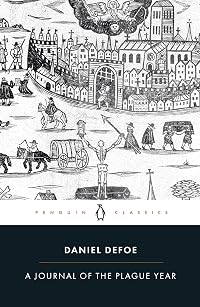
The black death invaded Europe during the middle ages. But it didn't just roll through and then disappear from the scene. Several hundred years later the plague returned to England in 1665 (Remember to avoid that year if you get a chance to go back in time). Mr. Bell talks about Defoe's book on the subject and how it is actually a work of fiction. He uses the death rolls that have been preserved to get an idea about what parts of the city the plague struck and how badly. He estimates about 100,000 people died in London and surrounding areas. The plague eventually died out and then inexplicably has never really returned. No one really knows why. Even if a modern person was bitten by a flea carrying the plague by the time you figured out show more you needed to the hospital there is a good chance you would not make it.
Overall a bit dry but educational. show less
Overall a bit dry but educational. show less
Ratings
Members
- Recently Added By
Author Information

15 Works 524 Members
Some Editions
Work Relationships
Is an abridged version of
Common Knowledge
- Canonical title
- The Great Plague in London
- Original title
- The Great Plague in London
- Alternate titles
- The Great Plague in London
- Original publication date
- 1924
- Important places
- London, England, UK
- Important events
- plagues (Great Plague of London, 1665)
Classifications
- Genres
- History, Nonfiction, General Nonfiction
- DDC/MDS
- 942.1066 — History & geography History of Europe England and Wales London Historical periods; Modified standard subdvisions of London 1603-1714, House of Stuart and Commonwealth periods
- LCC
- RC178 .G72 .L6 — Medicine Internal medicine Internal medicine Infectious and parasitic diseases
Statistics
- Members
- 242
- Popularity
- 133,974
- Reviews
- 2
- Rating
- (3.79)
- Languages
- English
- Media
- Paper
- ISBNs
- 1
- ASINs
- 12