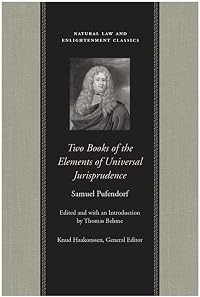
Two Books of the Elements of Universal Jurisprudence
by Samuel Pufendorf
On This Page
Description
"Two Books of the Elements of Universal Jurisprudence" was Pufendorf's first work, published in 1660. Its appearance effectively inaugurated the modern natural-law movement in the German-speaking world. The work also established Pufendorf as a key figure and laid the foundations for his major works, which were to sweep across Europe and North America."Elements of Universal Jurisprudence" established Pufendorf's political theory, which, when fully developed, became the most significant show more alternative to rights-based theories. Pufendorf rejected the concept of natural rights as liberties and the suggestion that political government is justified by its protection of such rights, arguing instead for a principled limit to the state's role in human life. The Liberty Fund edition is based on the translation by William Abbott Oldfather prepared for the Classics of International Law series published by the Carnegie Endowment for International Peace.Samuel Pufendorf (1632-1694) was one of the most important figures in early-modern political thought. An exact contemporary of Locke and Spinoza, he transformed the natural law theories of Grotius and Hobbes, developed striking ideas of toleration and of the relationship between church and state, and wrote extensive political histories and analyses of the constitution of the German empire.Thomas Behme is a member of the Institute for Philosophy at the Free University of Berlin.William Abbott Oldfather (1880-1945) was Professor of Classics at the University of Illinois at Urbana-Champaign.Knud Haakonssen is Professor of Intellectual History at the University of Sussex, England. show lessTags
Recommendations









Members
- Recently Added By
Author Information

50 Works 413 Members
Born in Dorfchemnitz, Saxony, the son of a Lutheran pastor, Samuel Pufendorf was educated at Leipzig and Jena. At Jena he first read Grotius and Hobbes, and studied under Erhard Weigel. In 1658 he became a tutor in the household of the Swedish ambassador to Denmark; when war erupted between these two countries, he was imprisoned for eight months. show more It was during this time that Pufendorf wrote his first work in philosophy of law, the brief Universal Elements of Jurisprudence (1660). Subsequently he taught jurisprudence at the University of Heidelberg and the University of Lund (in Sweden); from 1688 onward he lived in Berlin as court historian to the Duke of Brandenburg. Pufendorf produced historical writings, such as his 1667 account of the Holy Roman Empire, as well as treatises on moral and legal philosophy. His greatest work was the On the Law of Nature and Nations (1672). Although Pufendorf is often described (accurately enough) as a natural rights theorist and also as the thinker who first introduced the ideas of Grotius and Hobbes into Germany, his true originality consisted in his view that a society's law and morality are a function of its culture considered as a determinate and living whole. He may thus be regarded as the inventor of the sociological approach to law. As a historian, he anticipated many of the views of nineteenth-century historicism. (Bowker Author Biography) show less
Series
Belongs to Publisher Series
Common Knowledge
- Canonical title
- Two Books of the Elements of Universal Jurisprudence
Classifications
Statistics
- Members
- 27
- Popularity
- 1,012,575
- Languages
- English
- Media
- Paper, Ebook
- ISBNs
- 4
- ASINs
- 1