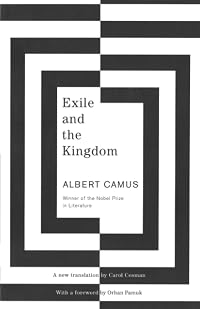
Exile and the Kingdom
by Albert Camus
On This Page
Description
From a variety of masterfully rendered perspectives, these six stories depict people at painful odds with the world around them. A wife can only surrender to a desert night by betraying her husband. An artist struggles to honor his own aspirations as well as society's expectations of him. A missionary brutally converted to the worship of a tribal fetish is left with but an echo of his identity. Whether set in North Africa, Paris, or Brazil, the stories in Exile and the Kingdom are probing show more portraits of spiritual exile, and man's perpetual search for an inner kingdom in which to be reborn. They display Camus at the height of his powers. show lessTags
Recommendations











Member Reviews
I haven't read Camus in a long long time and before that, only The Stranger which I think everyone has read. Camus is, of course, an exceptional writer but the strength in this collection is within each story and the variety of each. It's also in the fact that the stories themselves are so unique and memorable that their presence stays with you even when you wish you could leave them behind in a sense (the image of a man without a tongue being tortured for example isn't something I'd like to dream about on a pleasant afternoon.) Camus is quite adept at creating not just characters but engaging situations to place them in as well as sometimes incredibly vivid metaphors that may not even be quite obvious at first as in the case of his show more first story, "The Adulterous Woman." He also creates a certain kind of landscape in other stories-"The Guest" and telling a story of a life in "The Artist at Work," which was definitely my favorite of the collection. What becomes overwhelmingly clear is his grasp of humans as much as his understanding of the sense of a personal story, whether it be one of doubt and searching or one of tragedy and it is this theme that unites them all in a unique sort of exile. show less
Exile and the Kingdom is a collection of six obstruse and challenging short stories that are, for the patient reader, ultimately rewarding ones. Each of the stories presents a scenario which communicates author Albert Camus' ideas of absurdist philosophy, with their protagonists each at a muted crossroads in their lives. There's an impressively complete air of quiet desolation hanging over each of the stories, a sense of struggle matched by the hope of something more (we must imagine Sisyphus happy) – or, as one of the stories puts it, "he still had to discover what he had not yet clearly understood, although he had always known it and had always painted as if he knew it" (pg. 112). Hence the title of the collection: they are each in show more a sort of exile but are seeking out the kingdom.
This sense of latent discovery extends to the reader, who has to be patient with the stories' slow-build and their heavily-laden prose style. Each one grips, quietly, once you commit to them, but they take a while to get there. Because of this, and the sophistication of the ideas – many of which only become clear after much reflection from the reader, and perhaps a bit of googling – this book certainly won't be for everyone. His novel The Plague remains the most accessible introduction to Camus; the apparent brevity of the short stories in Exile and the Kingdom proves to be something of a Siren song. show less
This sense of latent discovery extends to the reader, who has to be patient with the stories' slow-build and their heavily-laden prose style. Each one grips, quietly, once you commit to them, but they take a while to get there. Because of this, and the sophistication of the ideas – many of which only become clear after much reflection from the reader, and perhaps a bit of googling – this book certainly won't be for everyone. His novel The Plague remains the most accessible introduction to Camus; the apparent brevity of the short stories in Exile and the Kingdom proves to be something of a Siren song. show less
Désert et rivages méditerranéens sont le cadre éclatant de la plupart des nouvelles de L'Exil et le Royaume. Ocre et gris, le désert étire à l'infini ses sables et ses pierres où cheminent sans trêve des hommes « qui ne possèdent rien mais ne servent personne ». Dans cet étrange royaume que Janine entrevoit au-delà des palmeraies s'incarnent la grandeur et la liberté. En contraste, sa propre vie, étriquée. De là naît le drame bref de La Femme adultère. Même quand l'angoisse ne paralyse pas les aspirations les plus hautes des êtres, ils succombent souvent - tel Le Rénégat, prisonniers de la Ville interdite. Ou bien leurs actes sont mal interprétés, et c'est la tragédie de L'Hôte ou des Muets. Que peut-on les show more uns pour les autres ? Saisir le fardeau prêt à choir comme le héros de la Pierre qui pousse ? Quelle ligne de conduite faut-il donc adopter pour rompre l'exil, entrer dans le royaume ? La transparente affabulation de Jonas donne une réponse dont l'humour masque la gravité. show less
Hat elbeszélés a magányról. De hát mi másról írhatna egy egzisztencialista? A kiscicás történetek, úgy fest, nem kompatibilisek ezzel a filozófiai rendszerrel. (Bár el tudok képzelni novellát egy parttalan magányra ítélt kiscicáról. Ami azonban még megírásra vár.) Igazából csak egy történet nem tetszett: a Jonas, avagy a mester dolgozik c. opusz, amit nem is igen tudtam mire vélni, egy erős lezáráshoz vezető vontatott és jobbára érdektelen felvezetésnek éreztem. Viszont amikor Camus szereplőinek egzisztenciális magánya a gyarmatosító magányával párosul a gyarmatosítottak között, az mindig nagyon izgalmas. Láthatólag nagyon foglalkoztatja őt ez: hogy az európai ember a maga európaias show more kultúrájával milyen számkivetett tud lenni azok között, akiket pedig meghódított és uralma alá hajtott. De ezt az uralmat a hajára kenheti, mint ahogy hajára kenheti (gyakran ambivalens) vonzalmát is Algéria iránt, mert ez a vonzalom egyoldalú, sosem képes megrepeszteni a kitaszítottság burkát. Mondhatnánk, Camus algériai franciái olyan urak, akik - legalábbis időnként, lelkük mélyén - jobb szeretnének a szolgák közösségéhez tartozni, de a szolgák közössége túl finnyás ahhoz, hogy befogadja őket. Ez maradt nekik fegyverül - hogy kitaszíthatnak.
Ui.: Érdekes, hogy az utolsó elbeszélés lezárásában (Az eleven kő) a kibékíthetetlen ellentét - SPOILER! -mintha feloldást nyerne. Ez talán valamiféle bolond reményt tükrözhet, hogy a kultúrák között azért kialakulhat valamiféle párbeszéd. Persze ez az optimizmus - az életmű egészét tekintve - inkább csak egyszeri felvillanás, nem trend. show less
Ui.: Érdekes, hogy az utolsó elbeszélés lezárásában (Az eleven kő) a kibékíthetetlen ellentét - SPOILER! -mintha feloldást nyerne. Ez talán valamiféle bolond reményt tükrözhet, hogy a kultúrák között azért kialakulhat valamiféle párbeszéd. Persze ez az optimizmus - az életmű egészét tekintve - inkább csak egyszeri felvillanás, nem trend. show less
From the back cover: Modern man, condemned by nature and circumstances to spiritual exile, ever seeking an inner kingdom in which to be reborn. Camus encapsulates the feeling of straddling two worlds, two loyalties, while acknowledging that one will never be able to find true peace. The book could use better translation in parts.
The Adulterous Woman is the strongest story; in two sentences it sums up overall themes or images in the book: “She was waiting, but she didn’t know for what. She was aware only of her solitude, and too of the penetrating cold, and of a greater weight in the region of her heart.” As with the European characters in the other five stories, this character feels ‘too large’ to fit into the spaces around show more her, compared to ‘thin’ faces and bodies of the Arab characters, comments on ‘taking up space’ contrast with images of vast infinities of the landscape. The question of solitary versus solidarity runs throughout the stories. There are recurring images of the sea, stars, the light on water, and barren landscapes.
Some critics naïvely labeled Camus a colonial sympathizer, showing their lack of understanding of what it’s like to be of two systems, to have one’s own culture be meshed with another. Camus presents a realistic portrayal of characters as products of their environment who struggle with that environment. Camus rejected the designation of an existentialist: in many ways his prose is a natural successor to the Romantics. show less
The Adulterous Woman is the strongest story; in two sentences it sums up overall themes or images in the book: “She was waiting, but she didn’t know for what. She was aware only of her solitude, and too of the penetrating cold, and of a greater weight in the region of her heart.” As with the European characters in the other five stories, this character feels ‘too large’ to fit into the spaces around show more her, compared to ‘thin’ faces and bodies of the Arab characters, comments on ‘taking up space’ contrast with images of vast infinities of the landscape. The question of solitary versus solidarity runs throughout the stories. There are recurring images of the sea, stars, the light on water, and barren landscapes.
Some critics naïvely labeled Camus a colonial sympathizer, showing their lack of understanding of what it’s like to be of two systems, to have one’s own culture be meshed with another. Camus presents a realistic portrayal of characters as products of their environment who struggle with that environment. Camus rejected the designation of an existentialist: in many ways his prose is a natural successor to the Romantics. show less
There is a saying in Urdu language which goes "دھوبی کا کُتّا گَھر کا نَہ گھاٹ کا", and roughly translates in English to "A washerman's dog neither belongs to his house nor to the washing area". This sentence is often used for people who are banished by the society and have no place they can call home. Exile and the Kingdom is a collection of 6 short stories and deals with such "washerman's dogs" who are on a quest to find their kingdom and end their state of exile.
The short stories in the book cover different societies and demographics to paint the state of exile as a universal phenomenon, but this central concept and the journey it's supposed to take the protagonists on doesn't show its complete strength in show more every story. The book manages to find its footing in the second half, but the first half provides a steady warm-up to that, and there are substantial takeaways from every protagonist's journey. show less
The short stories in the book cover different societies and demographics to paint the state of exile as a universal phenomenon, but this central concept and the journey it's supposed to take the protagonists on doesn't show its complete strength in show more every story. The book manages to find its footing in the second half, but the first half provides a steady warm-up to that, and there are substantial takeaways from every protagonist's journey. show less
There is an atmosphere in Camus' stories which sticks with the reader long after finishing them – sometimes of the scene, sometimes of the mood, and occasionally of both. In this collection of short stories we have one of his most brutal, intense, and inhuman tales he has written alongside some of the more human and generous of feeling.
As a writer of shorter short stories (6 here span 150 pages) Camus is at least equal in his abilities to his longer and more well known novellas or short novels. Here he shows his ability to create an atmosphere rich in psychological strain, convincing but distinctive characters, and a compelling tale, while taking it no further than is necessary to achieve the peculiar artistic, philosophical, or show more psychological effect that he sought to express. show less
As a writer of shorter short stories (6 here span 150 pages) Camus is at least equal in his abilities to his longer and more well known novellas or short novels. Here he shows his ability to create an atmosphere rich in psychological strain, convincing but distinctive characters, and a compelling tale, while taking it no further than is necessary to achieve the peculiar artistic, philosophical, or show more psychological effect that he sought to express. show less
Members
- Recently Added By
Lists

20th Century Literature
1,161 works; 54 members

Existentialism
90 works; 11 members

SHOULD Read Books!
354 works; 9 members

1964 College Preparatory Reading List
202 works; 8 members

In Our Time books
4,934 works; 2 members
Author Information

358+ Works 108,029 Members
Born in 1913 in Algeria, Albert Camus was a French novelist, dramatist, and essayist. He was deeply affected by the plight of the French during the Nazi occupation of World War II, who were subject to the military's arbitrary whims. He explored the existential human condition in such works as L'Etranger (The Outsider, 1942) and Le Mythe de Sisyphe show more (The Myth of Sisyphus, 1942), which propagated the philosophical notion of the "absurd" that was being given dramatic expression by other Theatre of the Absurd dramatists of the 1950s and 1960s. Camus also wrote a number of plays, including Caligula (1944). Much of his work was translated into English. He was awarded the Nobel Prize for Literature in 1957. Camus died in an automobile accident in 1960. (Bowker Author Biography) show less
All Editions
Some Editions
Awards and Honors
Distinctions
Notable Lists
Series
Belongs to Publisher Series
Work Relationships
Common Knowledge
- Canonical title*
- L'exil et le royaume
- Original title
- L'exil et le royaume
- Original publication date
- 1957
- Important places*
- Algérie
- Dedication
- For Francine
- First words
- A housefly had been circling for the last few minutes in the bus, though the windows were closed.
- Last words
- (Click to show. Warning: May contain spoilers.)The brother moved a little away from the cook and, half turning towards D'Arrast but without looking at him, pointed to the empty place and said: 'Sit down with us.'
- Original language
- French
- Disambiguation notice*
- La Femme adultère - Le Renégat (ou Un esprit confus) - Les Muets - L'Hôte - Jonas (ou L'Artiste au travail) - La Pierre qui pousse.
*Some information comes from Common Knowledge in other languages. Click "Edit" for more information.
Classifications
Statistics
- Members
- 3,222
- Popularity
- 5,326
- Reviews
- 28
- Rating
- (3.82)
- Languages
- 18 — Catalan, Czech, Danish, Dutch, English, Estonian, Finnish, French, German, Greek, Hungarian, Italian, Polish, Russian, Spanish, Swedish, Turkish, Portuguese (Portugal)
- Media
- Paper, Audiobook, Ebook
- ISBNs
- 65
- ASINs
- 66