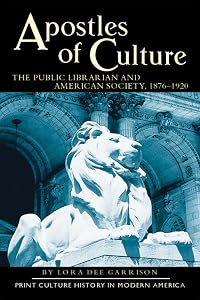
Apostles of Culture : The Public Librarian and American Society, 1876-1920
by Dee Garrison
On This Page
Description
In her Foreword, Christine Pawley sums up the importance of Dee Garrison's book as follows: "Nearly a quarter-century has passed since the first edition of Apostles of Culture appeared. Since no book-length study of the formation of the American public library has yet challenged Dee Garrison's 1979 analysis, it remains the most recent---and most-cited--- interpretation of the public library's past, a landmark in the history, and the historiography, of libraries and librarianship...For show more students and researchers who want to understand the development of a field that still suffers the status of the taken-for-granted, Apostles of Culture stands as a historical document. Its reissue allows its historiographical and political---as well as its historical---significance to be more fully appreciated." show lessTags
Recommendations











































Member Recommendations


Member Reviews
Garrison has done a remarkable job of culling primary sources to expound on the history of the profession of librarianship. Although a discerning topic for any interested reader, it was particularly fascinating to me as a budding librarian myself. No doubt, this book itself has served to shape the profession contemporarily.
The book is arranged in four parts. The first part is concerned with the early library and its elitist society leaders. The public library was born out of a reform movement to socialize and to educate all, especially the poor and the immigrants. The early leaders saw themselves as educational missionaries, bringing literacy and literature to the masses. Short biographies and the social ideals of 36 early library show more leaders are included.
Part two discusses the moral leanings of the public library and the role of the library in espousing virtues to change society for the better. Topics discussed, such as censorship and the literature versus popular fiction debate, are still relevant and deliberated to this day.
Part three is devoted solely to Melvil Dewey. He is probably the most well-known name from the library world, yet one of the most misunderstood. He was obsessive-compulsive, preoccupied with time and death, and did much for the feminization of the profession while still remaining rather sexist. It is interesting to learn of the many paradoxes of this man.
The fourth part discusses the feminization of the profession and how the influx of women to librarianship seems to have lowered the profession's status in society. There are numerous instances in the sources that cite how women, more so than men, are fit for library work because of its tediousness, attention to detail, work with children, and women's helpful nature. Even more, the lower pay women were willing to accept further pushed the feminization and discouraged men from becoming librarians and prevented women from taking a substantial portion of the leadership roles within the library.
All sexism aside, there are many grains of truth to this analysis, though I hate to admit it. Professional librarianship came about at a strange place in time when middle class women did not often work and the work they did was undervalued. Also, they were willing to receive much lower pay than men and, economically speaking, it made sense to hire women because of this. The women did not demand more, nor could they. The social climate of the time limited women very much, especially in aggression; asking for more pay would go against the social conventions and possibly mark one for ridicule.
On a more positive note, the book ends with a call to make the profession feminist rather than feminized. In this way, both men and women are equal forces for the betterment of the profession and the institution of the public library. It is interesting that many of the same themes have such a longstanding history. The "woman" question was around over 100 years ago, written about by Garrison almost 30 years ago, and continues to be discussed today. It seems that the more we change, the more we stay the same. Perhaps in another 100 years, we will have solved this dilemma of equity, not just in librarianship, but in all professions.
I cannot help but wonder about the future of public libraries in general and how this highly feminine profession will deal with the digital era. It is my fear that a high percentage of women in libraries will effect the social psychology of communities, making public libraries seem even less important, rather than more, in the Internet age. One thing is true, part of the new role of the librarian is to recognize their self-worth strongly enough to make others see the library's vitality. Regardless of the women to men ratio, without the underlying institution not only the profession but the entire society has lost something very special and so subtly substantial to our development and advancement. show less
The book is arranged in four parts. The first part is concerned with the early library and its elitist society leaders. The public library was born out of a reform movement to socialize and to educate all, especially the poor and the immigrants. The early leaders saw themselves as educational missionaries, bringing literacy and literature to the masses. Short biographies and the social ideals of 36 early library show more leaders are included.
Part two discusses the moral leanings of the public library and the role of the library in espousing virtues to change society for the better. Topics discussed, such as censorship and the literature versus popular fiction debate, are still relevant and deliberated to this day.
Part three is devoted solely to Melvil Dewey. He is probably the most well-known name from the library world, yet one of the most misunderstood. He was obsessive-compulsive, preoccupied with time and death, and did much for the feminization of the profession while still remaining rather sexist. It is interesting to learn of the many paradoxes of this man.
The fourth part discusses the feminization of the profession and how the influx of women to librarianship seems to have lowered the profession's status in society. There are numerous instances in the sources that cite how women, more so than men, are fit for library work because of its tediousness, attention to detail, work with children, and women's helpful nature. Even more, the lower pay women were willing to accept further pushed the feminization and discouraged men from becoming librarians and prevented women from taking a substantial portion of the leadership roles within the library.
All sexism aside, there are many grains of truth to this analysis, though I hate to admit it. Professional librarianship came about at a strange place in time when middle class women did not often work and the work they did was undervalued. Also, they were willing to receive much lower pay than men and, economically speaking, it made sense to hire women because of this. The women did not demand more, nor could they. The social climate of the time limited women very much, especially in aggression; asking for more pay would go against the social conventions and possibly mark one for ridicule.
On a more positive note, the book ends with a call to make the profession feminist rather than feminized. In this way, both men and women are equal forces for the betterment of the profession and the institution of the public library. It is interesting that many of the same themes have such a longstanding history. The "woman" question was around over 100 years ago, written about by Garrison almost 30 years ago, and continues to be discussed today. It seems that the more we change, the more we stay the same. Perhaps in another 100 years, we will have solved this dilemma of equity, not just in librarianship, but in all professions.
I cannot help but wonder about the future of public libraries in general and how this highly feminine profession will deal with the digital era. It is my fear that a high percentage of women in libraries will effect the social psychology of communities, making public libraries seem even less important, rather than more, in the Internet age. One thing is true, part of the new role of the librarian is to recognize their self-worth strongly enough to make others see the library's vitality. Regardless of the women to men ratio, without the underlying institution not only the profession but the entire society has lost something very special and so subtly substantial to our development and advancement. show less
Ratings
Members
- Recently Added By
Author Information

3+ Works 102 Members
Common Knowledge
- Canonical title
- Apostles of Culture : The Public Librarian and American Society, 1876-1920
- Dedication
- For Tray and Marty
- First words
- This analysis of the American public library system, during the crucial years of its formation from 1876 to 1920, has two related purposes The first is to examine the origins, functions, and evolution of the public library as... (show all) one of the institutions for urban reform designed to cope with the problems of an industrializing society. The second is to consider the relation of librarianship to the larger professionalization movement that transformed American society during this period. I am especially interested in librarianship as one of the emerging feminized service professions of the late nineteenth century. Prior to this study there has been no substantial historical analysis of the natural linkage to a sex-biased culture between protoprofessionalism and feminization. -Introduction
The American Library Association was born on a warm October morning in 1876 at the centennial celebration in Philadelphia, in the heavily draped and book-lined rooms of the Historical Society. The commissioner of education ha... (show all)d reported in 1870 that there were 209 librarians in the United States, with 99 of these in Massachusetts and New York. Therefore, the 103 persons present at Philadelphia who were interested in library development actually represented a significant portion of the whole. So pressing was the devotion of these library pioneers that they claimed to have neglected the wonders of the Centennial Exposition, for "no one desired to go... so long as this valuable opportunity to meet was before the, and so the conference drove, drove, drove for three days." -Chapter 1, The Genteel Setting
Classifications
- Genres
- Nonfiction, History, General Nonfiction, Sociology
- DDC/MDS
- 021.20973 — Computer science, information & general works Library & information sciences Scope, usefulness and founding of libraries Library as an educator; people's university
- LCC
- Z731 .G38 — Bibliography, Library Science and Information Resources Libraries Library reports. History. Statistics
- BISAC
Statistics
- Members
- 68
- Popularity
- 458,417
- Reviews
- 1
- Rating
- (3.78)
- Languages
- English
- Media
- Paper
- ISBNs
- 2