On This Page
Description
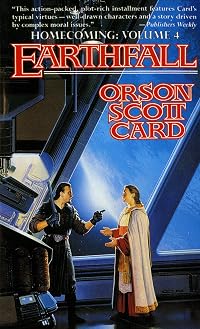
When war broke out on the planet Harmony, the Oversoul of that colonized world selected the family of Wetchik to carry it back to long-lost Earth. Now the tribe is ready at last to take a ship to the stars. But from the beginning there has been bitter dispute between Wetchik’s sons, Nafai and Elemak. On board the starship Basilica, the children of the tribe will become pawns in the struggle for control of reclaimed Earth. Each faction is making secret plans to awaken the children early show more from the cold-sleep capsules in which they will pass the decades-long journey, hoping to gain years of influence on their minds and win their loyalty. But the Oversoul is truly in control of this journey, and only the son who wears the cloak of the Starmaster really understands what this will mean to all their plans for the future.. show less
Tags
Recommendations




Member Reviews
After the very long flight, the few humans on board the ships have finally arrived at Earth. Not knowing what to expect when they arrive, what they find isn't a surprise, but it is also hard to understand. They now have to make contact and choose sides again, and again the wars start up between those who will follow their guide, and those who won't.
This is consistent with the other books, in terms of the ongoing conflict. What they find on Earth is original and interesting. I found each of the books in this series equally easy to read.
This is consistent with the other books, in terms of the ongoing conflict. What they find on Earth is original and interesting. I found each of the books in this series equally easy to read.
I guess the best way I can describe the ending to the fourth volume of the Homecoming series is with the term flaccid. This book is essentially split in two - the journey to Earth and then the splintering of the human colony on Earth. The first part ratchets up the temperature with Ellemak capturing and torturing Nafai. Nafai's Starmaster's cloak is the only reason he survives the beatings he takes from Ellemak and his trusty steel pipe. The resolution of that situation confused me... the whole thing just seemed to vanish in so much smoke. And really... if you've had your skull caved in on purpose by your brother, will you still love him? I don't think so. If it was me, I'd have taken the first opportunity to exterminate him - and show more probably jettison his worthless carcass into space.
The end of the second half was just as odd. Vas finds out that Sevet has been sleeping with Ellemak, and decides to take revenge now for the wrongs that he's had to endure. So he kills Obring and then goes to find and kill Ellemak. But when he gets there, he does the stupid Scooby-doo villian thing and starts talking... and talking... and talking until Meb shows up and squishes his skull like Gallagher. Dumb.
Then Volemak dies and Ellemak takes Nafai and all his people hostage. Nafai gives the cloak to Shedemai while the Oversoul puts everyone to sleep. Nafai and his folks skip town and build a new settlement with the angels and a few diggers. Shedemai and Zdorab hop in the ship and orbit the Earth for a couple hundred years, coming in and out of suspended animation. And Ellemak begins a war against Nafai.
And that's the end of the book. So I'll take a cue from the master and end my review here as well... after having resolved nothing but my need to say something. show less
The end of the second half was just as odd. Vas finds out that Sevet has been sleeping with Ellemak, and decides to take revenge now for the wrongs that he's had to endure. So he kills Obring and then goes to find and kill Ellemak. But when he gets there, he does the stupid Scooby-doo villian thing and starts talking... and talking... and talking until Meb shows up and squishes his skull like Gallagher. Dumb.
Then Volemak dies and Ellemak takes Nafai and all his people hostage. Nafai gives the cloak to Shedemai while the Oversoul puts everyone to sleep. Nafai and his folks skip town and build a new settlement with the angels and a few diggers. Shedemai and Zdorab hop in the ship and orbit the Earth for a couple hundred years, coming in and out of suspended animation. And Ellemak begins a war against Nafai.
And that's the end of the book. So I'll take a cue from the master and end my review here as well... after having resolved nothing but my need to say something. show less
I don't know why, but this one didn't grip me as much as the first two books in this series. It is well written and continues the story line, I think it just kept yelling (in my head) at the protagonist to do something different much more in this book.
Finally, we're on Earth. However, if you think you might get some answers about who the Keeper of Earth might be, both you and the Oversoul are sorely mistaken. The rift between Nafai and Elemak comes to a head, and although it's pretty satisfying, it's not all shiny and happy. The angel and digger societies are interesting bits of archaeology, though, so the book is worth reading.
Nafai's group finds Earth and more of the never-ending conflict among themselves, as well as more of the mysteries of the Keeper of the Earth.
This is a fairly preachy book, and though the characters are written well, I couldn't bring myself to love it as much as others in my OSC library. Yes, the concept is interesting... humans 40 million years in the future, returning to Earth, meeting the sentient creatures who have developed in their absence... how does the knowledge that a computer is one of the higher powers in your life make you feel about the unknown power above that? How do slighted people hold on to their anger, causing an ever-present rift in the community?
But it still didn't sit perfectly with me. Eh.
This is a fairly preachy book, and though the characters are written well, I couldn't bring myself to love it as much as others in my OSC library. Yes, the concept is interesting... humans 40 million years in the future, returning to Earth, meeting the sentient creatures who have developed in their absence... how does the knowledge that a computer is one of the higher powers in your life make you feel about the unknown power above that? How do slighted people hold on to their anger, causing an ever-present rift in the community?
But it still didn't sit perfectly with me. Eh.
This was a good book, and fit with the nature of the rest of the series. It gets into some weirdness by introducing sentient species that I found to be more than a bit of a stretch to believe, but they were more plot devices than compelling characters. After reading this and the original four Ender's Game series, Card seems to write interesting human stories and mix them with aliens that I have a lot of difficulty getting attached to (or even interested in) in the way he seems to intend us to....moreThis was a good book, and fit with the nature of the rest of the series. It gets into some weirdness by introducing sentient species that I found to be more than a bit of a stretch to believe, but they were more plot devices than compelling show more characters. After reading this and the original four Ender's Game series, Card seems to write interesting human stories and mix them with aliens that I have a lot of difficulty getting attached to (or even interested in) in the way he seems to intend us to.
Earthfall brought the series to a reasonable (though frustratingly realistic and open-ended) close. However, Card wrote and published a fifth book to follow this fourth in the series. It's not that it was unreasonable to write a fifth, but having now read that also, be aware that while Earthborn shares a common universe and world with the rest of the series, Earthfall does bring the main story arc to a close. show less
Earthfall brought the series to a reasonable (though frustratingly realistic and open-ended) close. However, Card wrote and published a fifth book to follow this fourth in the series. It's not that it was unreasonable to write a fifth, but having now read that also, be aware that while Earthborn shares a common universe and world with the rest of the series, Earthfall does bring the main story arc to a close. show less
I've enjoyed this whole series, but this 4th book was the best so far. It includes the group making the trip to Earth and what they find when they get there. This part of the saga is a very rich story with some unusual characters other than those who land in the starship.
Members
- Recently Added By
Lists

Space Colonization
100 works; 26 members
Author Information

575+ Works 213,935 Members
Orson Scott Byron Walley Card, was born in 1951 and studied theater at Brigham Young University. He received his B.A. in 1975 and his M.A. in English in 1981. He wrote plays during that time, including Stone Tables (1973) and the musical, Father, Mother, Mother and Mom (1974). A Mormon, Scott served a two-year mission in Brazil before starting show more work as a journalist in Utah. He also designed games at Lucas Film Games, 1989-92. He is best known for his science fiction novels, including the popular Ender series. Well known titles include A Planet Called Treason (1979), Treasure Box (1996), and Heartfire (1998). He has also written the guide called How to Write Science Fiction and Fantasy (1990). His novel Ender's Game and its sequel Speaker for the Dead, both won Hugo and Nebula awards, making Card the only author to win both prizes in consecutive years. His titles Shadows in Flight, Ruins and Ender's Game made The New York Times Best Seller List. He is also the author of The First Formic War Series, which includes the titles Earth Unaware, Earth Afire, and Earth Awakens. (Bowker Author Biography) show less
Some Editions
Series

Belongs to Publisher Series
Bastei Science Fiction-Special (24211)
Work Relationships
Common Knowledge
- Canonical title
- Earthfall
- Original title
- Earthfall
- Original publication date
- 1995-02
- People/Characters
- Hushidh - Shuya; Luet aka Lutya; Nafai - Nyef; Issib - Issya
- Dedication
- To Shayne Bell, a good friend, a good writer, a good man.
- First words
- Prologue - The master computer of Harmony was no longer quite itself; or rather, if you look at it in another way, it was twice itself.
The master computer of the planet Harmony was no longer quite itself; or rather, if you look at it in another way, it was twice itself. - Last words
- (Click to show. Warning: May contain spoilers.)The human race was home again.
Classifications
Statistics
- Members
- 1,941
- Popularity
- 10,953
- Reviews
- 15
- Rating
- (3.37)
- Languages
- 6 — English, French, German, Polish, Romanian, Spanish
- Media
- Paper, Audiobook, Ebook
- ISBNs
- 25
- ASINs
- 9