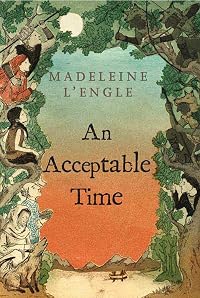
On This Page
Description
Polly's visit to her grandparents in Connecticut becomes an extraordinary experience as she encounters old friends and mysterious stangers and finds herself traveling back in time to play a crucial role in a prehistoric confrontation.Tags
Recommendations

Member Recommendations
Member Reviews
In keeping with my habit of reading novel series in the wrong order (see Margaret J. Anderson, passim), I've just followed my reading of the first volume in L'Engle's Time Quintet with a reading of the fifth. Next up is likely (for arcane reasons) to be the fourth . . .
Teenaged Polly O'Keefe, eldest child of Calvin and Meg from A Wrinkle in Time, is staying with her genius-scientist Murry grandparents in order to get some studying done away from the sibling horde at home. One day Zachary Gray, whom she met briefly while bumming around Europe the previous summer, turns up at the isolated house; he has romance in mind, though constrained in his ambitions by the fact that he's been diagnosed with a weak heart and not given long to go. show more Together they see a mysterious man with a mysterious dog; returning to the house, they admire a 3000-year-old stone carved with Ogam lines that a family friend, Bishop Nason Colubra, has brought to show Polly's grandparents. Later, when Polly is having a swim, a mysterious girl appears, Anaral, indicating that she is from a far-distant past -- the time of Bishop Colubra's stone. Next day, when Polly is out walking, there's a rumble of the earth and a trembling of the air and she finds herself transported back to Anaral's time. (Among the reasons she knows she's in the past is that the local mountains aren't their rounded placid selves but are all jagged and new-looking. I'd have said a mere 3000 years' erosion wouldn't have made much visible difference to a mountain, but there you go.)
Polly's first trip into the past doesn't last long. Back home, she and her parents talk a lot about the nature of time and of religion, together with the bishop and his sister. It emerges that the bishop knows a lot more about the opening up of the timegate between now and then than he's been letting on; it's because he's been bopping back there regularly that several of the People of the Wind, as Anaral's tribe are called, can speak fluent English. Polly, an astonishing linguist (and, as we later discover, an Olympic-standard swimmer), promptly teaches herself Ogam -- a neat trick if you can do it. Zachary, hearing about what's been going on, insists on dragging her back to the past era, in the hope that, since modern medical science has shown itself incapable of curing his heart condition, perhaps a prehistoric shaman might have better luck. (I must confess I stared at the page in disbelief when this bit of plotting Bandaid was introduced.)
This time, though, Polly and Zachary -- and the bishop, who's made the transition independently -- find that they can't get home to their own time so easily: the timegate is closed. Further, all is not well with the People of the Wind. The rascally People Across the Lake, who've been suffering a drought, have been raiding for crops and cattle. Because Polly has a mop of red hair and because she appears to have been befriended by a snake, both lots of People tend to think she's a goddess -- and there's a general inclination to sacrifice her to the Mother to either (a) stop the raids or (b) bring rain. Zachary, whose whingeing has by now reached epic proportions, betrays Polly to the People Across the Lake in the hope that their healer will cure his heart condition in return for the tribe being allowed to blood-sacrifice her. The relationship between them will never be quite the same again.
Needless to say, after many a conniption, Polly escapes being forced to perform a propitiatiory function, the two Peoples sort out their differences thanks to her ministrations, the time travellers get home, the news is broken to Zachary that, under the circumstances, rather than anticipating a bright romantic future with Polly, he might be better advised to stick his head in a location inconvenient to describe, and -- this being a L'Engle book -- a whole lot of devoutery is spouted.
In fact, I found the devoutery in this book, while there's quite a lot of it (the very title is from Psalms: "Lord, I make my prayer to you in an acceptable time"), far less oppressive than in A Wrinkle in Time. I think this is probably because it seems to appear just as a natural part of the plot (and with one of the characters a bishop, it's to be expected); in the earlier book, there were instances where the religiosity seemed just to have been jammed in gratuitously while, elsewhere, there was a suspicion that perhaps the whole purpose of the book was to push a religious agenda. Further, in An Acceptable Time, the tone of the religiosity is much altered: it seems far more ecumenical and indeed liberal: there's no attempt to force the People of the Wind to abandon their reverence for the Mother and take up worship of the as-yet-unborn Christ instead. And there are some direct challenges to the faux-Christian right:
"The idea of blood sacrifice is gone from our frame of reference, but it's not that much different or worse than things that go on today. What else is the electric chair or lethal injection than human sacrifice?"
"We're told that it's to protect society," Polly said.
"Isn't Tav trying to protect his society in the only way he knows how? [. . .:]" (p183)
All in all, although this is a much longer book than A Wrinkle in Time, and although some of the plot's mechanics creaked near-deafeningly, I found it by far the more readable of the two books. I am less apprehensive about reading the other books in the series than I was. show less
Teenaged Polly O'Keefe, eldest child of Calvin and Meg from A Wrinkle in Time, is staying with her genius-scientist Murry grandparents in order to get some studying done away from the sibling horde at home. One day Zachary Gray, whom she met briefly while bumming around Europe the previous summer, turns up at the isolated house; he has romance in mind, though constrained in his ambitions by the fact that he's been diagnosed with a weak heart and not given long to go. show more Together they see a mysterious man with a mysterious dog; returning to the house, they admire a 3000-year-old stone carved with Ogam lines that a family friend, Bishop Nason Colubra, has brought to show Polly's grandparents. Later, when Polly is having a swim, a mysterious girl appears, Anaral, indicating that she is from a far-distant past -- the time of Bishop Colubra's stone. Next day, when Polly is out walking, there's a rumble of the earth and a trembling of the air and she finds herself transported back to Anaral's time. (Among the reasons she knows she's in the past is that the local mountains aren't their rounded placid selves but are all jagged and new-looking. I'd have said a mere 3000 years' erosion wouldn't have made much visible difference to a mountain, but there you go.)
Polly's first trip into the past doesn't last long. Back home, she and her parents talk a lot about the nature of time and of religion, together with the bishop and his sister. It emerges that the bishop knows a lot more about the opening up of the timegate between now and then than he's been letting on; it's because he's been bopping back there regularly that several of the People of the Wind, as Anaral's tribe are called, can speak fluent English. Polly, an astonishing linguist (and, as we later discover, an Olympic-standard swimmer), promptly teaches herself Ogam -- a neat trick if you can do it. Zachary, hearing about what's been going on, insists on dragging her back to the past era, in the hope that, since modern medical science has shown itself incapable of curing his heart condition, perhaps a prehistoric shaman might have better luck. (I must confess I stared at the page in disbelief when this bit of plotting Bandaid was introduced.)
This time, though, Polly and Zachary -- and the bishop, who's made the transition independently -- find that they can't get home to their own time so easily: the timegate is closed. Further, all is not well with the People of the Wind. The rascally People Across the Lake, who've been suffering a drought, have been raiding for crops and cattle. Because Polly has a mop of red hair and because she appears to have been befriended by a snake, both lots of People tend to think she's a goddess -- and there's a general inclination to sacrifice her to the Mother to either (a) stop the raids or (b) bring rain. Zachary, whose whingeing has by now reached epic proportions, betrays Polly to the People Across the Lake in the hope that their healer will cure his heart condition in return for the tribe being allowed to blood-sacrifice her. The relationship between them will never be quite the same again.
Needless to say, after many a conniption, Polly escapes being forced to perform a propitiatiory function, the two Peoples sort out their differences thanks to her ministrations, the time travellers get home, the news is broken to Zachary that, under the circumstances, rather than anticipating a bright romantic future with Polly, he might be better advised to stick his head in a location inconvenient to describe, and -- this being a L'Engle book -- a whole lot of devoutery is spouted.
In fact, I found the devoutery in this book, while there's quite a lot of it (the very title is from Psalms: "Lord, I make my prayer to you in an acceptable time"), far less oppressive than in A Wrinkle in Time. I think this is probably because it seems to appear just as a natural part of the plot (and with one of the characters a bishop, it's to be expected); in the earlier book, there were instances where the religiosity seemed just to have been jammed in gratuitously while, elsewhere, there was a suspicion that perhaps the whole purpose of the book was to push a religious agenda. Further, in An Acceptable Time, the tone of the religiosity is much altered: it seems far more ecumenical and indeed liberal: there's no attempt to force the People of the Wind to abandon their reverence for the Mother and take up worship of the as-yet-unborn Christ instead. And there are some direct challenges to the faux-Christian right:
"The idea of blood sacrifice is gone from our frame of reference, but it's not that much different or worse than things that go on today. What else is the electric chair or lethal injection than human sacrifice?"
"We're told that it's to protect society," Polly said.
"Isn't Tav trying to protect his society in the only way he knows how? [. . .:]" (p183)
All in all, although this is a much longer book than A Wrinkle in Time, and although some of the plot's mechanics creaked near-deafeningly, I found it by far the more readable of the two books. I am less apprehensive about reading the other books in the series than I was. show less
I spent most of this book wishing Zachary Gray didn't exist. He just keeps popping up in L'Engle's books, causing problems. How he managed to trick Polly's grandparents into thinking he was a decent young man is beyond me.
However, he actually serves a pretty powerful purpose in this book. He was a coward. He doesn't have many redeeming qualities. He doesn't believe in God. But despite all this, he is still worth saving.
However, he actually serves a pretty powerful purpose in this book. He was a coward. He doesn't have many redeeming qualities. He doesn't believe in God. But despite all this, he is still worth saving.
I enjoyed the first three books in this series when I was younger. The fourth book, Many Waters, I read more recently, and it was good, if not with the same spark as the earlier ones. The fifth book, unfortunately, doesn't stand up.
An Acceptable Time is about Polly, a teenager staying with her grandparents. For reasons that are hinted at but never really explained, a gate opens to a time 3,000 years before, where Polly and her neighbour the bishop interact with the natives (who are led by a wise European).
It's a pleasant enough read in some ways, but much of it seems haphazard. The plot seems more of a sketch than a final product, full of inconsistencies and lucky coincidences. The science is decorative but vague and not very logical. show more Religion obtrudes more awkwardly than in the previous books. Characters are black or white, and fairly flat. At the same time, the tone is light and fun, and some of the animal characters are nice companions.
All in all, a disappointing book. Fans of L'Engle and her various interconnected series will no doubt want to read this. For others, I advise stopping after A Swiftly Tilting Planet. show less
An Acceptable Time is about Polly, a teenager staying with her grandparents. For reasons that are hinted at but never really explained, a gate opens to a time 3,000 years before, where Polly and her neighbour the bishop interact with the natives (who are led by a wise European).
It's a pleasant enough read in some ways, but much of it seems haphazard. The plot seems more of a sketch than a final product, full of inconsistencies and lucky coincidences. The science is decorative but vague and not very logical. show more Religion obtrudes more awkwardly than in the previous books. Characters are black or white, and fairly flat. At the same time, the tone is light and fun, and some of the animal characters are nice companions.
All in all, a disappointing book. Fans of L'Engle and her various interconnected series will no doubt want to read this. For others, I advise stopping after A Swiftly Tilting Planet. show less
"An Acceptable Time" is the final installment in Madeleine L'Engle's beloved Time Quintet, and it is rather different in tone from the previous books. The plot centers around Polly, Meg and Calvin's daughter, as she visits her Murry grandparents in New England. Somehow time circles nearby have been opened, allowing Polly to cross over into prehistoric times.
Whereas the threats of the previous books came from without the Murry circle of friends and family, in this story Polly is put in considerable danger by a friend, and then the challenge becomes whether to do the right thing and help the person who selfishly harmed you, or leave them to suffer the consequences of their own bad decisions.
I liked this book, despite the fact that it is show more very different from the adventures of the previous generation. The tone is just a little more downcast, as it revolves around human sacrifice and betrayal, and Alex and Kate Murry have grown less open-minded in their older age, refusing at first to believe that Polly has truly time-traveled. That was slightly hard to swallow considering all they had seen (Alex Murry having himself tessered in the first book).
But the writing was still captivating, and I very much wanted to find out what happened in the course of the novel (even though I've read it before) so I would still recommend the book. show less
Whereas the threats of the previous books came from without the Murry circle of friends and family, in this story Polly is put in considerable danger by a friend, and then the challenge becomes whether to do the right thing and help the person who selfishly harmed you, or leave them to suffer the consequences of their own bad decisions.
I liked this book, despite the fact that it is show more very different from the adventures of the previous generation. The tone is just a little more downcast, as it revolves around human sacrifice and betrayal, and Alex and Kate Murry have grown less open-minded in their older age, refusing at first to believe that Polly has truly time-traveled. That was slightly hard to swallow considering all they had seen (Alex Murry having himself tessered in the first book).
But the writing was still captivating, and I very much wanted to find out what happened in the course of the novel (even though I've read it before) so I would still recommend the book. show less
This book mixes characters that L'Engle readers have previously met in both her Murry and Austin family books, although it's a stand-alone novel. Two college-age folks, Polly and Zachary, along with a family friend who is a retired bishop, pass through a "time-gate" into 3000 years ago, and a tribe of celtic-influenced Native Americans, some of whom, regrettably, think that strange and seemingly powerful strangers would make an excellent blood sacrifice to bring rain.
This book is more overtly Christian than I remember her earlier books being (although all of her writing is informed by her beliefs). However, it's the sort of Christianity that makes me think her books should be required reading for all the anti-science, xenophobic, show more war-mongering so-called Christians out there!
Still, there are a few moments when it gets out of hand - the bishop character has a tendency to preach, and there's a totally unneccessary little jab at the "evil" of fortune-telling (which I personally think is a totally harmless and entertaining [if a bit silly] activity.)
What I find a bit more off-putting (to me personally) than her religion is the portrayed centrality of family. Not just in this book, but in her writing in general. Family members Always love each other and get along fabulously. If she has a character that isn't in the family, and isn't a family friend (as opposed to a personal friend), they're bound to be bad news. If a character doesn't have a strong relationship with their family, they're bound to be sad, disturbed, and in need of help. When confronted with a dilemma, her young adult characters think of confiding in/consulting their parents or grandparents, first thing! (Eh, my mom would think it was just wonderful....but it's just not likely.)
Like I said, maybe it's just me... I've always been a very independent person; I left home very early, and although I love my immediate family and make an effort to stay in touch and see them at least once or twice a year, they're not central to my life, nor do they know every detail of what's going on in my life... which I find happy and normal!
Still L'Engle is a good writer, and this is a fast read... (it didn't feel like over 300 pages at all!) show less
This book is more overtly Christian than I remember her earlier books being (although all of her writing is informed by her beliefs). However, it's the sort of Christianity that makes me think her books should be required reading for all the anti-science, xenophobic, show more war-mongering so-called Christians out there!
Still, there are a few moments when it gets out of hand - the bishop character has a tendency to preach, and there's a totally unneccessary little jab at the "evil" of fortune-telling (which I personally think is a totally harmless and entertaining [if a bit silly] activity.)
What I find a bit more off-putting (to me personally) than her religion is the portrayed centrality of family. Not just in this book, but in her writing in general. Family members Always love each other and get along fabulously. If she has a character that isn't in the family, and isn't a family friend (as opposed to a personal friend), they're bound to be bad news. If a character doesn't have a strong relationship with their family, they're bound to be sad, disturbed, and in need of help. When confronted with a dilemma, her young adult characters think of confiding in/consulting their parents or grandparents, first thing! (Eh, my mom would think it was just wonderful....but it's just not likely.)
Like I said, maybe it's just me... I've always been a very independent person; I left home very early, and although I love my immediate family and make an effort to stay in touch and see them at least once or twice a year, they're not central to my life, nor do they know every detail of what's going on in my life... which I find happy and normal!
Still L'Engle is a good writer, and this is a fast read... (it didn't feel like over 300 pages at all!) show less
I was surprised to see that I had missed this sequal to A Wrinkle in Time, but found it to be a fairly flat novel so am not surprised it slipped past my radar. Or maybe I'm just so much older than when I read Wrinkle that I expect more from a novel than I did then.
Too much preaching--so much, that L'Engle had her character apologize frequently for preaching. While Polly is a thoughtful, caring character, Zachary is such a self-centered user he irritated me & I couldn't figure out why Polly would give him any attention.
Too much preaching--so much, that L'Engle had her character apologize frequently for preaching. While Polly is a thoughtful, caring character, Zachary is such a self-centered user he irritated me & I couldn't figure out why Polly would give him any attention.
This book was just okay. Maybe I'm a bit meh about Christian fantasy/sf in general, or specifically, but I did enjoy the moments of particle physics and the apologia for all things Jesus. (Sure, time travel is fine because even though you're going back a thousand years before the time of Christ, his spirit is eternal, etc., etc.)
MAYBE I would have liked this a lot more if it hadn't been super-primitive societies performing ritual sacrifice and we're supposed to go back and civilize the bastards. Or something like that.
Hmmm. Well, I do like certain ASPECTS of this. Like any time period that is ours. That's pretty cool. But when what should have been the cool bit, like TIME TRAVEL, something between my shoulder-blades started itching and show more I just wanted to be through this. I'm afraid that it didn't age all that well.
Which is a shame, because I used to love the rough-and-tumble mix of science and religion in the previous books.
I think it is a case of, "I've changed, you haven't. Sorry, L'Engle." show less
MAYBE I would have liked this a lot more if it hadn't been super-primitive societies performing ritual sacrifice and we're supposed to go back and civilize the bastards. Or something like that.
Hmmm. Well, I do like certain ASPECTS of this. Like any time period that is ours. That's pretty cool. But when what should have been the cool bit, like TIME TRAVEL, something between my shoulder-blades started itching and show more I just wanted to be through this. I'm afraid that it didn't age all that well.
Which is a shame, because I used to love the rough-and-tumble mix of science and religion in the previous books.
I think it is a case of, "I've changed, you haven't. Sorry, L'Engle." show less
Members
- Recently Added By
Lists

NPRs Ultimate Backseat Bookshelf: 100 Must-Reads for kids 9-14
222 works; 30 members

Speculative Fiction to Read
706 works; 32 members

Books Read in 2023
5,638 works; 147 members

Unread books
1,063 works; 82 members

Time travel -- children's/young adult fiction
231 works; 10 members

Favorite Kids Books (chapter, middle grade)
170 works; 4 members

Read For Your Life
157 works; 1 member
Author Information

122+ Works 128,827 Members
Author Madeleine L'Engle was born in New York City on November 29, 1918. She graduated from Smith College. She is best known for A Wrinkle in Time (1962), which won the 1963 Newbery Medal for best American children's book. While many of her novels blend science fiction and fantasy, she has also written a series of autobiographical books, including show more Two Part Invention: The Story of a Marriage, which deals with the illness and death of her husband, soap opera actor Hugh Franklin. In 2004, she received a National Humanities Medal from President George W. Bush. She died on September 6, 2007 of natural causes. Since 1976, Wheaton College in Illinois has maintained a special collection of L'Engle's papers, and a variety of other materials, dating back to 1919. (Bowker Author Biography) show less
Some Editions
Awards and Honors
Series


Work Relationships
Common Knowledge
- Canonical title
- An Acceptable Time
- Original publication date
- 1989
- People/Characters
- Polly O'Keefe; Zachary Gray; Katherine "Kate" Murry; Alexander Murry Sr.; Louise Colubra; Bishop Nason Colubra (show all 8); Anaral; Karralys
- Important places
- New England, USA
- Dedication
- For
Dana, Ber & Eddie
Ron, Annie & Jake - First words
- She walked through an orchard, fallen apples red and cidery on the ground, crossed a stone wall, and wandered on into a small wood.
- Last words
- (Click to show. Warning: May contain spoilers.)They went into the house.
Classifications
- Genres
- Fiction and Literature, Fantasy, Kids, Teen, Young Adult
- DDC/MDS
- 813.54 — Literature & rhetoric American literature in English American fiction in English 1900-1999 1945-1999
- LCC
- PZ7 .L5385 .A — Language and Literature Fiction and juvenile belles lettres Fiction and juvenile belles lettres Juvenile belles lettres
- BISAC
Statistics
- Members
- 5,676
- Popularity
- 2,327
- Reviews
- 51
- Rating
- (3.74)
- Languages
- English, Spanish, Portuguese (Portugal)
- Media
- Paper, Audiobook, Ebook
- ISBNs
- 28
- ASINs
- 24