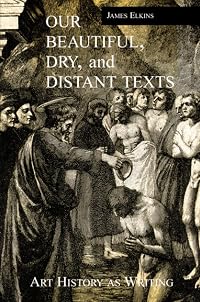
Our Beautiful, Dry and Distant Texts: Art History as Writing
by James Elkins 
On This Page
Description
How do psychoanalytic, semiotic, deconstructive, and other interpretations represent works of art? What can they see, and what must they miss? In Our Beautiful, Dry, and Distant Texts, Elkins suggests that the philosophic problems posed by these questions are essentially insuperable because philosophy makes demands of visual artifacts that they can answer only by becoming mirror images of philosophic discourse. Elkins argues that writing is what art historians produce, and, whether such show more writing is a transparent vehicle for the transmission of facts or an embattled forum for the rehearsal of institutional relations and constructions of history, it is an expressive medium, with the capacity for emotion and reflection. Therefore, it needs to be taken seriously for its own sake: it is the testament of art history and of individual historians, and it is only weakened and slighted by versions of history that imagine it either as uncontrolled dissemination or as objective discovery and reporting. show lessTags
Recommendations






Members
- Recently Added By
Author Information

52+ Works 2,145 Members
James Elkins is E.C. Chadbourne Chair in the Department of Art History, Theory, and Criticism at the School of the Art Institute of Chicago. He is the author of Pictures and Tears, How to Use Your Eyes, Stories of Art, Visual Studies, Why Are Our Pictures Puzzles?, Our Beautiful, Dry, and Distant Texts, On the Strange Place of Religion in show more Contemporary Art, and Master Narratives and Their Discontents, all published by Routledge. He is editor of Art History Versus Aesthetics, Photography Theory, Landscape Theory, The State of Art Criticism, and Visual Literacy, all published by Routledge. show less
James Elkins is a LibraryThing Author, an author who lists their personal library on LibraryThing.
Classifications
Statistics
- Members
- 26
- Popularity
- 1,044,960
- Languages
- English
- Media
- Paper
- ISBNs
- 2