
Bitch: In Praise of Difficult Women
by Elizabeth Wurtzel
On This Page
Description
No one better understands the desire to be bad than Elizabeth Wurtzel. Bitchis a brilliant tract on the history of manipulative female behavior. By looking at women who derive their power from their sexuality, Wurtzel offers a trenchant cultural critique of contemporary gender relations. Beginning with Delilah, the first woman to supposedly bring a great man down (latter-day Delilahs include Yoko Ono, Pam Smart, Bess Myerson), Wurtzel finds many biblical counterparts to the men and show more women in today's headlines. In five brilliant extended essays, she links the lives of women as demanding and disparate as Amy Fisher, Hillary Clinton, Margaux Hemingway, and Nicole Brown Simpson. Wurtzel gives voice to those women whose lives have been misunderstood, who have been dismissed for their beauty, their madness, their youth. She finds in the story of Amy Fisher the tragic plight of all Lolitas, our thirst for their brief and intense flame. She connects Hemingway's tragic suicide to those of Sylvia Plath, Edie Sedgwick, and Marilyn Monroe, women whose beauty was an end, ultimately, in itself. Wurtzel, writing about the wife/mistress dichotomy, explains how some women are anointed as wife material, while others are relegated to the role of mistress. She takes to task the double standard imposed on women, the cultural insistence on goodness and society's complete obsession with badness: what's a girl to do? Let's face it, if women were any real threat to male power, "Gennifer Flowers would be sitting behind the desk of the Oval Office," writes Wurtzel, "and Bill Clinton would be a lounge singer in the Excelsior Hotel in Little Rock." Bitchtells a tale both celebratory and cautionary as Wurtzel catalogs some of the most infamous women in history, defending their outsize desires, describing their exquisite loneliness, championing their take-no-prisoners approach to life and to love. Whether writing about Courtney Love, Sally Hemings, Bathsheba, Kimba Wood, Sharon Stone, Princess Di--or waxing eloquent on the hideous success ofThe Rules,the evil that isThe Bridges of Madison County,the twisted logic ofYou'll Never Make Love in This Town Again--Wurtzel is back with a bitchography that cuts to the core. In prose both blistering and brilliant,Bitchis a treatise on the nature of desperate sexual manipulation and a triumph of pussy power. show lessTags
Recommendations






















Member Reviews
The frantic, tangential, contradictory ramblings of a namedropping feminist cokehead. At times outrageously offensive, but mostly fascinating and sometimes even incredibly insightful. An index would be useful.
I think this book is an example of authorial voice obscuring intent. If it'd been broken down into article-sized bites, I might have had a different reaction to Wurtzel, but in a 400 page chunk she was too much for me. Yes, she's a brash, brave young voice in the field of feminism, but she irritated me. She tried too hard, she generalized too much on subjects she plainly didn't know, like domestic violence or BDSM. I agreed with a lot of what she said, like the freedom of women to make self-destructive choices and still get help recovering from them, but there were stretches at a time where her way of getting to the point just pissed me right the hell off. She's obviously intelligent, her writing is good, but her attititude grated on show more me, and some of her soundbites ("If Amy Fisher had a father figure, she wouldn't have gotten in trouble"; "We don't have REAL women on the Cabinet if all we have is women like Janet Reno") made me foam at the mouth. show less
Interesting, but I can certainly see why so many people disliked this book. Rambling, ranting, suddenly coming back to the point. It explains so much to learn that the autbor was using many drugs during this writing. I wonder what her editor was thinking about? A week off maybe? And I was really amused that she wrote "how did we let Henry VIII execute Anne Boleyn?" WE? Who are you talking WE? There was no WE, there was one cruel and pig-headed spoiled rotten king that all in the realm feared. To be fair, I thought what she had to say about Nicole Simpson was compelling, but all those pages could have used some editing and focus.
Too bad Wurtzel spends most of the book coming off as a complete poseur & name dropping every 2 pages. When she actually gets down to cultural analysis, her arguments are actually pretty intelligent Her "cooler than thou" attitude she cops throught the book overshadows what could've been a valuable work of cultural criticism.
Far different from any of Wurtzel's other books, not necessarily bad but a little too forced in places. Jumping from long pieces based on experience and personal issues to a heavily ressearch based commentary, you can tell at times it's not comming from Elizabeth, but something Elizabeth read somewhere. Other parts are hilarious. Read it for yourself. You won't be disappointed I'm sure.
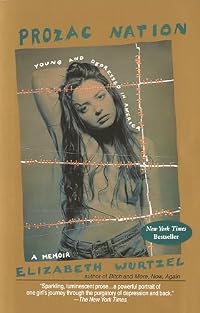
I was eager to read Bitch after having read Prozac Nation years before. I was sorely disappointed. Wurtzel rants and expounds on various maligned women throughout history. Her rambling can be hard to follow and I soon lost interest. This book had a lot of potential but Wurtzel just wasn't able to deliver.
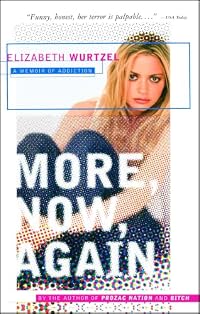
I later read her memoir of drug addiction and recovery, More, Now, and Again which explained Bitch's dismal failure. It turns out that during the time Wurtzel was writing Bitch she was heavily using a myriad of drugs.
I suggest reading Prozac Nation and More, Now and Again and skipping Bitch. Read Manifesta and Grassroots for a modern perspective on feminism.
I later read her memoir of drug addiction and recovery, More, Now, and Again which explained Bitch's dismal failure. It turns out that during the time Wurtzel was writing Bitch she was heavily using a myriad of drugs.
I suggest reading Prozac Nation and More, Now and Again and skipping Bitch. Read Manifesta and Grassroots for a modern perspective on feminism.
This is another terrible book about women who are supposedly bad ass. I'm not interested in books like this. But what really floored me was in another book or article that she wrote when she was talking about this book, she admits that she actually paid a graduate student $24.00 an hour to go to the library and research these various women for her. Then she wrote the book out of those notes. This reminds me of a student hiring someone to write her research paper and then wanting to be a brilliant writer. The least she could have done was stuck with the successful formula of the original book, Prozac Nation. It would have been better for her to just talk about herself, no matter how painful that was then to write this book. When you're show more talking about difficult women, you're not talking about any form of courageousness, you're just talking about angry people who try to upset the Peace of Mind of other people because they feel that the world owes them something. You might as well call this book in Praise of Dysfunctional Women. show less
Members
- Recently Added By
Lists

Best Feminist Literature
188 works; 26 members

Books Featured on Gilmore Girls
307 works; 21 members

Books mentioned in bell hooks' All About Love
70 works; 1 member

The Complete Rory Gilmore Reading List
506 works; 5 members
Author Information

Elizabeth Wurtzel is the bestselling author of Prozac Nation and Bitch. After graduating from Harvard College, she was the popular music critic for The New Yorker and New York magazine. Her articles have also appeared in Glamour, Mademoiselle, Mirabella, Seventeen, and the Oxford American. She lives in New York City. (Bowker Author Biography) show more Elizabeth Wurtzel was the bestselling author of Prozac Nation and Bitch. After graduating from Harvard College, she was the popular music critic for The New Yorker and New York magazine. Her articles have also appeared in Glamour, Mademoiselle, Mirabella, Seventeen, and the Oxford American. She chronicled her struggle with depression and drug addiction in best-selling memoirs that helped spur a boom in confessional writing, turning her into a Gen X celebrity at 26. She struggled with breast cancer in 2015 and underwent a double mastectomy, but the breast cancer had metastasized to her brain. Elizabeth Wurtzel passed away on January 7, 2020 at the age of 52. (Bowker Author Biography) show less
Some Editions
Work Relationships
Is a commentary on the text of
Common Knowledge
- Canonical title
- Bitch: In Praise of Difficult Women
- Alternate titles
- Bitch
- Original publication date
- 1998
- Epigraph
- Down with a world in which the guarantee that we will not die of starvation has been purchased with the guarantee that we will die of boredom.
–Situationist graffiti
Paris 1968 - Dedication
- For Betsy Lerner and Lydia Wills, without whom . . .
- First words
- In the November 1996 issue of Allure, editor-in-chief Linda Wells writes a column about how she wants to be dark and bad.
- Quotations
- It seems like, all this, all these years of feminism, Mary Wollstonecraft, Charlotte Perkins Gilman, Simone de Beauvoir, Virginia Woolf, Gloria Steinem, Susan Faludi—all that smart writing all so we could learn to behave? B... (show all)ra-burning in Atlantic City—so we could learn to behave? Roe v. Wade—so we could learn to behave? Thelma & Louise—so we could learn to behave? The gender gap—so we could learn to behave? Madonna, Sally Ride, Joycelyn Elders, Golda Meir, Anita Hill, Bette Davis, Leni Riefenstahl—all those strong indefatigable souls so we could learn to behave?
The power you have as a girl at eleven is to make men uncomfortable; it is not yet to make them feel good.
[...] in Vladimir Nabokov's novel she is actually rather vile, obnoxious, not in the least bit seductive. She chews on gum with bovine vigor and blows enormous pink bubbles that pop into sticky puddles across her face. She pr... (show all)efers her sleeve to napkins and tissues. Her nail polish is always chipped. She may be the subject of blue movies, but Nabokov's Lolita is green, still picking at earwax in public, an unwashed phenomenon.
This is the story of a girl who pretty much just wants what boys are guaranteed as their birthright—to go out there and hunt and make claims and take lovers and take chances and take in and take off and take out and say gim... (show all)me gimme gimme and never once be told that a lady must wait and all that stuff.
Beauty is so powerful to us that we forget that it is only what it is, it is its own closed system, open it up and it contains nothing, it signifies nothing and it implies nothing other than the premium of pleasure that beaut... (show all)y itself provides: it does not bestow goodness or braininess or anything more, and yet the omnipotence of beauty by itself is enough to make it perhaps the most desirable asset in God's creation.
People liked Steinem because she was pretty and disliked Friedan because she was so damn froglike, which is just fine by me: given the choice between someone aesthetically pleasing and someone else whose appearance is somewhe... (show all)re short of offensive, I will always take the former.
People romanticize insanity because they believe it is the thing behind the art; in fact, it is the thing in front of the art, the roadblock and police barrier and phantom tollbooth that you are pushing against.
And the photography and artwork that portray and celebrate depression not only fail to enlighten us about the emotional illness of the ravishing subject—if anything, they make us appreciate it too much, enjoying the ... (show all)aesthetics rather than aiding with an antidote—but also fail to increase our generosity toward the majority of the mentally ill people whose pain is not so pretty. - Last words
- (Click to show. Warning: May contain spoilers.)How I would love to be that woman.
- Blurbers
- Showalter, Elaine
- Original language
- English US
Classifications
- Genres
- Sexuality and Gender Studies, Nonfiction, General Nonfiction, Biography & Memoir, History
- DDC/MDS
- 920.72 — History & geography Biographies, Genealogy, Healdry Biographies Famous People of Native Nations Women
- LCC
- HQ1123 .W87 — Social sciences The family. Marriage, Women and Sexuality The Family. Marriage. Women Women. Feminism
- BISAC
Statistics
- Members
- 1,384
- Popularity
- 17,048
- Reviews
- 16
- Rating
- (3.25)
- Languages
- 6 — Dutch, English, German, Norwegian (Bokmål), Norwegian, Swedish
- Media
- Paper, Ebook
- ISBNs
- 12
- ASINs
- 4