On This Page
Description
The third thrilling book in the stunning Predator Cities series! The mighty engines of Anchorage have been rusted and dead for years. The derelict city no longer roams the Ice Wastes, but has settled on the edge of the land that was once America. Tom Natsworthy and Hester Shaw are happy in the safety of a static settlement, but their daughter, Wren, is desperate for adventure. When a dangerously charming submarine pirate offers her a chance to escape, Wren doesn't think twice about leaving show more her home and her parents behind. But the pirate wants something in return—Wren must steal the mysterious Tin Book. To do so will ignite a conflict that could tear the whole world apart.. show less
Tags
Recommendations




















Member Reviews
Well. That was really excellent.
The Hungry City Chronicles has been quite good so far. I had quibbles, especially in the character development department, but overall the first two installments were quite excellent. But I kind of wished I'd found the series when I was in late middle or high school, when I was more in line with the targeted age bracket. The first two books were exactly the kind of books I would have adored as a teenager.
Infernal Devices is the first book in the series that has really escaped the YA bounds, I think. There's still plenty of the YA footprint all over it, don't get me wrong. There's a teenage protagonist and a matching teenage love interest. But Infernal Devices is also a much more mature book. In large part show more this is because there’s a fifteen year time jump between the last book and this one, and as a result, our heroes Tom and Hester are older adults instead of teenagers. Because YA tends to feature teenage protagonists (people like to read about characters who are the same age as them), YA tends to very heavily be about people making momentous decisions: who to fall in love with, whether to lead a revolution to destroy [insert-generic-dystopia-here], and so on. Very rarely does YA dwell on the long-term consequences of those momentous decisions. But thanks to the time jump, a great deal of Infernal Devices is about Tom and Hester separately dwelling on the past choices that led them to where they've ended up, and whether they regret those choices in the end. That's a fascinating choice from a writing perspective, and it's fascinating to read.
The reason why I still read YA (beyond enjoying fluffy trash because it's fun to hate on) is because I'm looking for books like Infernal Devices that are more than "just" YA. I'm looking for books that might be aimed at a particular age demographic but are still timeless stories that don't have an age limit on enjoyment and appreciation.
And you know what? I still think I would have loved Infernal Devices if I'd read it at age fifteen. But I think I'd love it exactly as much as I love it now, reading it for the first time at age twenty-four. show less
The Hungry City Chronicles has been quite good so far. I had quibbles, especially in the character development department, but overall the first two installments were quite excellent. But I kind of wished I'd found the series when I was in late middle or high school, when I was more in line with the targeted age bracket. The first two books were exactly the kind of books I would have adored as a teenager.
Infernal Devices is the first book in the series that has really escaped the YA bounds, I think. There's still plenty of the YA footprint all over it, don't get me wrong. There's a teenage protagonist and a matching teenage love interest. But Infernal Devices is also a much more mature book. In large part show more this is because there’s a fifteen year time jump between the last book and this one, and as a result, our heroes Tom and Hester are older adults instead of teenagers. Because YA tends to feature teenage protagonists (people like to read about characters who are the same age as them), YA tends to very heavily be about people making momentous decisions: who to fall in love with, whether to lead a revolution to destroy [insert-generic-dystopia-here], and so on. Very rarely does YA dwell on the long-term consequences of those momentous decisions. But thanks to the time jump, a great deal of Infernal Devices is about Tom and Hester separately dwelling on the past choices that led them to where they've ended up, and whether they regret those choices in the end. That's a fascinating choice from a writing perspective, and it's fascinating to read.
The reason why I still read YA (beyond enjoying fluffy trash because it's fun to hate on) is because I'm looking for books like Infernal Devices that are more than "just" YA. I'm looking for books that might be aimed at a particular age demographic but are still timeless stories that don't have an age limit on enjoyment and appreciation.
And you know what? I still think I would have loved Infernal Devices if I'd read it at age fifteen. But I think I'd love it exactly as much as I love it now, reading it for the first time at age twenty-four. show less
I really wish this had been better. "Mortal Engines" is one of my favorite sci-fi books, and even the sequel was pretty dang good! But this one just...lacks. In a lot of places.
Reeve's writing itself is still super readable and interesting, a lovely blend of storytelling-like narration and vivid descriptions. I love the cities and towns he creates! The world of Mortal Engines is easy to get lost in, and he has managed to keep things feeling fresh throughout three books.
I also really enjoyed the time jump and getting to know Wren. I was a bit hesitant when I saw that this book was 17 years after the events of "Predator's Gold" but Reeve transitioned to this story almost seamlessly. Wren, while a tad underdeveloped, is an interesting show more character and I liked the generational leap.
Unfortunately, the plot itself wasn't very good. It felt a bit rehashed, like the first book with a bunch of bits and pieces rearranged and a new setting. I also have to admit that I'm 100% DONE with Pennyroyal's reoccurring appearance. He's predictable. He's blustering. He was fine originally, but I wish we could have gotten much less of him. I don't usually mind reoccurring characters, like Shrike, but because Pennyroyal is so predictable it makes the book that way, too.
One of the biggest problems with this book is Hester's characterization. The whole book she is angry, violent, childish, and lacked any sort of development. She seems almost jealous of Wren, and says several times that she wishes Wren would have never been born or that she is glad Wren got kidnapped. I would have thought that all those years in Anchorage would have given Tom and Hester time to get to know each other even more and communicate with each other, but apparently Hester hated it there the whole time and just never said anything to Tom even after all they've been through together. :/ Everything with Hester was just disappointing in this novel.
All in all, "Infernal Devices" was fine. I liked bits of it, disliked other bits. I'm still going to read the final book because I really am invested in the series, but I'm realllllyyy hoping the last book has more of the dynamic, action-packed wonders and fun of the first couple books, with way less murderous Hester. show less
Reeve's writing itself is still super readable and interesting, a lovely blend of storytelling-like narration and vivid descriptions. I love the cities and towns he creates! The world of Mortal Engines is easy to get lost in, and he has managed to keep things feeling fresh throughout three books.
I also really enjoyed the time jump and getting to know Wren. I was a bit hesitant when I saw that this book was 17 years after the events of "Predator's Gold" but Reeve transitioned to this story almost seamlessly. Wren, while a tad underdeveloped, is an interesting show more character and I liked the generational leap.
Unfortunately, the plot itself wasn't very good. It felt a bit rehashed, like the first book with a bunch of bits and pieces rearranged and a new setting. I also have to admit that I'm 100% DONE with Pennyroyal's reoccurring appearance. He's predictable. He's blustering. He was fine originally, but I wish we could have gotten much less of him. I don't usually mind reoccurring characters, like Shrike, but because Pennyroyal is so predictable it makes the book that way, too.
One of the biggest problems with this book is Hester's characterization. The whole book she is angry, violent, childish, and lacked any sort of development. She seems almost jealous of Wren, and says several times that she wishes Wren would have never been born or that she is glad Wren got kidnapped. I would have thought that all those years in Anchorage would have given Tom and Hester time to get to know each other even more and communicate with each other, but apparently Hester hated it there the whole time and just never said anything to Tom even after all they've been through together. :/ Everything with Hester was just disappointing in this novel.
All in all, "Infernal Devices" was fine. I liked bits of it, disliked other bits. I'm still going to read the final book because I really am invested in the series, but I'm realllllyyy hoping the last book has more of the dynamic, action-packed wonders and fun of the first couple books, with way less murderous Hester. show less
Predator's Gold had a cosy and happy ending. Anchorage had escaped Arkangel and found refuge in the green parts of America, the city's ordeals were over, and Hester was pregnant with Tom's child. Terrible things had happened to Anna Fang, and there was a dark implication that war was coming to the world... but that would never trouble Anchorage, which was secret and safe.
In Infernal Devices, sixteen years have passed, and Tom and Hester's teenage daughter Wren is bored of her backwater life and aching for the same adventures her parents had. When a group of Lost Boys arrive from Grimsby, seeking the mysterious Tin Book of Anchorage, Wren is enchanted by their sense of romance and danger, and agrees to help them steal the Tin Book in show more exchange for taking her away with them. But as with any of Reeve's books, charming strangers turn out to be less altruistic than they appear, and it's not long before the blood and violence comes and Tom and Hester are drawn back across the ocean to rescue their kidnapped daughter.
The largest change here is clearly the shift from Tom and Hester to the younger generation: their daughter Wren, and the slave-boy Theo whom she later meets in captivity. Tom and Hester are still vital parts of the book (and Hester's character arc is still the most important one) but it still feels something of a shame; Wren is cut from Tom's mould, a naive character swept up in events beyond her, and Theo is not particularly interesting either. There are two major characters from previous books returning, however, to make up for this. Shrike is found and resurrected in the opening chapter, raised from the grave he was left in on the Black Island in Mortal Engines and turned by the Green Storm towards a hidden agenda; and Pennyroyal also returns, not having been punished by the gods for his actions in Predator's Gold, but rather having risen to a position of weath, power and luxury. (Speaking of antagonists, Infernal Devices' villain of the day is probably the weakest of the series; Nabisco Shkin, a stereotypical cold and cruel slave trader, not as interesting as the megalomaniacal Magnus Crome or the tragic hero Valentine or the pampered show-off Masgard or the dashing yet fascist Wolf von Kobold, from A Darkling Plain).
The first half of the book starts off slowly, as though Reeve himself was having trouble adjusting to the sudden chronological jump. There's a lot of shuttling back and forth in limpet subs, and we revisit both the sunken city of Grimsby and Caul's story arc from Predator's Gold; both of which I felt were covered fairly well in the second book and didn't need to be repeated. Infernal Devices hits its stride in the second half, as Tom and Hester arrive in the floating pleasure resort of Brighton, where Wren has been sold into slavery. The Green Storm's assault on the city at the climax of the novel is probably one of the high points of the entire series, sparkling with spectacular imagery as chaos and violence erupts in, around and above Brighton. Featuring airships, fighter planes, cyborg troops, a floating palace under attack, a slave revolt, and several characters running about in the chaos trying to accomplish their own ends, Reeve very successfully brings the big-screen mayhem of a battle to life on the pages. It is awesome, in both the contemporary and the old-fashioned sense of the word.
Not wanting to be caught up in the stampede, Theo pushed Wren into the shelter of one of Pennyroyal's abstract statues. They huddled together and watched moon-lit exhaust trails billow in the sky around Cloud 9 like skeins of spider-silk as the Flying Ferrets buzzed and tumbled, hurling themselves at the Storm's airships. It was as if each ship had a seed of fire inside it, and the Flying Ferrets were patiently probing for it with streams of incendiary bullets. When they found it the airship would begin to glow from inside like a MoonFest lantern, then blinding patterns of light would chequer the envelope, and finally the whole thing would become a dazzling pyre, casting eerie shadows from the cypress groves as the wind carried it past Cloud 9.
But the airships were fighting back, and so were the clouds of Resurrected eagles and condors which flew with them. The birds descended in flapping black clouds upon the Ferrets' flying machines, slashing at the wings and rigging and the unprotected pilots, and as the Ferrets struggled to evade them they made easy targets for the airships' rocket and machine-cannon. Wings were shredded, fuel tanks blew apart, rotor-blades came flipping and fluttering across the Pavilion's lawns like bits of an exploding venetian blind. The Bad Hair Day, its wings ripped off, plunged burning into the cable-car station. The Group Captain Mandrake veered sideways into the Wrestling Cheese and both machines crashed together through the flank of a Green Storm destroyer and went down with it, a vast barrel of fire sinking gracefully towards the sea.
Against the backdrop of this greater violence is Hester's own developing bloodlust, as she raids the Shkin corporation's headquarters and cuts down those who stand in her way with a passion. At first others begin to question it...
"I'm sure Hester only did what she had to," said Tom, a little uneasily, because he wasn't sure of that at all.
... and are later appalled by it:
"You enjoy it," he said. "Don't you? Like when you killed all those people at Shkin's place, you were enjoying it..."
Hester said, "They were slavers, Tom. They were villains. They were the ones who sold Wren. They sold our little girl. The world's a better place without them in it."
"But..."
She shook her head and gave a cry of frustration. Why could he not understand? "Look," she said, "we're just little people, aren't we? Little small people, trying to live our lives, but always at the mercy of men like Uncle and Shkin and Masgard and Pennyroyal and... and Valentine. So yes. It feels good to be as strong as them; it feels good to fight back, and even things up a bit."
Tom said nothing. By the light of the instrument panels she could see a fresh bruise forming on his head where it had struck the chart table. "Poor Tom," she said, leaning over to kiss it, but he twitched away again, staring at the fuel gauges.
Unlike most children's fiction, Reeve's world is morally grey, and no characters are all good or all bad. Despite Hester's terrible attributes, she still has good in her, and the reader sympathises with her. Even Tom, when he meets Pennyroyal again, is somewhat capable of hate and anger. And it's hard to tell what to make of Pennyroyal himself: a liar, thief, scoundrel and general selfish bastard, who still manages to seem charming and vaguely likeable, even to the reader. Indeed, at the climax of the novel, he helps the characters escape his burning city alongside him. There's a character inthe film The Mummy called Benny, who is a snivelling weasel of long acquaintance with Brendan Fraser's protagonist, and who sells him out at every opportunity and aligns himself with the evil mummy. And yet when they're all fleeing the City of the Dead at the end, and are escaping from the ol' descending-roof trick, Brendan Fraser still sticks a hand out and tries to save him. Not because he's better than Benny, or has forgiven him, but because they've been through so much crazy shit together that they still have a sort of ill-defined camraderie. That, in a way, is Pennyroyal.
I mentioned in my review of Predator's Gold that the actions of the characters have much wider and more complex repercussions than in most young adult fiction, or indeed any fantasy, sci-fi or adventure novels. That's apparent even more in Infernal Devices, particularly with regards to Hester and the Lost Boy named Fishcake. While much of what happens in the novel revolves around the MacGuffin of the Tin Book, more subtle chains of cause and effect are unfolding in the background. Hester's betrayal of Anchorage to the Huntsmen, which seemed so neatly resolved in Predator's Gold when she told Freya, becomes very important towards the climax of Infernal Devices.
When I began this re-read I was particularly interested to see what I would make of the second two books. The series can be easily divided into two halves, one with a young Tom and Hester deeply in love, and one with an old Tom and Hester who have a kid and a marriage built on routine. There is a part of me that wishes we had five or ten books of Tom and Hester in their early twenties, flying around the world getting into adventures on the Jenny Haniver. But Reeve, to his credit, is not interested in pumping out colour-by-number adventure books. He's interested in writing rich, detailed and exciting adventure books, which also explore deeper themes and have excellent characterisation. There is a faint sense that something has been lost - that if he was going to pass the torch to a new generation of characters, he could have made them as interesting as Hester - but Hester is still there, and still wonderful, and one fascinating character is more than most young adult books can offer. Infernal Devices is yet another beautiful entry in my favourite adventure series of all time.
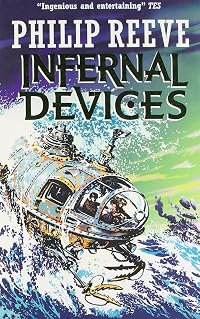
(And I particularly love the cover for this one, with Tom and Hester flailing at the controls of a submarine. HOW DO YA WORK THIS CRAZY THING?!) show less
In Infernal Devices, sixteen years have passed, and Tom and Hester's teenage daughter Wren is bored of her backwater life and aching for the same adventures her parents had. When a group of Lost Boys arrive from Grimsby, seeking the mysterious Tin Book of Anchorage, Wren is enchanted by their sense of romance and danger, and agrees to help them steal the Tin Book in show more exchange for taking her away with them. But as with any of Reeve's books, charming strangers turn out to be less altruistic than they appear, and it's not long before the blood and violence comes and Tom and Hester are drawn back across the ocean to rescue their kidnapped daughter.
The largest change here is clearly the shift from Tom and Hester to the younger generation: their daughter Wren, and the slave-boy Theo whom she later meets in captivity. Tom and Hester are still vital parts of the book (and Hester's character arc is still the most important one) but it still feels something of a shame; Wren is cut from Tom's mould, a naive character swept up in events beyond her, and Theo is not particularly interesting either. There are two major characters from previous books returning, however, to make up for this. Shrike is found and resurrected in the opening chapter, raised from the grave he was left in on the Black Island in Mortal Engines and turned by the Green Storm towards a hidden agenda; and Pennyroyal also returns, not having been punished by the gods for his actions in Predator's Gold, but rather having risen to a position of weath, power and luxury. (Speaking of antagonists, Infernal Devices' villain of the day is probably the weakest of the series; Nabisco Shkin, a stereotypical cold and cruel slave trader, not as interesting as the megalomaniacal Magnus Crome or the tragic hero Valentine or the pampered show-off Masgard or the dashing yet fascist Wolf von Kobold, from A Darkling Plain).
The first half of the book starts off slowly, as though Reeve himself was having trouble adjusting to the sudden chronological jump. There's a lot of shuttling back and forth in limpet subs, and we revisit both the sunken city of Grimsby and Caul's story arc from Predator's Gold; both of which I felt were covered fairly well in the second book and didn't need to be repeated. Infernal Devices hits its stride in the second half, as Tom and Hester arrive in the floating pleasure resort of Brighton, where Wren has been sold into slavery. The Green Storm's assault on the city at the climax of the novel is probably one of the high points of the entire series, sparkling with spectacular imagery as chaos and violence erupts in, around and above Brighton. Featuring airships, fighter planes, cyborg troops, a floating palace under attack, a slave revolt, and several characters running about in the chaos trying to accomplish their own ends, Reeve very successfully brings the big-screen mayhem of a battle to life on the pages. It is awesome, in both the contemporary and the old-fashioned sense of the word.
Not wanting to be caught up in the stampede, Theo pushed Wren into the shelter of one of Pennyroyal's abstract statues. They huddled together and watched moon-lit exhaust trails billow in the sky around Cloud 9 like skeins of spider-silk as the Flying Ferrets buzzed and tumbled, hurling themselves at the Storm's airships. It was as if each ship had a seed of fire inside it, and the Flying Ferrets were patiently probing for it with streams of incendiary bullets. When they found it the airship would begin to glow from inside like a MoonFest lantern, then blinding patterns of light would chequer the envelope, and finally the whole thing would become a dazzling pyre, casting eerie shadows from the cypress groves as the wind carried it past Cloud 9.
But the airships were fighting back, and so were the clouds of Resurrected eagles and condors which flew with them. The birds descended in flapping black clouds upon the Ferrets' flying machines, slashing at the wings and rigging and the unprotected pilots, and as the Ferrets struggled to evade them they made easy targets for the airships' rocket and machine-cannon. Wings were shredded, fuel tanks blew apart, rotor-blades came flipping and fluttering across the Pavilion's lawns like bits of an exploding venetian blind. The Bad Hair Day, its wings ripped off, plunged burning into the cable-car station. The Group Captain Mandrake veered sideways into the Wrestling Cheese and both machines crashed together through the flank of a Green Storm destroyer and went down with it, a vast barrel of fire sinking gracefully towards the sea.
Against the backdrop of this greater violence is Hester's own developing bloodlust, as she raids the Shkin corporation's headquarters and cuts down those who stand in her way with a passion. At first others begin to question it...
"I'm sure Hester only did what she had to," said Tom, a little uneasily, because he wasn't sure of that at all.
... and are later appalled by it:
"You enjoy it," he said. "Don't you? Like when you killed all those people at Shkin's place, you were enjoying it..."
Hester said, "They were slavers, Tom. They were villains. They were the ones who sold Wren. They sold our little girl. The world's a better place without them in it."
"But..."
She shook her head and gave a cry of frustration. Why could he not understand? "Look," she said, "we're just little people, aren't we? Little small people, trying to live our lives, but always at the mercy of men like Uncle and Shkin and Masgard and Pennyroyal and... and Valentine. So yes. It feels good to be as strong as them; it feels good to fight back, and even things up a bit."
Tom said nothing. By the light of the instrument panels she could see a fresh bruise forming on his head where it had struck the chart table. "Poor Tom," she said, leaning over to kiss it, but he twitched away again, staring at the fuel gauges.
Unlike most children's fiction, Reeve's world is morally grey, and no characters are all good or all bad. Despite Hester's terrible attributes, she still has good in her, and the reader sympathises with her. Even Tom, when he meets Pennyroyal again, is somewhat capable of hate and anger. And it's hard to tell what to make of Pennyroyal himself: a liar, thief, scoundrel and general selfish bastard, who still manages to seem charming and vaguely likeable, even to the reader. Indeed, at the climax of the novel, he helps the characters escape his burning city alongside him. There's a character inthe film The Mummy called Benny, who is a snivelling weasel of long acquaintance with Brendan Fraser's protagonist, and who sells him out at every opportunity and aligns himself with the evil mummy. And yet when they're all fleeing the City of the Dead at the end, and are escaping from the ol' descending-roof trick, Brendan Fraser still sticks a hand out and tries to save him. Not because he's better than Benny, or has forgiven him, but because they've been through so much crazy shit together that they still have a sort of ill-defined camraderie. That, in a way, is Pennyroyal.
I mentioned in my review of Predator's Gold that the actions of the characters have much wider and more complex repercussions than in most young adult fiction, or indeed any fantasy, sci-fi or adventure novels. That's apparent even more in Infernal Devices, particularly with regards to Hester and the Lost Boy named Fishcake. While much of what happens in the novel revolves around the MacGuffin of the Tin Book, more subtle chains of cause and effect are unfolding in the background. Hester's betrayal of Anchorage to the Huntsmen, which seemed so neatly resolved in Predator's Gold when she told Freya, becomes very important towards the climax of Infernal Devices.
When I began this re-read I was particularly interested to see what I would make of the second two books. The series can be easily divided into two halves, one with a young Tom and Hester deeply in love, and one with an old Tom and Hester who have a kid and a marriage built on routine. There is a part of me that wishes we had five or ten books of Tom and Hester in their early twenties, flying around the world getting into adventures on the Jenny Haniver. But Reeve, to his credit, is not interested in pumping out colour-by-number adventure books. He's interested in writing rich, detailed and exciting adventure books, which also explore deeper themes and have excellent characterisation. There is a faint sense that something has been lost - that if he was going to pass the torch to a new generation of characters, he could have made them as interesting as Hester - but Hester is still there, and still wonderful, and one fascinating character is more than most young adult books can offer. Infernal Devices is yet another beautiful entry in my favourite adventure series of all time.
(And I particularly love the cover for this one, with Tom and Hester flailing at the controls of a submarine. HOW DO YA WORK THIS CRAZY THING?!) show less
I'm feeling some frustration with this series. I should say first that Reeve's imaginative worldbuilding and fearless plotting and characterization are a joy; his books are gloriously unsentimental, and I put this book down thinking "damn: here is an author with the courage of his convictions." His characters are compelling but barely likeable.
MILD SPOILERS FOLLOW.
At the same time, I was hoping to see some growth. Hester is just as bitter, needy, and violent as she was fifteen years ago, and Tom has become, if anything, more vague and ineffectual. I'm not saying I needed to see Hester softened by love and motherhood, but she hasn't gained any wisdom with age, and it's hard to see her tear everything around her apart.
When she thought to show more herself at the end of Predator's Gold that she was her father's daughter - evil, and violent - I'd hoped that she would, at least, use her brutality to protect her loved ones, and perhaps lay it aside some day. I'd also hoped that she was acknowledging her own darker urges, but not necessarily assuming it was the ultimate truth about herself. Now, I wonder.
It's frustrating to spend time with characters who have so little wisdom and self-knowledge, and Tom's just as bad as Hester. If he could have half her resolution and unflinching powers of assessment, and if she could have half his tender-heartedness and empathy, we might get somewhere. It doesn't feel like they've grown up at all. Supporting characters are even more two-dimensional - Pennyroyal's back, and he and his wife Boo-Boo, etc. etc. are still silly and annoying. On the other hand, subplots around the Lost Boys and the Striker Fang have suspense and texture.
Infernal Devices has a surprising and extreme ending - epic stuff, with more shattering cities and burning heavens but also equally extreme changes for Tom and Hester. As much as I feel like kicking them both, I am definitely pursuing them and their resilient Stalker foils into the next book.
(N.B.: I felt very silly that I'd called Grike "Shrike" in my earlier review, but I see it depends on which edition you read, the European or American; isn't that odd?) show less
MILD SPOILERS FOLLOW.
At the same time, I was hoping to see some growth. Hester is just as bitter, needy, and violent as she was fifteen years ago, and Tom has become, if anything, more vague and ineffectual. I'm not saying I needed to see Hester softened by love and motherhood, but she hasn't gained any wisdom with age, and it's hard to see her tear everything around her apart.
When she thought to show more herself at the end of Predator's Gold that she was her father's daughter - evil, and violent - I'd hoped that she would, at least, use her brutality to protect her loved ones, and perhaps lay it aside some day. I'd also hoped that she was acknowledging her own darker urges, but not necessarily assuming it was the ultimate truth about herself. Now, I wonder.
It's frustrating to spend time with characters who have so little wisdom and self-knowledge, and Tom's just as bad as Hester. If he could have half her resolution and unflinching powers of assessment, and if she could have half his tender-heartedness and empathy, we might get somewhere. It doesn't feel like they've grown up at all. Supporting characters are even more two-dimensional - Pennyroyal's back, and he and his wife Boo-Boo, etc. etc. are still silly and annoying. On the other hand, subplots around the Lost Boys and the Striker Fang have suspense and texture.
Infernal Devices has a surprising and extreme ending - epic stuff, with more shattering cities and burning heavens but also equally extreme changes for Tom and Hester. As much as I feel like kicking them both, I am definitely pursuing them and their resilient Stalker foils into the next book.
(N.B.: I felt very silly that I'd called Grike "Shrike" in my earlier review, but I see it depends on which edition you read, the European or American; isn't that odd?) show less
Book 3 of this series (which appears to have multiple names on LT and everywhere else--Traction Cities, Hungry City Chronicles, etc.). It's been fifteen years since the end of the last one and Hester and Tom's child, Wren, is growing up and bored to death. Well, you guessed it, she finds adventure, a lot more adventure than she bargained for. Green Storm and the Anti-Traction movement and the Traction Cities are all fighting like mad and she gets caught up. Mom and Dad set out to rescue her, but things get twisty and a secret comes out. And that's all I can say without spoiling. This is a very good series - somewhere between YA and adult in my view, rich in complex characters especially, plenty of humor, violence but not egregious show more violence and a sturdy plot. **** show less
Anchorage, the once-glorious ice city, has become a static and its inhabitants have settled into their peaceful lives on the shores of Vineland in the Dead Continent of America. Tom and Hester have raised a daughter, Wren, who at fifteen is desperate to escape the boredom and dull routine and dreams of having adventures of her own. But when she is kidnapped and eventually sold as a slave, Wren realises that having adventures is not all it’s cracked up to be.
Set sixteen years after the events in Predator’s Gold, the fantasy epic continues, this time with Tom and Hester’s daughter Wren the focus of the narrative. Slower in pace and not as tightly plotted as the previous two volumes, it feels at times like a filler book to prepare show more for the finale in A Darkling Plain, though the overarching narrative still manages to draw in the reader with its inventiveness, colourful and morally ambivalent characterisations and atmospheric set pieces, and explores the notion that in war there are no winners, only losers. show less
Set sixteen years after the events in Predator’s Gold, the fantasy epic continues, this time with Tom and Hester’s daughter Wren the focus of the narrative. Slower in pace and not as tightly plotted as the previous two volumes, it feels at times like a filler book to prepare show more for the finale in A Darkling Plain, though the overarching narrative still manages to draw in the reader with its inventiveness, colourful and morally ambivalent characterisations and atmospheric set pieces, and explores the notion that in war there are no winners, only losers. show less
Infernal Devices and A Darkling Plain seem like two parts of one story, less stand along than either Mortal Engines or Predator's Gold. I struggled with the Hester/Wren relationship, too often it seemed combative primarily as a plot device with Hester's personality being flattened to a single dimension before being puffed back to life as soon as she didn't need to be the unfeeling mother anymore.
Still, every book brings a new aspect of the world to life and this is no different. I may roll my eyes at some characterizations, but keep coming back for the world-building.
Still, every book brings a new aspect of the world to life and this is no different. I may roll my eyes at some characterizations, but keep coming back for the world-building.
Members
- Recently Added By
Lists

Best Dystopias
280 works; 276 members

Favourite Steampunk Books
80 works; 16 members

An End of the World Reading List
63 works; 4 members

Favourite Books
1,819 works; 316 members

Best Post-Apocalyptic Stories
143 works; 88 members

Best Science Fiction Novels
816 works; 430 members

Favourite Science Fiction Books of the 21st Century
47 works; 8 members

Books Read in 2019
4,052 works; 108 members

Library Fantasy/Science Fiction
159 works; 2 members
Author Information

102+ Works 16,786 Members
Philip Reeve was born in Brighton, England, and worked in a bookshop for many years before breaking out and becoming the illustrator of children's book He has also produced and directed several no-budget theater productions, and cowrote a musical, The Ministry of Biscuits. Mr. Reeve and his wife and son now live in a hamlet high above the moorland show more in Devon, England show less
Some Editions
Awards and Honors
Awards
Series

Work Relationships
Common Knowledge
- Canonical title
- Infernal Devices
- Original title
- Infernal Devices
- Original publication date
- 2005
- People/Characters
- Tom Natsworthy; Hester Natsworthy; Wren Natsworthy; Nimrod Pennyroyal; Boo-Boo Pennyroyal; Theo Ngoni (show all 18); Oenone Zero; Stalker Fang; Shrike; Freya Rasmussen; Caul; Gargle; Remona; Fishcake; Uncle; Dr Popjoy; Nabisco Shkin; Monica Weems
- Important places
- Anchorage-in-Vineland (static city); Brighton (raft city); Grimsby (underwater city)
- Dedication
- For Sarah,
as always,
For my editors, Kirsten Stansfield
and Holly Skeet,
with thanks,
And for
Sam Reeve, Tom Skeet and
Edward Stansfield,
one day. - First words
- At first there was nothing. Then came a spark; a sizzling sound that stirred frayed webs of dream and memory.
- Last words
- (Click to show. Warning: May contain spoilers.)And in the silence, before the scavenger towns came roaring in to gobble up the wreckage, the Stalker Shrike stood up and lifted Hester in his arms, and walked away with her into the desert, and the dark.
- Publisher's editor
- Stansfield, Kirsten; Skeet, Holly
- Original language
- English UK
Classifications
Statistics
- Members
- 1,570
- Popularity
- 14,524
- Reviews
- 21
- Rating
- (3.88)
- Languages
- 13 — Danish, Dutch, English, Estonian, Finnish, French, German, Italian, Lithuanian, Portuguese, Spanish, Swedish, Turkish
- Media
- Paper, Audiobook, Ebook
- ISBNs
- 55
- ASINs
- 11