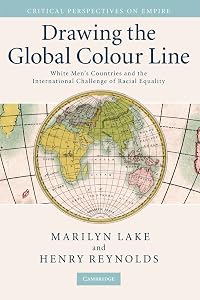
Drawing the Global Colour Line: White Men's Countries and the International Challenge of Racial Equality
by Marilyn Lake, Henry Reynolds
Critical Perspectives on Empire
On This Page
Description
In 1900 W. E. B. DuBois prophesied that the colour line would be the key problem of the twentieth-century and he later identified one of its key dynamics: the new religion of whiteness that was sweeping the world. Whereas most historians have confined their studies of race-relations to a national framework, this book studies the transnational circulation of people and ideas, racial knowledge and technologies that under-pinned the construction of self-styled white men's countries from South show more Africa, to North America and Australasia. Marilyn Lake and Henry Reynolds show how in the late nineteenth century and early twentieth century these countries worked in solidarity to exclude those they defined as not-white, actions that provoked a long international struggle for racial equality. Their findings make clear the centrality of struggles around mobility and sovereignty to modern formulations of both race and human rights. show lessTags
Recommendations











Member Reviews
Taken from http://shawjonathan.wordpress.com/2009/11/23/drawing-the-global-colour-line/
This book starts brilliantly, quoting W E B DuBois's 1910 essay, 'The Souls of White Folk':
' the discovery of personal whiteness among the world's peoples is a very modern thing – a nineteenth and twentieth century matter indeed. ... What is whiteness that one should so desire it? ... Whiteness is the ownership of the earth forever and ever, Amen.'
The historical narrative starts with the arrival of an entrepreneurial Chinese man in Melbourne in 1855, two years after the discovery of gold, and ranges around Australia, New Zealand, South Africa, California, British Columbia, tracing the progress of the ideal of 'white men's countries', and along with show more it the betrayal of promises made by the British Empire and US to their non-Anglo-Saxon subjects and citizens.
It's a hard read, especially in the first two sections – 'Discursive frameworks' and 'Transnational solidarities' – where public intellectuals of more than a hundred years ago solemnly put forward blatantly racist propositions that are still awfully familiar, but with very little of the dog-whistling, denial and misdirection we're used to these days, and then democracy-loving politicians proceed to build on each other's successes in excluding and disenfranchising anyone who is classified as not white. We have our noses rubbed in the arrogant and repulsive racist atmosphere in which the Australian Commonwealth and the Union of South Africa were founded and first California and then the rest of the US chose 'racial solidarity' even with recent bitter enemies and legislated to keep Asian, particularly Japanese, immigrants away from their shores.
In some ways it's like a horror story, a sort of "I know what you did last century". The scientific consensus reached in the 1940s, that 'race' was 'not so much a biological phenomenon as a social myth, which had "created an enormous amount of damage, taking a heavy toll in human lives causing intolerable suffering",'* followed by the UN's Universal Declaration of Human Rights in 1948, amounts to the moment where we wake up and discover it was all a terrible dream ... or was it? That moment is followed by a long tail, in which the 'white men's countries' one by one open their doors and legislate against racial discrimination, until 'Nelson Mandela and the African National Congress sweep into power and dismantle the last bastion of white supremacy.'
The book marshalls a vast amount of material, and it has hugely enriched my understanding of the White Australia Policy, among other things, but the prose is very heavy going, and the authors are often absent except as very competent and passionate compilers of evidence. This may well be necessary when there is such a complex field to cover, but it doesn't make for literary excellence.
The chapter on the Paris Peace Conference of 1919 is a rich exception. The Australian Prime Minister, W M Hughes, emerges there as a lively fall-guy cum villain: he vociferous opposes the Japanese delegation's diplomatic, courteous and eminently rational push to include a paragraph on racial equality in the covenant of the League of Nations. The other white leaders, who generally despise the uncouth Australian, say that if it was up to them they'd include the paragraph, but you know, the Australians (who didn't actually have a seat at the table) won't stand for it ... Hughes went to the grave thinking of this as a great victory. Someone ought to make a movie of that chapter. show less
This book starts brilliantly, quoting W E B DuBois's 1910 essay, 'The Souls of White Folk':
' the discovery of personal whiteness among the world's peoples is a very modern thing – a nineteenth and twentieth century matter indeed. ... What is whiteness that one should so desire it? ... Whiteness is the ownership of the earth forever and ever, Amen.'
The historical narrative starts with the arrival of an entrepreneurial Chinese man in Melbourne in 1855, two years after the discovery of gold, and ranges around Australia, New Zealand, South Africa, California, British Columbia, tracing the progress of the ideal of 'white men's countries', and along with show more it the betrayal of promises made by the British Empire and US to their non-Anglo-Saxon subjects and citizens.
It's a hard read, especially in the first two sections – 'Discursive frameworks' and 'Transnational solidarities' – where public intellectuals of more than a hundred years ago solemnly put forward blatantly racist propositions that are still awfully familiar, but with very little of the dog-whistling, denial and misdirection we're used to these days, and then democracy-loving politicians proceed to build on each other's successes in excluding and disenfranchising anyone who is classified as not white. We have our noses rubbed in the arrogant and repulsive racist atmosphere in which the Australian Commonwealth and the Union of South Africa were founded and first California and then the rest of the US chose 'racial solidarity' even with recent bitter enemies and legislated to keep Asian, particularly Japanese, immigrants away from their shores.
In some ways it's like a horror story, a sort of "I know what you did last century". The scientific consensus reached in the 1940s, that 'race' was 'not so much a biological phenomenon as a social myth, which had "created an enormous amount of damage, taking a heavy toll in human lives causing intolerable suffering",'* followed by the UN's Universal Declaration of Human Rights in 1948, amounts to the moment where we wake up and discover it was all a terrible dream ... or was it? That moment is followed by a long tail, in which the 'white men's countries' one by one open their doors and legislate against racial discrimination, until 'Nelson Mandela and the African National Congress sweep into power and dismantle the last bastion of white supremacy.'
The book marshalls a vast amount of material, and it has hugely enriched my understanding of the White Australia Policy, among other things, but the prose is very heavy going, and the authors are often absent except as very competent and passionate compilers of evidence. This may well be necessary when there is such a complex field to cover, but it doesn't make for literary excellence.
The chapter on the Paris Peace Conference of 1919 is a rich exception. The Australian Prime Minister, W M Hughes, emerges there as a lively fall-guy cum villain: he vociferous opposes the Japanese delegation's diplomatic, courteous and eminently rational push to include a paragraph on racial equality in the covenant of the League of Nations. The other white leaders, who generally despise the uncouth Australian, say that if it was up to them they'd include the paragraph, but you know, the Australians (who didn't actually have a seat at the table) won't stand for it ... Hughes went to the grave thinking of this as a great victory. Someone ought to make a movie of that chapter. show less
Two academic experts on the plight of the Australian indigene have thrown a strong light on black/white relations.
Ratings
Members
- Recently Added By
Lists

Charleston Syllabus (waitingtoderail)
143 works; 2 members
Author Information

13 Works 195 Members
Marilyn Lake currently holds the Chair in Australian Studies at Harvard University.

27+ Works 1,104 Members
Henry Reynolds is the author of Forgotten War which made the Tasmanian Premier¿s Literary Prizes 2015 shortlists in the Tasmanian content in any genre category. (Bowker Author Biography)
Awards and Honors
Series

Common Knowledge
- Canonical title
- Drawing the Global Colour Line: White Men's Countries and the International Challenge of Racial Equality
Classifications
- Genres
- Nonfiction, Anthropology, History, General Nonfiction, Politics and Government
- DDC/MDS
- 305.8009 — Society, government, & culture Social sciences, sociology & anthropology Social group - Age, Gender, Ethnicity Ethnic and national groups standard subdivisions / Ethnic and national groups with ethnic origins from more than one continent, of European descent standard subdivisions Biography And History
- LCC
- HT1507 .L35 — Social sciences Communities. Classes. Races Communities. Classes. Races Races
- BISAC
Statistics
- Members
- 64
- Popularity
- 486,825
- Reviews
- 2
- Rating
- (3.90)
- Languages
- English
- Media
- Paper, Ebook
- ISBNs
- 8
- ASINs
- 3