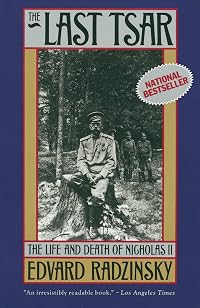
The Last Tsar: The Life and Death of Nicholas II
by Edvard Radzinsky
On This Page
Description
Biography of Tsar Nicholas II providing a portrait of the monarch and detailed account of his last days and assassination. The execution of Tsar Nicholas II and his family at the hands of revolutionaries in 1918 is one of the pivotal events of the 20th century, an event that brought the 300-year rule of the House of Romanov to a brutal and tragic end and set the tone for the Stalinist atrocities that would follow. The truth behind these murders remained long buried under more than seventy show more years of myth, legend, and speculation. Then, in a sensational biography that could not have been written before glasnost, noted Russian historian Edvard Radzinsky unearthed solutions to many of the questions that had remained unanswered since the terrible events in Ekaterinburg on the night of July 16-17, 1918. Mining sources long unavailable--including firsthand accounts of the slaying--he creates both a fascinating portrait of the monarch and a minute-by-minute account of his terrifying last days. Included is documentation linking the order of execution directly to Lenin, as well as the suggestion that two family members may have survived the ordeal. Included, too, is the testimony of ordinary Russians who at last felt free to contribute their own recollections, documents, and handed-down secrets. Radzinsky weaves together scores of firsthand accounts into a haunting, epic narrative. The Last Tsar is an important and momentous work, one that will stand as the definitive account of the terrible last days of one of Europe's greatest dynasties.--Adapted from dust jacket. show lessTags
Recommendations













Member Recommendations

Member Reviews
How do you make a story suspenseful when everyone knows how it ends? Mr. Radzinsky solved this problem in The Last Tsar by writing a historical-detective tale. The death of Russia’s last tsar, along with that of his family, is told largely through actual documents: diaries and letters of the tsar and his wife, and painstakingly uncovered reports from the Soviet archives. In addition, there are interviews with people who contacted Mr. Radzinsky after he began publishing articles in Russia about the tsar’s execution.
The Soviet state was highly secretive and paranoid, and the details of the tsar’s death had been buried. So the public record on the execution was skeletal: the world knew the family had been killed, but that was about show more it. Mr. Radzinsky builds the story slowly, so that even on the last pages of this 400-page book the reader still learns new, fascinating details.
I was intrigued with the Soviet Union when I was younger. I spent six weeks in 1979 traveling through the western part of Russia; I could speak Russian at the time. I have studied Russian and Soviet history, but my attention when I read about the Russian revolution was always on the Bolsheviks. I had never read about this event from the tsar’s point of view.
What becomes clear is that the tsar and his wife were detached from reality. They traveled between their palaces, took trips on the royal yacht, and held balls. They lived in a dream world that they thought would never end, even though the warnings couldn’t have been clearer. The French Revolution was an obvious cautionary tale, but closer to home, Nicholas’ grandfather had been assassinated in 1881, and in 1905 there was a mini-Russian revolution. But because Nicholas and Alexandra were so oblivious in their dream world, they never stopped fighting the prospect of a constitution and a constituent assembly.
The tsaritsa was the worst. All she could think of was getting her son on the throne. The disaster of her relationship with Rasputin was her desperate attempt to keep the hemophiliac heir well enough to rule one day. In addition, she wanted him to have absolute power.
When the tsar and his family were arrested and sent to Siberia (Tobolsk), it’s hard to believe how thoroughly they were abandoned. It appears that no one tried to rescue them. It also seems that they could have escaped and didn’t, in part because there was no one who cared enough about them to help, and also because the tsar felt he belonged to Russia and couldn’t leave her. Not to mention their faith: God was on their side and whatever happened was His will.
If you’re interested in details about how the tsar lived you’ll have to look elsewhere. You also won’t learn much about the Soviet revolution—other than the fascinating detail that the Bolsheviks were close to losing power in 1918; they were almost defeated in the civil war that erupted after the Revolution. The executions took place a day or two before the White Russians took the town where the royal family had been held captive.
This isn’t an easy book, but if you like history it’s definitely worth the read. show less
The Soviet state was highly secretive and paranoid, and the details of the tsar’s death had been buried. So the public record on the execution was skeletal: the world knew the family had been killed, but that was about show more it. Mr. Radzinsky builds the story slowly, so that even on the last pages of this 400-page book the reader still learns new, fascinating details.
I was intrigued with the Soviet Union when I was younger. I spent six weeks in 1979 traveling through the western part of Russia; I could speak Russian at the time. I have studied Russian and Soviet history, but my attention when I read about the Russian revolution was always on the Bolsheviks. I had never read about this event from the tsar’s point of view.
What becomes clear is that the tsar and his wife were detached from reality. They traveled between their palaces, took trips on the royal yacht, and held balls. They lived in a dream world that they thought would never end, even though the warnings couldn’t have been clearer. The French Revolution was an obvious cautionary tale, but closer to home, Nicholas’ grandfather had been assassinated in 1881, and in 1905 there was a mini-Russian revolution. But because Nicholas and Alexandra were so oblivious in their dream world, they never stopped fighting the prospect of a constitution and a constituent assembly.
The tsaritsa was the worst. All she could think of was getting her son on the throne. The disaster of her relationship with Rasputin was her desperate attempt to keep the hemophiliac heir well enough to rule one day. In addition, she wanted him to have absolute power.
When the tsar and his family were arrested and sent to Siberia (Tobolsk), it’s hard to believe how thoroughly they were abandoned. It appears that no one tried to rescue them. It also seems that they could have escaped and didn’t, in part because there was no one who cared enough about them to help, and also because the tsar felt he belonged to Russia and couldn’t leave her. Not to mention their faith: God was on their side and whatever happened was His will.
If you’re interested in details about how the tsar lived you’ll have to look elsewhere. You also won’t learn much about the Soviet revolution—other than the fascinating detail that the Bolsheviks were close to losing power in 1918; they were almost defeated in the civil war that erupted after the Revolution. The executions took place a day or two before the White Russians took the town where the royal family had been held captive.
This isn’t an easy book, but if you like history it’s definitely worth the read. show less
This book was a much a memoir of the author as it was a biography of Tsar Nicholas II of Russia. Written shortly after the fall of the Soviet Union, Radzinsky includes details he collected through decades of interviewing those with memories of pre-revolutionary Russia and especially those connected with the murder of the tsar and his family. These details and memories are what set this book apart from other histories which cover similar territory. However, I disliked the author's habit of including things like Nicholas II's internal thoughts and motivations without documentation, which gave parts of the narrative a novel-like feeling. An interesting read, although one written before some of the more recent discoveries concerning the show more Romanov graves. show less
This book is not so much about life of Nicholas II as about his death. The first half of the book is just a prologue to the events and people surrounding his death - which take the whole second half. It is interesting and intriguing and well researched but I had different expectations. I expected it to be a study of Nicholas II life in the context of political environment and events - and there were so many important events. It's all has been mentioned but very briefly, without going into details. Much more emphasize has been put on personality of Nicholas II, and especially his relationship with Alix. Which is all good and interesting but not enough.
As I noted somewhere before, I continue to be fascinated with the Bolshevik Revolution of 1917, with the whole history of the Russian czars and with the arrest and deaths of the last Czar, Nicholas II, and his family.
Rather than a dry history, Radzinsky uses documents that were opened from archives, personal histories & diaries from those individuals involved in the Romanov assassinations and from Nicholas & Alexandra themselves to create a very good study of what actually happened to Nicholas II and his family. After having read through the end, I was left with a vivid picture of what were the final days of the Romanovs. His research seems to be incredibly thorough.
Radzinsky is a playwright; his book comes out not in a general tone show more most often taken by historians -- it is very readable. Thank God there was a family tree showing both Nicholas & Alexandra's families in the front cover; I would have been totally lost without it. As it was, I probably should have xeroxed it instead of flipping back to it time after time, because I really needed it. I think it probably could have also used a map.
While the book has a few problems, overall it was very well done & a very welcome addition to my history library. show less
Rather than a dry history, Radzinsky uses documents that were opened from archives, personal histories & diaries from those individuals involved in the Romanov assassinations and from Nicholas & Alexandra themselves to create a very good study of what actually happened to Nicholas II and his family. After having read through the end, I was left with a vivid picture of what were the final days of the Romanovs. His research seems to be incredibly thorough.
Radzinsky is a playwright; his book comes out not in a general tone show more most often taken by historians -- it is very readable. Thank God there was a family tree showing both Nicholas & Alexandra's families in the front cover; I would have been totally lost without it. As it was, I probably should have xeroxed it instead of flipping back to it time after time, because I really needed it. I think it probably could have also used a map.
While the book has a few problems, overall it was very well done & a very welcome addition to my history library. show less
The author's writing style was rather jarring but otherwise, this Russian writer's meticulous research into the life and times of Nicholas II and the tragic end of him and his family was superb.
Pacey written history that mixes eye witness accounts with written sources to explore how the royal family were a factor in their downfall as well as speculation that some members survived
Gave up on this book after 60 pages. Radzinsky didn't always write it in chronological order, making it confusing. In addition, he would frequently insert himself into it by giving theories and opinions about events. He may have had support for his comments, but offered none to the reader. Too bad it was so badly written, because I was really looking forward to learning about the Tsar. I'll try another book in the future and hope for better.
Members
- Recently Added By
Lists

All Things Russia
459 works; 11 members

Books recommended in the history category on FiveBooks.com
329 works; 4 members
Author Information

29+ Works 2,880 Members
Some Editions
Awards and Honors
Distinctions
Series
Belongs to Publisher Series
Common Knowledge
- Canonical title
- The Last Tsar: The Life and Death of Nicholas II
- Original publication date
- 1992
- People/Characters
- Nicholas II, Emperor of Russia; Alexandra Feodorovna, Empress of Russia; Marie Feodorovna, Empress of Russia
- Important places
- Russian Empire
- Epigraph
- Though thou exalt thyself as the eagle, and thou set they next among the stars, thence I will bring thee down, saith the Lord. --Obediah 1:4
Lord save Russia and bring her peace. --Tsar Nicholas II, October 17, 1905 - First words
- Prologue: As now, the century then was living out its last years.
- Last words
- (Click to show. Warning: May contain spoilers.)Will I never finish this book?
Classifications
- Genres
- History, Nonfiction, Biography & Memoir, General Nonfiction
- DDC/MDS
- 947.08 — History & geography History of Europe Eastern European Counties and Russia Russian & Slavic History by Period 1855-
- LCC
- DK258 .R2813 — History of Europe, Asia, Africa and Oceania Russia. Soviet Union. Former Soviet Republics – Poland History of Russia. Soviet Union. Former Soviet Republics History House of Romanov, 1613-1917
- BISAC
Statistics
- Members
- 1,160
- Popularity
- 21,757
- Reviews
- 14
- Rating
- (3.99)
- Languages
- 12 — Danish, Dutch, English, Estonian, Finnish, French, German, Italian, Russian, Spanish, Swedish, Portuguese (Portugal)
- Media
- Paper, Audiobook, Ebook
- ISBNs
- 33
- ASINs
- 6