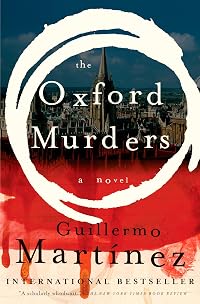
On This Page
Description
When an Argentine math student discovers the smothered body of his landlady, conventional wisdom points to a family member with the most prosaic of motives. But then renowned logician Arthur Seldom, author of a book on the mathematics of serial killers, tells of a strange note left in his mailbox. The note indicates that the murder is the first in a series linked by a mysterious pattern. Each new death is accompanied by a different mathematical shape. It seems that the serial killer can be show more stopped only if someone can crack the next symbol in the sequence. The leading Oxford logician and the math graduate team up on a quest to crack the cryptic clues. show lessTags
Recommendations















Member Reviews
I found this short mystery fascinating due to its cerebral nature. Joining serious mathematics with murder made this novel unique in my experience.
When an Argentine math student at Oxford (presumedly based on the author's own experience) discovers the smothered body of his landlady, conventional wisdom points to a family member with the most prosaic of motives. However a famous logician, Arthur Seldom, and author of a book on the mathematics of serial killers, shares the appearance of a strange note in his mailbox. The murder may be the first of a series linked by a mysterious pattern. More bodies pile up, apparently of natural causes, but each paired with a message bearing a new arcane symbol. Arthur and his student ponder whether the show more deaths are innocent or the subtle, "imperceptible" homicides of a madman seeking to match wits with the great logician, and they rack their brains to decipher a pattern behind the signs before another corpse turns up.
The author, Guillermo Martinez, is a novelist with a Ph.D. in mathematics. His writing style, while conventionally elegant, is enhanced with brief disquisitions on Gödel's theorem, Heisenberg's uncertainty principle and Wittgenstein's paradox, which demonstrates "the impossibility of establishing an unambiguous rule." While the math may not be essential for solving the crimes, it creates a curious context for the author's exploration of a fundamental mystery theme—how we impose meaningful patterns on the confusing evidence of reality and are in turn misled and blinded by those patterns. The combination of math and mystery works very well in this interesting and intriguing novel. show less
When an Argentine math student at Oxford (presumedly based on the author's own experience) discovers the smothered body of his landlady, conventional wisdom points to a family member with the most prosaic of motives. However a famous logician, Arthur Seldom, and author of a book on the mathematics of serial killers, shares the appearance of a strange note in his mailbox. The murder may be the first of a series linked by a mysterious pattern. More bodies pile up, apparently of natural causes, but each paired with a message bearing a new arcane symbol. Arthur and his student ponder whether the show more deaths are innocent or the subtle, "imperceptible" homicides of a madman seeking to match wits with the great logician, and they rack their brains to decipher a pattern behind the signs before another corpse turns up.
The author, Guillermo Martinez, is a novelist with a Ph.D. in mathematics. His writing style, while conventionally elegant, is enhanced with brief disquisitions on Gödel's theorem, Heisenberg's uncertainty principle and Wittgenstein's paradox, which demonstrates "the impossibility of establishing an unambiguous rule." While the math may not be essential for solving the crimes, it creates a curious context for the author's exploration of a fundamental mystery theme—how we impose meaningful patterns on the confusing evidence of reality and are in turn misled and blinded by those patterns. The combination of math and mystery works very well in this interesting and intriguing novel. show less
Ein junger argentinischer Mathematiker kommt für seine Promotion nach Oxford, wo er hofft, sich mit den Größen seines Faches intensiv über Formeln und Logik austauschen zu können. Schnell jedoch muss er sich mit etwas ganz anderem befassen, denn seine Vermieterin Mrs Eagleton wird ermordet. Arthur Seldom, Mathematik-Professor am College und Freund von Mrs Eagletons Familie, berichtet sowohl dem Erzähler wie auch der Polizei, dass er eine kryptische Nachricht erhalten habe, die ihn just am Mordtag zu dem Opfer führte. Einen wirklichen Reim kann er sich jedoch nicht auf die Zeichen machen. Erst als eine zweite Nachricht zu einem zweiten Mord führt, scheint er ein Muster zu erkennen und befürchtet, dass Oxford von einem höchst show more cleveren Serientäter heimgesucht wird, der die quasi perfekten Morde begeht. Doch dies ist nur der Anfang einer Serie, die schon bald ihr drittes Opfer fordern wird.
Guillermo Martínez Roman ist die Neuausgabe eines Krimis, der bereits unter dem Titel „Die Pythagoras-Morde“ erschienen ist. Der Atmosphäre nach ist die Geschichte für mich ein typischer Vertreter des cosy crime, die Welt der Oxford-Mathematiker ist überschaubar und wird durchaus mit einer gewissen ironischen Note beschrieben. Die Polizeiarbeit findet nur am Rande statt, stattdessen ermitteln der etwas mysteriöse ältere Professor und sein noch jugendlicher Zögling, der als Neuankömmling in der Universitätsstadt natürlich mit einer gewissen neugierigen Naivität ausgestattet ist und sich gerne von einem erfahrenen Experten an die Hand nehmen lässt. Angereichert wird das ganze durch Exkurse in die Welt der Mathematik, denn immerhin sind die Nachrichten durch mathematische Zeichen kodiert und können nur durch diese auch entschlüsselt werden.
Vieles passt in dem Roman sehr gut zusammen: der Erzähler, der unbedarft an die neue Wirkungsstätte kommt; seine ältliche Vermieterin, Witwe eines Mathematikers und Ersatzmutter für das verwaiste Enkelkind; der Professor, der sich sogleich in die Suche nach logischen Strukturen bei den Nachrichten des Täters stürzt; die Figuren umgeben von den ehrwürdigen Mauern der traditionsreichen Universität, die auch gar nicht an einen profanen Alltag jenseits der geistigen Sphären denken lässt. Die mathematischen Höhen indes sind so wohldosiert, dass sie auch rechnerische Tiefflieger problemlos nachvollziehen und gemeinsam mit den Hobbydetektiven die Spur verfolgen und die Zeichen entschlüsseln können.
Obwohl ein Serienmörder im Zentrum steht und immer mehr Opfer zu beklagen sind, bleibt jedoch die große Spannung aus. Dies liegt vermutlich an den mathematischen Abhandlungen, die notwendig sind, um gewissen Zusammenhänge zu verstehen, aber letztlich auch von der Geschichte wegführen. Die Begeisterung für sein Fach, ebenso für Logik und Magie, bringt der Mathematiker Martínez hervorragend in seinem Roman unter und kann damit auch mich als Leserin überzeugen. Leider nimmt dies jedoch der Krimihandlung etwas den Raum, so dass daraus eine solide, gut konstruierte Erzählung wird, die jedoch in der Darstellung der Charaktere und des Handlungsrahmens etwas blass bleibt. show less
Guillermo Martínez Roman ist die Neuausgabe eines Krimis, der bereits unter dem Titel „Die Pythagoras-Morde“ erschienen ist. Der Atmosphäre nach ist die Geschichte für mich ein typischer Vertreter des cosy crime, die Welt der Oxford-Mathematiker ist überschaubar und wird durchaus mit einer gewissen ironischen Note beschrieben. Die Polizeiarbeit findet nur am Rande statt, stattdessen ermitteln der etwas mysteriöse ältere Professor und sein noch jugendlicher Zögling, der als Neuankömmling in der Universitätsstadt natürlich mit einer gewissen neugierigen Naivität ausgestattet ist und sich gerne von einem erfahrenen Experten an die Hand nehmen lässt. Angereichert wird das ganze durch Exkurse in die Welt der Mathematik, denn immerhin sind die Nachrichten durch mathematische Zeichen kodiert und können nur durch diese auch entschlüsselt werden.
Vieles passt in dem Roman sehr gut zusammen: der Erzähler, der unbedarft an die neue Wirkungsstätte kommt; seine ältliche Vermieterin, Witwe eines Mathematikers und Ersatzmutter für das verwaiste Enkelkind; der Professor, der sich sogleich in die Suche nach logischen Strukturen bei den Nachrichten des Täters stürzt; die Figuren umgeben von den ehrwürdigen Mauern der traditionsreichen Universität, die auch gar nicht an einen profanen Alltag jenseits der geistigen Sphären denken lässt. Die mathematischen Höhen indes sind so wohldosiert, dass sie auch rechnerische Tiefflieger problemlos nachvollziehen und gemeinsam mit den Hobbydetektiven die Spur verfolgen und die Zeichen entschlüsseln können.
Obwohl ein Serienmörder im Zentrum steht und immer mehr Opfer zu beklagen sind, bleibt jedoch die große Spannung aus. Dies liegt vermutlich an den mathematischen Abhandlungen, die notwendig sind, um gewissen Zusammenhänge zu verstehen, aber letztlich auch von der Geschichte wegführen. Die Begeisterung für sein Fach, ebenso für Logik und Magie, bringt der Mathematiker Martínez hervorragend in seinem Roman unter und kann damit auch mich als Leserin überzeugen. Leider nimmt dies jedoch der Krimihandlung etwas den Raum, so dass daraus eine solide, gut konstruierte Erzählung wird, die jedoch in der Darstellung der Charaktere und des Handlungsrahmens etwas blass bleibt. show less
An interesting murder mystery set in Oxford and written by an Argentinean maths professor. A serial killer at work in Oxford leaves notes announcing the time and place of each murder where professor of logic Arthur Seldom will find them. Each note also includes a mathematical symbol as if the murderer is taunting him, so with the blessing of the police, Seldom and an Argentinean graduate student who was lodging with the first victim, take up the murderer's challenge and attempt to solve the problem of predicting what the next symbol will be and what the series means. Although I had some ideas about the murderer's identity, I didn’t guess the true motive for the crimes.
Unfortunately, the characterisation was very one-dimensional and show more there were a few blatant mistakes about the way things work in the UK. For one thing, desperate parents whose children need organ transplants do not get to plead in person with the bereaved parents of possible donors. But if you are interested in maths, or like mysteries that are driven by plot rather than character, you should enjoy it. show less
Unfortunately, the characterisation was very one-dimensional and show more there were a few blatant mistakes about the way things work in the UK. For one thing, desperate parents whose children need organ transplants do not get to plead in person with the bereaved parents of possible donors. But if you are interested in maths, or like mysteries that are driven by plot rather than character, you should enjoy it. show less
An Argentinian mathematics graduate student arrives in Oxford only to have his landlady murdered a short time later. There is a note left for Arthur Seldom, a renowned logic and mathematical expert who authored a book with a chapter on serial killers, indicating that the murder is the first in a series of mathematical murders. The key for investigators is to find the pattern. Other murders soon follow. I was a bit disappointed in the book as the mystery was fairly simplistic and easy to solve. There were some advanced mathematical theorems discussed in the course of the book. Characterization was not a particularly strong suit either. It was a pleasant way to spend a few hours, but I had hoped for a more challenging mystery.
The plot centers around a string of murders connected by messages containing a series of enigmatic symbols. Eminent Oxford mathematician Arthur Seldom is at the center of the crimes, but is the murderer trying to engage him, impress him, avenge himself upon him, or maybe destroy him?
The story is narrated in the first person by an Argentinian exchange student on a maths grant; however, don't bother getting excited about him as a character because nothing he says, thinks, or does imbues him with any qualities either foreign, exotic, or engaging. Honestly, his sole function seems to be asking Seldom to explain how he arrived at his latest brilliant deduction. Even Dr. Watson managed this with more style.
The author devotes large sections show more of the text to wide-ranging philosophical and mathematical explorations of life, fate, patterns, reality, and illusion. I found these explorations to be well-written, accessible, and thought-provoking, though I'm grateful I brought some background knowledge to the party as Martinez is no Dan Brown - there's not a lot of coddling here. (Brush off your Godel and Escher if you've got them; reintroduce yourself to Heisenberg's uncertainty, and refamiliarize yourself with Schroedinger's feline before beginning.) True, little of this turns out actually to be relevant to the mystery, but it was entertaining enough that I was willing to forgive the author these excesses.
What I'm decidedly less willing to forgive is a plot that was unnecessarily obscure and complex, sloppy, lacking in excitement or suspense, and disturbingly soulless. There's simply no reason for some of the elaborate red herrings the author strews across the path, and no excuse for leaving some of the "clues" (ex: the missing blanket, the apathetic cellist, the married man) unexplained; little excitement (forget suspense) to be derived from hundreds of pages of dialog punctuated by three of the of the dullest murders ever captured in prose; and a disturbing lack of compassion in everyone's reaction to the final act of violence in the story.
Add the nondescript narrator, an unimaginative supporting cast, several strained metaphors (the grossest being a dead badger in the middle of the road), some extremely dubious explanations that seem to require a belief in supernatural forces (or at least a vengeful fate), and a denoument that feels rushed and contrived, and you get a murder mystery where the real mystery is whether others are going to be as willing as I was to stick this out to the end. show less
The story is narrated in the first person by an Argentinian exchange student on a maths grant; however, don't bother getting excited about him as a character because nothing he says, thinks, or does imbues him with any qualities either foreign, exotic, or engaging. Honestly, his sole function seems to be asking Seldom to explain how he arrived at his latest brilliant deduction. Even Dr. Watson managed this with more style.
The author devotes large sections show more of the text to wide-ranging philosophical and mathematical explorations of life, fate, patterns, reality, and illusion. I found these explorations to be well-written, accessible, and thought-provoking, though I'm grateful I brought some background knowledge to the party as Martinez is no Dan Brown - there's not a lot of coddling here. (Brush off your Godel and Escher if you've got them; reintroduce yourself to Heisenberg's uncertainty, and refamiliarize yourself with Schroedinger's feline before beginning.) True, little of this turns out actually to be relevant to the mystery, but it was entertaining enough that I was willing to forgive the author these excesses.
What I'm decidedly less willing to forgive is a plot that was unnecessarily obscure and complex, sloppy, lacking in excitement or suspense, and disturbingly soulless. There's simply no reason for some of the elaborate red herrings the author strews across the path, and no excuse for leaving some of the "clues" (ex: the missing blanket, the apathetic cellist, the married man) unexplained; little excitement (forget suspense) to be derived from hundreds of pages of dialog punctuated by three of the of the dullest murders ever captured in prose; and a disturbing lack of compassion in everyone's reaction to the final act of violence in the story.
Add the nondescript narrator, an unimaginative supporting cast, several strained metaphors (the grossest being a dead badger in the middle of the road), some extremely dubious explanations that seem to require a belief in supernatural forces (or at least a vengeful fate), and a denoument that feels rushed and contrived, and you get a murder mystery where the real mystery is whether others are going to be as willing as I was to stick this out to the end. show less
I should preface this by stating that math has always been my nemesis, due to a completely inept math teacher in grade school who left me with minimal knowledge of the basics, and thus ensured me floundering throughout high school math.
This left me with some reservations about picking up a mystery centered around mathematics, but Martinez is a much more capable teacher, and a great writer. The mathematics sections are easy to follow regardless of background knowledge, and the mystery is really intriguing and well plotted.
An Argentinian mathematics student arrives in Oxford to continue his studies, only to find that within days of his arrival, the elderly woman running his boarding house has been murdered, and a mysterious note show more foretelling the death has been left for a famous mathematician. The student is drawn into helping to solve the murders, and must attempt to decipher the mysterious symbols the murderer continues to leave, before the killings begin again. show less
This left me with some reservations about picking up a mystery centered around mathematics, but Martinez is a much more capable teacher, and a great writer. The mathematics sections are easy to follow regardless of background knowledge, and the mystery is really intriguing and well plotted.
An Argentinian mathematics student arrives in Oxford to continue his studies, only to find that within days of his arrival, the elderly woman running his boarding house has been murdered, and a mysterious note show more foretelling the death has been left for a famous mathematician. The student is drawn into helping to solve the murders, and must attempt to decipher the mysterious symbols the murderer continues to leave, before the killings begin again. show less
I had to turn to the back flap of The Oxford Murders to look at Guillermo Martinez's bio and to confirm my suspicions -- namely, that "he earned a Ph.D. in mathematical science". What does that have to do with a murder mystery, you ask? Everything if it's this book.
Our unnamed narrator is a graduate student in mathematics who has come to Oxford from Argentina. His advisor suggests he takes a basement apartment in the home of a friend -- an older, partially-invalid woman. One day he approaches the front door and is joined on the doorstep by another man, Arthur Seldom, who is a famous mathematician. There is no answer to their knocking and so they enter the unlocked front door. This is where they find the owner of the house dead -- the show more first in a string of local murders that seem to be seeking Seldom's attention.
You might think that the reason that I knew the author had some sort of math background was because he made so many of his characters mathematicians but it's not that. The reason is that a good portion of the first half of this book consists of various discussions of mathematical theory. It's somewhat related to the plot but it was a tough bit to get through! However, once I got through the maths, the plot really got going and there was little besides story in the remainder of the book. I didn't love this one but didn't hate it either.
http://webereading.com/2010/09/rip-read-1-oxford-murders.html show less
Our unnamed narrator is a graduate student in mathematics who has come to Oxford from Argentina. His advisor suggests he takes a basement apartment in the home of a friend -- an older, partially-invalid woman. One day he approaches the front door and is joined on the doorstep by another man, Arthur Seldom, who is a famous mathematician. There is no answer to their knocking and so they enter the unlocked front door. This is where they find the owner of the house dead -- the show more first in a string of local murders that seem to be seeking Seldom's attention.
You might think that the reason that I knew the author had some sort of math background was because he made so many of his characters mathematicians but it's not that. The reason is that a good portion of the first half of this book consists of various discussions of mathematical theory. It's somewhat related to the plot but it was a tough bit to get through! However, once I got through the maths, the plot really got going and there was little besides story in the remainder of the book. I didn't love this one but didn't hate it either.
http://webereading.com/2010/09/rip-read-1-oxford-murders.html show less
Members
- Recently Added By
Published Reviews
The mix of mathematics and murder mystery makes for a powerful cocktail. The Oxford Murders is not the first thriller to combine the two, but it is one of the first to do it successfully.
added by lkernagh
Lists

Stories featuring characters who are mathematicians
42 works; 5 members

Latin America
26 works; 9 members

Fiction for Readers Who Love Science and Math
57 works; 15 members

Llibres que he llegit el 2015
34 works; 1 member

Books Read in 2018
4,360 works; 110 members

Books Read in 2024
4,623 works; 126 members

Books read in 2014
66 works; 1 member
Author Information

30 Works 2,457 Members
Some Editions
Awards and Honors
Series

Belongs to Publisher Series
Work Relationships
Has the adaptation
Common Knowledge
- Canonical title
- The Oxford Murders
- Original title
- Crímenes imperceptibles
- Alternate titles
- Los crímenes de Oxford
- Original publication date
- 2003
- People/Characters
- Seldom; Mrs. Eagleton; Beth Eagleton; Lorna Craig; Inspector Peterson; Detective Sergeant Sacks (show all 8); Podorov; Frank Kalman (Frankie)
- Important places
- Oxfordshire, England, UK; Radcliffe Hospital; Cunliffe Close; Merton College
- Related movies
- The Oxford Murders (2008 | IMDb)
- First words
- Now that the years have passed and everything's been forgotten, and now that I've received a terse e-mail from Scotland with the sad news of Seldom's death , I feel I can break my silence (which he never asked for anyway) and... (show all) tell the truth about the events that reached the British papers in the summer of '93 with macabre and sensationalist headlines, but to which Seldom and I always referred - perhaps due to the mathematical connotations - simply as the series, or the Oxford series.
- Last words
- (Click to show. Warning: May contain spoilers.)The last shred of flesh had disappeared, and as far as the eye could see, the road stretching ahead of me was clean, clear, innocent once more.
- Original language
- Spanish
Classifications
- Genres
- Fiction and Literature, Mystery
- DDC/MDS
- 813 — Literature & rhetoric American literature in English American fiction in English
- LCC
- PQ7798.23 .A69165 — Language and Literature French, Italian, Spanish and Portuguese literatures Spanish literature Provincial, local, colonial, etc. Spanish America
- BISAC
Statistics
- Members
- 1,611
- Popularity
- 14,059
- Reviews
- 71
- Rating
- (3.15)
- Languages
- 20 — Catalan, Chinese, Danish, Dutch, English, Estonian, Finnish, French, German, Hungarian, Icelandic, Italian, Latvian, Lithuanian, Norwegian (Bokmål), Portuguese, Russian, Croatian, Spanish, Swedish
- Media
- Paper, Audiobook, Ebook
- ISBNs
- 65
- ASINs
- 13