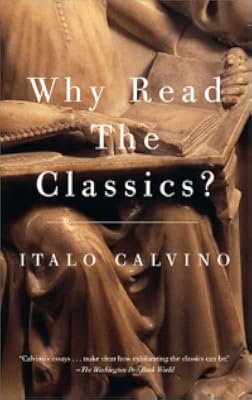
Why Read the Classics?
by Italo Calvino
On This Page
Description
This collection of essays by the acclaimed author of Cosmicomics offers a fascinating, personal journey through some of literature's greatest works. Classics, according to Italo Calvino, are not only works of enduring cultural value, but also personal touchstones. They are the books we are always rereading in order to understand our world and ourselves. Here, Calvino introduces more than thirty works from his own ideal library in essays of warmth, humor, and striking insight. He discusses show more great authors ranging from Homer to Jorge Luis Borges, and from Charles Dickens to the Persian folklorist Nezami. Whether tracing the links between Ovid's Metamorphoses and Alain Robbe-Grillet's objectivity, discovering the origins of science fiction in the writings of Cyrano de Bergerac, or convincing us that the Italian novelist Carlo Emilio Gadda's works are like artichokes, Calvino offers a new perspective on beloved favorites and introduces us to hidden gems. "This book serves as a welcome reminder that the great works are great because they can mean so much to readers, and Calvino is a most knowledgeable guide to all the best destinations."- San Francisco Chronicle show lessTags
Recommendations
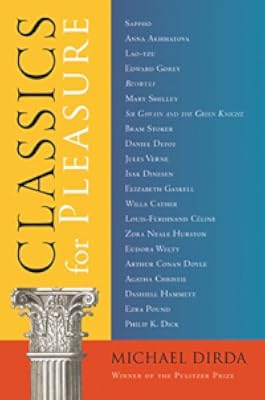
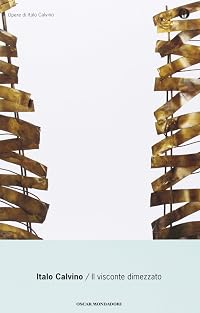
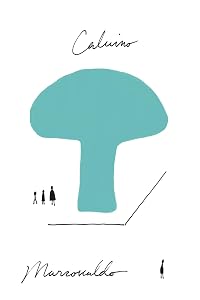
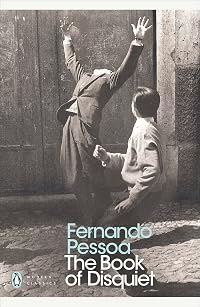

Member Recommendations

Oct326 Due libri che raccolgono testi brevi che descrivono, spiegano, commentano altri libri. Testi scritti da grandi lettori, come erano Citati e Calvino. Elegante, raffinato, prezioso, evocativo il primo; limpido, piano, amichevole il secondo, ma entrambi profondi e ammirevoli.
Member Reviews
O que é um clássico? E por que lê-lo? Este livro fornece várias respostas a essas perguntas, algumas consensuais, outras polêmicas, mas todas certamente enriquecedoras. Em verdadeiro trabalho de ourivesaria, Calvino desentranha as diversas facetas do que seja um clássico, para depois iluminar com uma leitura penetrante seus próprios clássicos, ou seja, alguns dos autores mais importantes da tradição literária e intelectual do Ocidente. Por que ler os clássicos? A razão definitiva que Calvino dá a essa pergunta e tão simples como as grandes verdades: a única justificativa que se pode apresentar e que ler os clássicos e melhor do que não os ler...
There is something fascinating in a great writer’s observations of the literature in which he is immersed. Might they reveal clues to his own prowess, or ogres against which he long strove? These occasional essays span a thirty-year period, from the 1950s to the 1980s—effectively, Calvino’s productive span as a writer. They vary considerably, from the journalistic to the academic. But across their range one spies a gentle, thoughtful reader teasing out the very roots of story and pressing to the edges of narrative form. It is thus no surprise to see Calvino’s fascination with such subjects as the structure of Orlando Furioso, or Candide, or even Robinson Crusoe. It is, however, useful to observe his admiration for Stendhal and show more Balzac, Tolstoy and Hemingway. His acknowledgement of Borges as one of his literary fathers goes without saying. But would you have guessed at Galileo as a forerunner? Of course in any eclectic mix of literary shorts there is likely to be discussion of works entirely new to one. This is true here also. But I like to think that some of these authors will gain new readers brought to them by, so to speak, a friend. In any case, I feel a keen desire to return to Calvino’s works of fiction in order to re-experience the culmination of his long life of reading and thinking about story. show less
É certamente verdade, como diz Italo Calvino, que "nenhum livro que fala de outro livro diz mais sobre o livro em questão". Ou seja, a leitura da crítica não substitui a leitura da obra de criação. Porém, ela pode ser uma excelente companhia de leitura, esclarecendo, chamando a atenção para detalhes importantes, revelando aspectos despercebidos e projetando nova luz sobre autores já empoeirados. É o que faz Calvino nesta coletânea de ensaios, críticas, prefácios e resenhas que constitui uma viagem instigante pelo mundo dos clássicos da literatura. A surpresa já se enconra no artigo que abre o livro, em que são apresentadas catorze definições do que sejam os clássicos. Na primeira delas, reencontramos o velho humor de show more Calvino: "Clássicos são aqueles livros dos quais, em geral, se ouve dizer:´Estou relendo´, e nunca ´Estou lendo´"... A viagem se inicia na Grécia, com a pergunta "quantas odisséias contém a Odisséia?", e atravessa séculos de tradição literária ocidental, para terminar em plena vanguarda, com Raymond Queneau. O trajeto está cheio de insights sobre autores essenciais, tanto da Antiguidade, como Xenofonte, Ovídio e Plínio, como dos tempos modernos, como Voltaire, Stendhal, Balzac, Flaubert, Henry James e Tolstoi, u ainda sobre os clássicos contemporâneos, como Borges, Montale, Ponge e Gadda. Longe das obviedades da história literária, calvino traz sempre uma visão muito pessoal, marcada pela lembrança de suas primeiras experiências de leitura dos autores em pauta. O ponto de partida pode ser insólito: que livro Hamlet poderia estar lendo quando entra em cena no segundo ato, ao qual se refere apnas como sendo "palavras, palavras, palavras"? O ângulo pode ser surpreendente: de que modo a existência da poligamia muda a estrutura da narrativa? A proposta pode ser inusitada: uma análise "cinematográfica" do Cândido de Voltaire, Diderot visto como precursor de Brecht, um exame a sério da filosofia de Hemingway. Mas o resultado é sempre enriquecedor. No primeiro ensaio, Calvino define a composição da biblioteca ideal: metade de livros que já lemos e outra de livros que pretendemos ler. Por que ler os clássicos tem seu lugar garantido nessa segunda metade.
Italo Calvino ( 1923-1985) nasceu em Santiago de Las Vegas, Cuba, indo para a Itália logo após o nascimento. Participou da resistência ao fascismo durante a guerra e foi membro do Partido Comunista até 1956. Publicou sua primeira obra, Il sentiero dei nidi di ragno, em 1947. Dele, a Companhia das Letras já editou As cidades invisíveis, O castelo dos destinos cruzados, O barão nas árvores, O cavaleiro inexistente, As cosmicômicas, Fábulas italianas, Os amores difíceis e a obra póstuma Seis propostas para o próximo milênio. show less
Italo Calvino ( 1923-1985) nasceu em Santiago de Las Vegas, Cuba, indo para a Itália logo após o nascimento. Participou da resistência ao fascismo durante a guerra e foi membro do Partido Comunista até 1956. Publicou sua primeira obra, Il sentiero dei nidi di ragno, em 1947. Dele, a Companhia das Letras já editou As cidades invisíveis, O castelo dos destinos cruzados, O barão nas árvores, O cavaleiro inexistente, As cosmicômicas, Fábulas italianas, Os amores difíceis e a obra póstuma Seis propostas para o próximo milênio. show less
This is the second book of Calvino's work, and the only of his non-fiction works, that I have read. The first was Marcovaldo, a collection of short stories about an Italian peasant who attempts to "reconcile country habits with urban life". I was aware that Calvino was regarded as something of a philosopher, and the title of this work intrigued me after reading Mortimer Adler's How to Read a Book. What I found interesting about Why Read the Classics?, which is effectively a collection of book reviews, is that Calvino covers from Homer to the present, adding a touch of personal insight into each review, and a depth that is still beyond my reading of the Great Books. Calvino does what I have been doing for some time now (albeit I do this show more nowhere near as well). I suspect that the individual essays in this collection were written as Calvino read or re-read these classic authors and their books. The first essay, which provides the title of the book, provides Calvino's list of fourteen definitions of a "classic book". In the introduction, the translator, Martin McLaughlin, uses Calvino's definitions to put forward an all-encompassing definition that I find useful in identifying "classic" works with more than just "old" works:
A classic work is a work which (like each of Calvino's texts) retains a consciousness of its own modernity without ceasing to be aware of other classic works of the past.Of the thirty-six essays, only eleven of the essays had appeared in English before. This immediately strikes me as fortunate, yet, at the same time, somewhat saddened that there is so much that monolingual readers like myself will never have the opportunity to read. Calvino provides confirmation of Mortimer Adler's view on reading classic works, and justifies my own stance on using my time for a first-hand reading, even though I must admit that a good deal of my learning up until completing my PhD was based on secondary sources (beyond journal articles and historical texts). Calvino suggests that:
Reading a classic must also surprise us, when we compare it to the image we previously had of it. That is why we can never recommend enough a first-hand reading of the text itself, avoiding as far as possible secondary bibliography, commentaries, and other interpretations.What I also find interesting is that Calvino explains what I feel when re-reading classic works that I may not have understood when I was younger. For example:
When we reread the book in our maturity, we then rediscover these constants which by now form part of our inner mechanisms though we have forgotten where they came from.This leads me to another of Calvino's definitions which rings true:
A classic is a book which even when we read it for the first time gives the sense of rereading something we have read before.I have experienced this many times before, however, it was most obvious recently when reading John Stuart Mill and Ruskin. In yet another definition, Calvino explains this further:
A classic does not necessarily teach us something that we did not know already; sometimes we discover in a classic something which we had always known (or had always thought we knew) but did not realise that the classic text had said it first (or that the idea was connected with the text in a particular way). And this discovery is also a very gratifying surprise, as is always the case when we learn the source of an idea, or its connection with the text, or who said it first.Again, Calvino justifies my own approach. For example, he says that a "person who derives maximum benefit from a reading of the classics is the one who skilfully alternates classic readings with calibrated doses of contemporary material" (p. 8). That is not to say that I consider myself to be particularly wise. Indeed, Calvino tells me that my reason for alternating classics with contemporary materials might be "the result of an impatient, nervy temperament, of someone constantly irritated and dissatisfied". This is probably closer to the truth. In Calvino's essay on the Odyssey he discusses the nature of folktales. In this way he echoes Aristotle's Poetics. For example, he looks at stories of rags to riches or the more complex riches to rags and back to riches again and how these different types of misfortune are enjoyed by all because these represent "the restoration of an ideal order belonging to the past" (p. 13). In some ways, this explains why I like the classics, yet Calvino warns us that:
The contemporary world may be banal and stultifying, but it is always the context in which we have to place ourselves to look either backwards or forwards (p. 8).So Calvino is not simply a "stuck in the mud", but for me, he places the classics in an appropriate context. While much was familiar in these essays, there was also a good deal of work that was unfamiliar to me. Many of these authors did not produce their works in English, hence my unfortunate lack of knowledge. One such author, Stendhal, introduced me to the interesting idea that "liberty and progress... was suffocated by the Restoration" (p. 136), and that Pliny considered there to be a "tacit accord" reached between peoples about "three cultural facts". These include "the adoption of the (Greek and Roman) alphabet; shaving of men's faces by Barber; and the marking of the hours of the day on a sundial" (pp. 44-5). There are some familiar authors too, including Dickens, Tolstoy, Mark Twain, Henry James, Robert Louis Stevenson, Joseph Conrad, and Ernest Hemingway. And I was pleasantly surprised to see that the behaviourist, B.F. Skinner, makes an appearance (p. 116), albeit briefly. There is little to be gained from going over each of the essays, however, I have kept notes that I can return to in accordance with Mortimer Adler's rules for reading. The concluding essay, Parvese and Human Sacrifice, provides an interesting response to politics that is relevant today:
...as though he were shrugging his shoulders because everything is already clear and is not worth expending any more words (p. 263).However, it is "The Philosophy of Raymond Queneau", the second last essay, that concludes the work best for me, in that the written word need not be pompous and unwelcoming, where a writer could make the reader:
...feel on the same level as he is, as they were about to play a round of cards with friends... [yet such a writer] is in reality someone with a cultural background that can never be fully explored, the background whose implications and presuppositions, explicit or implicit, one can never exhaust (p. 246).Calvino wrote many other works, including novels and non-fiction, and although I understand he was a very private person, his letters have recently been published. I think I shall read more of his fiction and non-fiction before I delve further into the his private life. But clearly, there is much to be learnt from reading Calvino. show less
An author of modern literary classics himself, Italo Calvino is represented in this collection with his literary criticism. And it is criticism of a high order considering classics from Homer to Borges and many other authors. It is a book to be relished for dipping into to get a taste of his critical writing or to get recommendations for classics to read, if you have not already or if you have merely forgotten how good a particular author or classic was when you read it many moons ago. If nothing else it reminds us that great writers, like Calvino, are great readers often with eclectic tastes, but always with a way to entice earnest readers into an exploration of great reading.
It’s always a somewhat humbling experience to read a book like this one — at least for me.
But why ‘humbling?’ Because reading it reminds me of how little I really know about classical literature. As well read in the classics as I sometimes like to believe I am (having almost adamantly refused to read anything written after the nineteenth century until I’d finished my formal education at the age of 34), I realize I’m not — that there’s still a tremendous amount in the Western Canon of which I’m profoundly ignorant, except by hearsay or secondary source (to say nothing of my total ignorance of the Eastern Canon — but that’s for another lifetime).
What can I say about this treatise?
I found the following citation from show more Stendhal’s Souvenirs d’égotisme to be of particular interest given that the reasoning behind it persuaded Stendahl to give his spiritual allegiance to Italy rather than to England: “The exaggerated and oppressive workload of the English labourer is our revenge for Waterloo…. The poor Italian, dressed only in rags, is much closer to happiness. He has time to make love, and for eight to a hundred days per year he gives himself over to a religion which is so much more interesting because it actually makes him a little bit afraid” (p. 129).
Moved as I then was to consult, online, my local library’s supply of books by Stendahl (looking specifically for The Red and the Black, a title I already knew, but also for three I hadn’t known and had learned about only through my reading of Calvino’s book — namely, Lucien Leuwen, The Charterhouse of Parma and On Love — I found that the translations of Stendahl’s works in the Brooklyn Public Library’s borough-wide system (possibly one of the largest in the country, if not in the world) were more prevalent in Russian than in English. While I don’t wish to reach any hasty conclusions about who’s reading the classics these days based on this single query, it doesn’t look good for us natives. Could it be that our own “exaggerated and oppressive workload”—the object of which, I fear, is an equally ‘exaggerated and oppressive’ consumerism that ultimately leaves us spiritually famished — quite simply usurps any time and energy we might otherwise devote to the classics?
But this is mere speculation on my part — and I’m here to review, not to speculate.
Why Read the Classics? is not a difficult read, but it is a dry one. Given that I finished up my academic career long ago, and that scholarly treatises are far less a part of my daily regimen than is fiction, I’m a poor judge. The best I can offer to future publishers is a note on various errata I found.
Apparently, Calvino (or, more likely, his translator, Martin McLaughlin) is not above an occasional Oops! as we see first on pp. 116-17 in Calvino’s essay on Giammaria Ortes: “In the same way an entire typology and categorization of conformisms and rebellions, judged according to their relative levels of sociability or unsociability, could be elaborated from the final sentence of the work where there is a contrast between he (sic!) who is ‘susceptible’ to a greater number of ‘opinions’ and he (sic!) who is ‘susceptible to fewer opinions’: the former becomes ‘more and more reserved, civil and dissimulating’, the latter ‘more sincere, more free and more savage’.”
Then, too, in quoting Cesare Pavese on Balzac, we find what may well be just a typographical error in “…but the hunches and tricks of a presiding magistrate flailing away at the mystery which dammit (sic!) must be cleared up” (p. 143). Damn those printers, anyway!
A mere two pages later, we find Charles Dickens’s Our Mutual Friend described as “the second last novel he wrote” — and again on p. 257 when Calvino mentions Les Fleurs bleues/The Blue Flowers as “…the second last novel published by (Raymond) Queneau.” Does that make both books the penultimate novels of the two authors, or is it a second novel that each was writing alongside another last novel? We’ll never know — unless, that is, McLaughlin simply omitted the distinctly unprepossessing “to” between “second” and “last” that we’re now meant to supply. Ditto the omission of an equally unprepossessing “on,” by the way, on p. 263 in “…and it is not worth expending any more words (on).”
And then there’s that personal bugaboo (on p. 211) that seems to be creeping — at least into English—like so much kudzu: “Montale is one of the few poets who knows (sic!) the secret of using rhyme…”. And yet, before we leave the subject of Eugenio Montale, Calvino make a bold declaration on p. 220: “I will come straight to the point. In an age of generic and abstract words, words that are used for everything, words that are used not to think and not to say, a linguistic plague which is spreading from the public sphere to the private, Montale was the poet of exactness…”. Keep in mind that Calvino published this particular essay in 1981 — i.e., while the Internet was still in utero, and the WorldWideWeb, just a gleam in its mother’s eye.
What are we to make of “entitled” (rather than “titled,” as it should be) on p. 151 — i.e., right at the start of the chapter discussing Flaubert’s Trois Contes? Flaubert would never have made this mistake. I doubt, too, that Calvino would’ve made it. I suspect McLaughlin is once again the perpetrator — just as he’s the repeat offender of the same minor crime on p. 241.
And finally, just what is Calvino/McLaughlin saying in Calvino’s essay on Hemingway with “…and what I continue to find in his not others’ works.” Might that have been “…in his, and not in others’ works?”
Geez, Bowser, throw me a bone, will ya? I’m feeling cantankerous!
A few observations and my highlighting of these minor blemishes notwithstanding, is there anything of real substance I can bring to my review of Why Read the Classics? by Italo Calvino? I wish there were, but I’m not really the man for the job — even if I did find the following, which Calvino culled from Raymond Queneau’s twin expository pieces “What is Art?” and “More and Less,” to be of particular relevance in this age when virtually anything consisting of a few unsung words and serendipitous line breaks passes for poetry: “‘Another highly fallacious idea which nevertheless is very popular nowadays is the equivalence that has been established between inspiration, exploration of the subconscious and liberation; between chance, automatic reaction and freedom. Now this inspiration which consists in blindly obeying every single impulse is in reality a form of slavery. The classical writer composing a tragedy by observing a certain number of rules with which he is familiar is freer than the poet who writes down whatever flits through his head and is enslaved to other rules which he is not aware of” (p. 251).
Why, then, the distinctly uncharitable three stars? Because — it seems to me — a work of this kind, if nothing more, should move me to go out and grab the works it analyzes. Other than the works by Stendahl and, quite possibly, the one work by Carlo Emilio Gadda (Quer pasticciaccio brutto de via Merulana/That Awful Mess on Via Merulana) and another by Cesare Pavese (La luna e I falò/The Moon and the Bonfires), it did not. Moreover, I would have to question Calvino’s choices. While every editor’s choice of the “classics” is certainly and rightfully his or her own, this compendium seems just a tad top-heavy with Italians of minor repute outside of Italy.
RRB
10/14/14
Brooklyn, NY
show less
But why ‘humbling?’ Because reading it reminds me of how little I really know about classical literature. As well read in the classics as I sometimes like to believe I am (having almost adamantly refused to read anything written after the nineteenth century until I’d finished my formal education at the age of 34), I realize I’m not — that there’s still a tremendous amount in the Western Canon of which I’m profoundly ignorant, except by hearsay or secondary source (to say nothing of my total ignorance of the Eastern Canon — but that’s for another lifetime).
What can I say about this treatise?
I found the following citation from show more Stendhal’s Souvenirs d’égotisme to be of particular interest given that the reasoning behind it persuaded Stendahl to give his spiritual allegiance to Italy rather than to England: “The exaggerated and oppressive workload of the English labourer is our revenge for Waterloo…. The poor Italian, dressed only in rags, is much closer to happiness. He has time to make love, and for eight to a hundred days per year he gives himself over to a religion which is so much more interesting because it actually makes him a little bit afraid” (p. 129).
Moved as I then was to consult, online, my local library’s supply of books by Stendahl (looking specifically for The Red and the Black, a title I already knew, but also for three I hadn’t known and had learned about only through my reading of Calvino’s book — namely, Lucien Leuwen, The Charterhouse of Parma and On Love — I found that the translations of Stendahl’s works in the Brooklyn Public Library’s borough-wide system (possibly one of the largest in the country, if not in the world) were more prevalent in Russian than in English. While I don’t wish to reach any hasty conclusions about who’s reading the classics these days based on this single query, it doesn’t look good for us natives. Could it be that our own “exaggerated and oppressive workload”—the object of which, I fear, is an equally ‘exaggerated and oppressive’ consumerism that ultimately leaves us spiritually famished — quite simply usurps any time and energy we might otherwise devote to the classics?
But this is mere speculation on my part — and I’m here to review, not to speculate.
Why Read the Classics? is not a difficult read, but it is a dry one. Given that I finished up my academic career long ago, and that scholarly treatises are far less a part of my daily regimen than is fiction, I’m a poor judge. The best I can offer to future publishers is a note on various errata I found.
Apparently, Calvino (or, more likely, his translator, Martin McLaughlin) is not above an occasional Oops! as we see first on pp. 116-17 in Calvino’s essay on Giammaria Ortes: “In the same way an entire typology and categorization of conformisms and rebellions, judged according to their relative levels of sociability or unsociability, could be elaborated from the final sentence of the work where there is a contrast between he (sic!) who is ‘susceptible’ to a greater number of ‘opinions’ and he (sic!) who is ‘susceptible to fewer opinions’: the former becomes ‘more and more reserved, civil and dissimulating’, the latter ‘more sincere, more free and more savage’.”
Then, too, in quoting Cesare Pavese on Balzac, we find what may well be just a typographical error in “…but the hunches and tricks of a presiding magistrate flailing away at the mystery which dammit (sic!) must be cleared up” (p. 143). Damn those printers, anyway!
A mere two pages later, we find Charles Dickens’s Our Mutual Friend described as “the second last novel he wrote” — and again on p. 257 when Calvino mentions Les Fleurs bleues/The Blue Flowers as “…the second last novel published by (Raymond) Queneau.” Does that make both books the penultimate novels of the two authors, or is it a second novel that each was writing alongside another last novel? We’ll never know — unless, that is, McLaughlin simply omitted the distinctly unprepossessing “to” between “second” and “last” that we’re now meant to supply. Ditto the omission of an equally unprepossessing “on,” by the way, on p. 263 in “…and it is not worth expending any more words (on).”
And then there’s that personal bugaboo (on p. 211) that seems to be creeping — at least into English—like so much kudzu: “Montale is one of the few poets who knows (sic!) the secret of using rhyme…”. And yet, before we leave the subject of Eugenio Montale, Calvino make a bold declaration on p. 220: “I will come straight to the point. In an age of generic and abstract words, words that are used for everything, words that are used not to think and not to say, a linguistic plague which is spreading from the public sphere to the private, Montale was the poet of exactness…”. Keep in mind that Calvino published this particular essay in 1981 — i.e., while the Internet was still in utero, and the WorldWideWeb, just a gleam in its mother’s eye.
What are we to make of “entitled” (rather than “titled,” as it should be) on p. 151 — i.e., right at the start of the chapter discussing Flaubert’s Trois Contes? Flaubert would never have made this mistake. I doubt, too, that Calvino would’ve made it. I suspect McLaughlin is once again the perpetrator — just as he’s the repeat offender of the same minor crime on p. 241.
And finally, just what is Calvino/McLaughlin saying in Calvino’s essay on Hemingway with “…and what I continue to find in his not others’ works.” Might that have been “…in his, and not in others’ works?”
Geez, Bowser, throw me a bone, will ya? I’m feeling cantankerous!
A few observations and my highlighting of these minor blemishes notwithstanding, is there anything of real substance I can bring to my review of Why Read the Classics? by Italo Calvino? I wish there were, but I’m not really the man for the job — even if I did find the following, which Calvino culled from Raymond Queneau’s twin expository pieces “What is Art?” and “More and Less,” to be of particular relevance in this age when virtually anything consisting of a few unsung words and serendipitous line breaks passes for poetry: “‘Another highly fallacious idea which nevertheless is very popular nowadays is the equivalence that has been established between inspiration, exploration of the subconscious and liberation; between chance, automatic reaction and freedom. Now this inspiration which consists in blindly obeying every single impulse is in reality a form of slavery. The classical writer composing a tragedy by observing a certain number of rules with which he is familiar is freer than the poet who writes down whatever flits through his head and is enslaved to other rules which he is not aware of” (p. 251).
Why, then, the distinctly uncharitable three stars? Because — it seems to me — a work of this kind, if nothing more, should move me to go out and grab the works it analyzes. Other than the works by Stendahl and, quite possibly, the one work by Carlo Emilio Gadda (Quer pasticciaccio brutto de via Merulana/That Awful Mess on Via Merulana) and another by Cesare Pavese (La luna e I falò/The Moon and the Bonfires), it did not. Moreover, I would have to question Calvino’s choices. While every editor’s choice of the “classics” is certainly and rightfully his or her own, this compendium seems just a tad top-heavy with Italians of minor repute outside of Italy.
RRB
10/14/14
Brooklyn, NY
show less
I'd hoped for a monograph exploring the question asked by the title, but I didn't confirm that before starting to read it. Whoopsie! Turns out it's a collection of reviews of classic literature. It provided some interesting insights into a lot of books I haven't read, and probably won't.
Members
- Recently Added By
Lists

Books translated from Romance Languages into English
102 works; 7 members

SHOULD Read Books!
354 works; 9 members
Italian Literature
558 works; 43 members

Books Read in 2009
464 works; 11 members

Read in 2009
44 works; 1 member
Author Information

402+ Works 70,288 Members
Italo Calvino 1923-1984 Novelist and short story writer Italo Calvino was born in Cuba on October 15, 1923, and grew up in Italy, graduating from the University of Turin in 1947. He is remembered for his distinctive style of fables. Much of his first work was political, including Il Sentiero dei Nidi di Ragno (The Path of the Nest Spiders, 1947), show more considered one of the main novels of neorealism. In the 1950s, Calvino began to explore fantasy and myth as extensions of realism. Il Visconte Dimezzato (The Cloven Knight, 1952), concerns a knight split in two in combat who continues to live on as two separates, one good and one bad, deprived of the link which made them a moral whole. In Il Barone Rampante (Baron in the Trees, 1957), a boy takes to the trees to avoid eating snail soup and lives an entire, fulfilled life without ever coming back down. Calvino was awarded an honorary degree from Mount Holyoke College in 1984 and died in 1985, following a cerebral hemorrhage. At the time of his death, he was the most translated contemporary Italian writer and a contender for the Nobel Prize for Literature. (Bowker Author Biography) show less
Some Editions
Awards and Honors
Series
Belongs to Publisher Series
Work Relationships
Is abridged in
Common Knowledge
- Canonical title
- Why Read the Classics?
- Original title
- Perché leggere i classici
- Original publication date
- 1991
- People/Characters
- Publius Ovidius Naso
- First words*
- Cominciamo con qualche proposta di definizione.
- Quotations*
- ...non si creda che i classici vanno letti perché «servono» a qualcosa. La sola ragione che si può addurre è che leggere i classici è meglio che non leggere i classici.
*Some information comes from Common Knowledge in other languages. Click "Edit" for more information.
Classifications
Statistics
- Members
- 1,874
- Popularity
- 11,516
- Reviews
- 25
- Rating
- (3.81)
- Languages
- 14 — Catalan, Chinese, Dutch, English, Finnish, French, German, Greek, Italian, Japanese, Polish, Portuguese, Spanish, Turkish
- Media
- Paper, Audiobook, Ebook
- ISBNs
- 48
- ASINs
- 17