
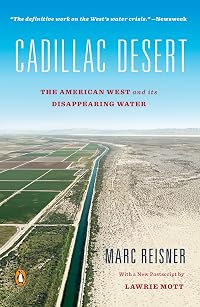
Cadillac Desert: The American West and Its Disappearing Water
by Marc Reisner
On This Page
Description
The story of the American West is the story of a relentless quest for a precious resource: water. It is a tale of rivers diverted and dammed, of political corruptions and intrigue, of billion-dollar battles over water rights, of ecologic and economic disaster. In Cadillac Desert, Marc Reisner writes of the earliest settlers, lured by the promise of paradise, and of the ruthless tactics employed by Los Angeles politicians and business interests to ensure the city's growth. He documents the show more bitter rivalry between two government giants, the Bureau of Reclamation and the US Army Corps of Engineers, in the competition to transform the West. Based on more than a decade of research, Cadillac Desert is a stunning exposé and a dramatic, intriguing history of the creation of Eden-an Eden that may be only a mirage. show lessTags
Recommendations









Member Recommendations
Member Reviews
5/5
In the western US, rivers flow backwards and uphill towards wealth and power. This sentence from Cadillac Desert best encapsulates the way that water resources have been 'managed' by both the Bureau of Reclamation and the US Army Corps of Engineers since the turn of the 20th century. While a lot of people hold this book up as a foundational text of environmental writing, it does so through a historical and political lens. There's very little here about the actual environment itself.
If you can walk away from Cadillac Desert without being thoroughly furious with the US government and the inherent greed in humanity you should probably get your morals checked. In the course of less than fifty years, every major waterway in the large show more majority of the United States was dammed countless times under the pretense of water conservation, power generation, and flood control. Most of the water these dams have is siphoned off towards agricultural lands in arid environments that should never have entered production in the first place. The land itself is mostly owned by large corporate entities that have little interest in the common good of the people. The water they are given was and has been subsidized by every American taxpayer for decades, and the projects themselves are constructed on our dime as well, with hardly a chance of them every being paid off, let alone profitable. Even with all of these projects in place, it's still not enough. There is simply not enough water in the southwest to support the industry and population that relies on it. As rivers dry up from climate change and groundwater reserves are drawn up at rates that will see the aquifers depleted beyond repair, we will soon find ourselves having to repay the debt that all of this gluttony and hubris have wrought.
This is to say nothing about the Bureau or the Corps themselves, who increasingly built dams in less and less ideal places, and lied more and more about how much it would cost. This is to say nothing about the dams silting up faster than was anticipated and becoming useless, or irrigated lands turning into plains of desolate salt. This is to say nothing of all of the wild rivers, riparian areas, flyways, swamps, and ecological niches that we have sunk under the reservoirs themselves. This is to say nothing of the thousands of humans that have been strong armed by their own government to give up their land for dams, or the cultural resources that we have lost along the way. Every way that you spin it, Cadillac Desert makes it clear that this period of dam building was an absolute mistake.
What puts Cadillac Desert over top for me is the voice with which Reisner writes. He is venomous, sarcastic, and sardonic. You can feel his contempt for the situation and the people responsible dripping off the text. It's excellent writing, in spite of the density of the information that he presents. I am predisposed towards being interested in natural resource management, specifically in the arid southwest, but I cant help but feel that Reisner could pull nearly anyone in with his treatment of the material. Another reason for this is that Reisner doesn't fiddle around or mince his words. He assumes that the reader is mostly already on the same page as him when it comes to the realities of climate in the southwest. He doesn't spend much time trying to argue that we ARE fucked, much more WHY and HOW we are fucked, and WHO did the fucking, which is a much more nuanced and important conversation to be having. Too many times environmental writing makes the mistake of becoming educational on a lot of fundamental concepts, and in the process water themselves down.
Cadillac Desert is a foundation piece of not only environmental writing, but of United States history that should be even more widely read than it already is. Absolutely critical to understanding just how far up the creek without a paddle we have gotten ourselves. show less
In the western US, rivers flow backwards and uphill towards wealth and power. This sentence from Cadillac Desert best encapsulates the way that water resources have been 'managed' by both the Bureau of Reclamation and the US Army Corps of Engineers since the turn of the 20th century. While a lot of people hold this book up as a foundational text of environmental writing, it does so through a historical and political lens. There's very little here about the actual environment itself.
If you can walk away from Cadillac Desert without being thoroughly furious with the US government and the inherent greed in humanity you should probably get your morals checked. In the course of less than fifty years, every major waterway in the large show more majority of the United States was dammed countless times under the pretense of water conservation, power generation, and flood control. Most of the water these dams have is siphoned off towards agricultural lands in arid environments that should never have entered production in the first place. The land itself is mostly owned by large corporate entities that have little interest in the common good of the people. The water they are given was and has been subsidized by every American taxpayer for decades, and the projects themselves are constructed on our dime as well, with hardly a chance of them every being paid off, let alone profitable. Even with all of these projects in place, it's still not enough. There is simply not enough water in the southwest to support the industry and population that relies on it. As rivers dry up from climate change and groundwater reserves are drawn up at rates that will see the aquifers depleted beyond repair, we will soon find ourselves having to repay the debt that all of this gluttony and hubris have wrought.
This is to say nothing about the Bureau or the Corps themselves, who increasingly built dams in less and less ideal places, and lied more and more about how much it would cost. This is to say nothing about the dams silting up faster than was anticipated and becoming useless, or irrigated lands turning into plains of desolate salt. This is to say nothing of all of the wild rivers, riparian areas, flyways, swamps, and ecological niches that we have sunk under the reservoirs themselves. This is to say nothing of the thousands of humans that have been strong armed by their own government to give up their land for dams, or the cultural resources that we have lost along the way. Every way that you spin it, Cadillac Desert makes it clear that this period of dam building was an absolute mistake.
What puts Cadillac Desert over top for me is the voice with which Reisner writes. He is venomous, sarcastic, and sardonic. You can feel his contempt for the situation and the people responsible dripping off the text. It's excellent writing, in spite of the density of the information that he presents. I am predisposed towards being interested in natural resource management, specifically in the arid southwest, but I cant help but feel that Reisner could pull nearly anyone in with his treatment of the material. Another reason for this is that Reisner doesn't fiddle around or mince his words. He assumes that the reader is mostly already on the same page as him when it comes to the realities of climate in the southwest. He doesn't spend much time trying to argue that we ARE fucked, much more WHY and HOW we are fucked, and WHO did the fucking, which is a much more nuanced and important conversation to be having. Too many times environmental writing makes the mistake of becoming educational on a lot of fundamental concepts, and in the process water themselves down.
Cadillac Desert is a foundation piece of not only environmental writing, but of United States history that should be even more widely read than it already is. Absolutely critical to understanding just how far up the creek without a paddle we have gotten ourselves. show less
There are three reasons I liked this book. One, I learned a lot about water policy in the US. Two, as an aspiring writer, I learned more about how long-form scholarship works and how it can be brought to a successful conclusion. Third, when Reisner brought in the big picture (I mean cosmic time and space, as when he compares the irrigation methods of 19th century Californians to those of the farmers of the barely historic era of the Fertile Crescent) I learned more about how the natural world intersects with the manmade.
On the third point, although Reisner never says so, there's a theological foundation to his work in that the natural law is taken as the starting and the ending for what works about feeding those on this planet in the show more ultimate sense of working—sustainability—which is arguably the only sense that matters. This is to say that short-term, utilitarian goals, even common sense political goals generated and justified by positive law, should not be the only consideration in long-term decision making. When we allow a self-serving efficiency and a headstrong rationality to become our be-all and end-all, and when engineering is enshrined above all else, we should not be surprised at the rich harvest of head-scratching folly, moral failings, and paradox cataloged so nicely in "Cadillac Desert."
Reiner's signal achievement is that he took the indignant spark of anger that he no doubt developed working for the Natural Resources Defense Council in the six years or so prior to the publication of the book and banked it into a righteous flame that sustained him during the incredible amount of work necessary for laying the foundation of his argument.
At the hands of a more emotional man the narrative might easily have tottered and collapsed into a foaming-at-the-mouth string of expletives, half-reasoned arguments, and non-sequiters. However, like a mighty arch-gravity dam, he was able to hold it all together. He found a way to bide his time, no doubt through clenched teeth, until he was able to marshal all the facts into a logical, though still stinging, rebuke. For once, the adjective "magisterial" to describe a writer's command of his material does not seem out of place.
The Weather Channel would have loved this man's gift for metaphor. His stragegy of varying his style also worked well. There were long stretches of descriptive writing, as in his sketch of the skirt-chasing Floyd Dominy, and in the passages where he helps us understand how soil, seed, water, wind, and weather patterns work together. But, there were also long stretches of exposition in which he gave his full attention to what might be called the infrastructure of the water industry: the policies, constituencies, results, challenges. The dozens and dozens of individuals, agencies, dams, projects, reports, and incidents, the particularity of all these things, matters enormously, because all were needed, and all 600 pages were needed, in order to make the case.
It is to his credit that even this mind-numbing aspect of the story was accessible, and even interesting. He proved again that an occasional emphasis such as italicizing critical parts of a sentence is no crime in non-fiction writing. On the contrary, italics and the occasional prod of an exclamation point are blessings for tiring readers who need their brains to be goosed back into full consciousness.
By the time a revised edition was put out in 1993 with an epilogue attached, Reisner's ardor had cooled. Though his re-cap is interesting in its own way, it had none of the through line and righteous wrath of the original narrative of 1986, and therefore came as a bit of a letdown.
I gave the book only four stars because although the content was exemplary, there were at least a dozen to a dozen and a half typos in the text. Penguin/Viking, really? This is a modern classic which went through 37 reprints, according to WorldCat. Granted, the Worldcat information is often inaccurate, but it's clear that Penguin, Viking, and a few other publishing houses in the UK made big money on the book. And yet none of them could be bothered to proof it for the countless re-issues, not even for the big one in 1993 or so? How lazy. show less
On the third point, although Reisner never says so, there's a theological foundation to his work in that the natural law is taken as the starting and the ending for what works about feeding those on this planet in the show more ultimate sense of working—sustainability—which is arguably the only sense that matters. This is to say that short-term, utilitarian goals, even common sense political goals generated and justified by positive law, should not be the only consideration in long-term decision making. When we allow a self-serving efficiency and a headstrong rationality to become our be-all and end-all, and when engineering is enshrined above all else, we should not be surprised at the rich harvest of head-scratching folly, moral failings, and paradox cataloged so nicely in "Cadillac Desert."
Reiner's signal achievement is that he took the indignant spark of anger that he no doubt developed working for the Natural Resources Defense Council in the six years or so prior to the publication of the book and banked it into a righteous flame that sustained him during the incredible amount of work necessary for laying the foundation of his argument.
At the hands of a more emotional man the narrative might easily have tottered and collapsed into a foaming-at-the-mouth string of expletives, half-reasoned arguments, and non-sequiters. However, like a mighty arch-gravity dam, he was able to hold it all together. He found a way to bide his time, no doubt through clenched teeth, until he was able to marshal all the facts into a logical, though still stinging, rebuke. For once, the adjective "magisterial" to describe a writer's command of his material does not seem out of place.
The Weather Channel would have loved this man's gift for metaphor. His stragegy of varying his style also worked well. There were long stretches of descriptive writing, as in his sketch of the skirt-chasing Floyd Dominy, and in the passages where he helps us understand how soil, seed, water, wind, and weather patterns work together. But, there were also long stretches of exposition in which he gave his full attention to what might be called the infrastructure of the water industry: the policies, constituencies, results, challenges. The dozens and dozens of individuals, agencies, dams, projects, reports, and incidents, the particularity of all these things, matters enormously, because all were needed, and all 600 pages were needed, in order to make the case.
It is to his credit that even this mind-numbing aspect of the story was accessible, and even interesting. He proved again that an occasional emphasis such as italicizing critical parts of a sentence is no crime in non-fiction writing. On the contrary, italics and the occasional prod of an exclamation point are blessings for tiring readers who need their brains to be goosed back into full consciousness.
By the time a revised edition was put out in 1993 with an epilogue attached, Reisner's ardor had cooled. Though his re-cap is interesting in its own way, it had none of the through line and righteous wrath of the original narrative of 1986, and therefore came as a bit of a letdown.
I gave the book only four stars because although the content was exemplary, there were at least a dozen to a dozen and a half typos in the text. Penguin/Viking, really? This is a modern classic which went through 37 reprints, according to WorldCat. Granted, the Worldcat information is often inaccurate, but it's clear that Penguin, Viking, and a few other publishing houses in the UK made big money on the book. And yet none of them could be bothered to proof it for the countless re-issues, not even for the big one in 1993 or so? How lazy. show less
In the American West, water doesn't flow downhill. Water flows towards money.
Cadillac Desert is an absolute monument, equal to any of the great damns the Reisner discusses and derides. This history, of settlement, irrigation, and the cruel legacy of dam building, is a comprehensively footnoted assassination against an ideal of the American west. The family farm is the image American democracy is built around. West of the rain line, the barrier on the Great Plains where annual rainfall is less than 20 inches annual, the family farm is cruel lie. Dryland farming can't sustain a family on the homestead of 160 acres, aside from a few sites on streams. Irrigation needs complex and expensive capital investments. Dams and canals and pumps.
The show more target of Reisner's ire is the Bureau of Reclamation, a rogue bureaucracy riddled with faulty numbers, blind corruption, and headless of oversight. The Bureau of Reclamation builds dams, spending hundreds of millions of dollars of taxpayer money to drown canyons and streams, argue that it's efforts are profitable through criminally poor accounting, and then sell power and water to immense agricultural conglomerates at prices that are basically free, a few dollars an acre-foot. Irrigated farms in California, Arizona, Idaho, and other western states have received incalculable subsidies to grow crops which farmers in the east are being paid not to grow; cotton, alfalfa, corn, and other low-value water-intensive crops. The byzantine world of water districts, senior rights, and and agricultural flows is a trillion ton beast, distorting sensible land and environmental policy in the West.
This book is detail heavy, it took me a solid week, and that's a rare thing. But over thirty years on, it reads like current events, like things that have happened yesterday. And in many ways, Reisner won. Dams in the west have come down. Three Gorges in China is perhaps the last superdam the world will ever build. This doesn't make up for the ecological impacts or the monetary waste, but he's won.
This book is vital reading for anyone who lives west of the Rockies. Reisner writes like a Jeremiah, crying out against immanent apocalypse. And if his doomsday hasn't yet come to pass, a killing Dust Bowl 2 drought, soil poisoned by accumulated salts, famine and refugees, it has not been avoided, only pushed off a little bit. And as an aside, I went to grad school in Tempe. I remember calculating that the incremental cost of a gallon of water on my utilities was something like a tenth of cent. show less
Cadillac Desert is an absolute monument, equal to any of the great damns the Reisner discusses and derides. This history, of settlement, irrigation, and the cruel legacy of dam building, is a comprehensively footnoted assassination against an ideal of the American west. The family farm is the image American democracy is built around. West of the rain line, the barrier on the Great Plains where annual rainfall is less than 20 inches annual, the family farm is cruel lie. Dryland farming can't sustain a family on the homestead of 160 acres, aside from a few sites on streams. Irrigation needs complex and expensive capital investments. Dams and canals and pumps.
The show more target of Reisner's ire is the Bureau of Reclamation, a rogue bureaucracy riddled with faulty numbers, blind corruption, and headless of oversight. The Bureau of Reclamation builds dams, spending hundreds of millions of dollars of taxpayer money to drown canyons and streams, argue that it's efforts are profitable through criminally poor accounting, and then sell power and water to immense agricultural conglomerates at prices that are basically free, a few dollars an acre-foot. Irrigated farms in California, Arizona, Idaho, and other western states have received incalculable subsidies to grow crops which farmers in the east are being paid not to grow; cotton, alfalfa, corn, and other low-value water-intensive crops. The byzantine world of water districts, senior rights, and and agricultural flows is a trillion ton beast, distorting sensible land and environmental policy in the West.
This book is detail heavy, it took me a solid week, and that's a rare thing. But over thirty years on, it reads like current events, like things that have happened yesterday. And in many ways, Reisner won. Dams in the west have come down. Three Gorges in China is perhaps the last superdam the world will ever build. This doesn't make up for the ecological impacts or the monetary waste, but he's won.
This book is vital reading for anyone who lives west of the Rockies. Reisner writes like a Jeremiah, crying out against immanent apocalypse. And if his doomsday hasn't yet come to pass, a killing Dust Bowl 2 drought, soil poisoned by accumulated salts, famine and refugees, it has not been avoided, only pushed off a little bit. And as an aside, I went to grad school in Tempe. I remember calculating that the incremental cost of a gallon of water on my utilities was something like a tenth of cent. show less
Cadillac Desert is a tremendous work of natural science, history, environmentalism, and politics, and despite it having dated somewhat since its publication, it should be considered required reading for anyone interested in those subjects, or who happens to live anywhere west of the hundredth meridian.
It starts off by recounting the history of the exploration and development of the West, with a particular focus on John Wesley Powell, a fascinating figure in his own right. It then moves to the development and settling of the West, in particular the city of Los Angeles, the creation of new institutions to exploit and develop water resources, and the increasingly desperate and deranged water projects that were constructed at the behest of show more powerful groups who wanted to maintain the explosive growth of the region, and not always with the best interests of the citizenry at heart. An endless series of dams, diversions, and canals were constructed, as various Western states battled with their interest groups, each other, and the federal Bureau of Reclamation to obtain the water they needed to maintain their growth. The book closes with a discussion of the North American Water and Power Alliance, a water engineering project of such ludicrous scope - damming nearly every river in British Columbia and shipping the water to Los Angeles through transcontinental canals - that it would seem preposterous if not for all of the previous projects that came before it, and there's also an epilogue that shows the tangible consequences to salmon fisheries of interfering with the natural flow of water.
It's an extremely well-written book that will teach you a lot about the West, but it's also a polemic that raises a lot of questions about how the West got to be where it is today, and as I was reading it I found myself thinking a lot about the political dynamic on display here. A big chunk of the West is a lifeless, waterless hellhole that has no business being settled at all, much less farmed for crops like cotton or rice. Yet time and time again, extremely right-wing officials went running to the federal government to build them more and more dams and canals with extremely dubious financial or environmental merits, sucking money and people away from perfectly habitable states. As you read 700 pages of this, it's almost enough to make you into a states' rights kind of guy. I'm not keen on that almost meaningless catchphrase at all, but I think most opposition to states' rights comes from Civil War-era social issues like the South's miserable record on discrimination. Would states' rights be more acceptable in a purely economic context, like Canadian provinces? Where would NYC be today if it hadn't had to keep shoveling money into stupid canals across Arizona that were a waste of space, a waste of land, a waste of power, and even more of a waste of water? Weren't the richer states of the Northeast subsidizing selfishness in the Southwest? Is the New Deal vision of infrastructure as progress, the TVAs and LCRAs, simply a mistake?
Reisner has an excellent paragraph that makes this very point: "The irrigation farmers not only had come to expect heavily subsidized water as a kind of right, allowing them to pretend that the region's preeminent natural fact - a drastic scarcity of that substance - was an illusion. They now believed that if it turned out they couldn't afford the water, the Bureau (which is to say, the nation's taxpayers) would practically give it away. These farmers were about the most conservative faction in what may be the most politically conservative of all the fifty states. They regularly sent to Congress politicians eager to demolish the social edifice built by the New Deal - to abolish welfare, school lunch programs, aid to the handicapped, funding for the arts, even to sell off some of the national parks and public lands. But their constituents had become the ultimate example of what they decried, so coddled by the government that they lived in the cocoonlike world of a child. They remained oblivious to what their CAP water would cost them but were certain it would be offered to them at a price they could afford. The farmers had become the very embodiment of the costly, irrational welfare state they loathed - and they had absolutely no idea."
To that end, I was also struck by the similarity between those farmers, who were often incredibly reactionary oligarchs in their states, and businessmen who make their money off of things like oil, gas, or railroads (and often these were the same people). Is there something inherent to natural resource extraction that encourages plutocrat behavior as opposed to, say, software development? I have an unprovable pet theory about how the different incentives that come from making money off of a rivalrous and legally excludable good like natural resources makes entrepreneurs more likely to be dickheads than someone who gets rich off of developing human capital, but even this weren't true, it's remarkable how the same people who Reisner quotes as saying "Contracts are made to be broken" if the result is cheaper water will lobby their Congressmen for taxpayer-subsidized boondoggles. Reisner again: "In the Congress, water projects are a kind of currency, like wampum, and water development itself is a kind of religion. Senators who voted for drastic cuts in the school lunch program in 1981 had no compunction about voting for $20 billion worth of new Corps of Engineers projects in 1984, the largest such authorization ever. A jobs program in a grimly depressed city in the Middle West, where unemployment among minority youth is more than 50 percent, is an example of the discredited old welfare mentality; a $300 million irrigation project in Nebraska giving supplemental water to a few hundred farmers is an intelligent, farsighted investment in the nation’s future."
And that's another great aspect of the book, where it shows the perversities that this grand construction spree enabled in the federal bureaucracy itself. An astonishing percentage of these public works were built not so much to solve specific problems, but as part of a turf war between the Bureau of Reclamation and the Army Corps of Engineers. A dam could be used for flood control, irrigation, navigation/recreation, or drinking water, and there were tons of shell games between those uses so that one agency could steal a project away from the other. Bureau of Reclamation head Floyd Dominy, who was profiled a bit more sympathetically in John McPhee's masterful Encounters With the Archdruid, comes off as an evil civil servant version of LBJ in his ceaseless efforts to maximize his Bureau's budget and prestige regardless of how useless his dams were. He encouraged lots of cool scumbag behavior by Congressmen noted for it, like Jim Wright, the "Representative from American Airlines" who prevented Southwest Airlines from flying out of Love Field in Dallas to all but a few places just to protect American Airlines' headquarters at nearby DFW. Jimmy Carter was the only President to try to take on this system, and Congressmen of both parties and all ideological persuasions laughed in his face. Decades earlier, badass Senator Paul Douglas also tried to stand in the system's way, with a similarly depressing lack of results.
And in a way, it is morbidly fascinating to read about all of the underhanded deals that went down to do things like make LA the metastasized monster it is today. If you've seen the excellent film Chinatown the basic story will be familiar, but it's still impressive to read about William Mulholland's corrupt deals with Joseph Lippincott and diabolical Robert Moses-esque plots to gain Owens Valley's water rights, build aqueduct, and expand the city all at once. Or to see how shady contractors like Bechtel began life with shady contracts to build Boulder Canyon Dam. Or to learn how otherwise iconic stars like Woody Guthrie were hired to propagandize dams for the government in the name of Progress.
And on and on until you're confronted with what's more than an ideological dilemma, but an existential dilemma: what are these pharaonic structures doing to our civilization in the long run? Reisner mentions irrigating cultures like the Hohokam, the Sumerians, and the Egyptians, and how frail they ended up being. China wasn't yet on its dam-building tear in 1986 when the book was published, but he discusses the problems that the construction of the Aswan Dam had already had for Egypt, and how the country was likely to be forced to construct yet more gargantuan works to solve the problems of its earlier ones. He doesn't use this language, but it felt like a sort of Jevon's Paradox for water - each dam you build helps ameliorate groundwater depletion from dumb farming decisions, but that just ends up encouraging even more farming that ends up being a net loss: "illegal subsidies enrich big farmers, whose excess production depresses crop prices nationwide and whose waste of cheap water creates an environmental calamity that could cost billions to solve." In my city of Austin our aquifer seems like it will last a while, but it's always worth pondering the true sustainability of life on the wrong side of the Hundredth Meridian, and this book is one of the best at that you'll find. show less
It starts off by recounting the history of the exploration and development of the West, with a particular focus on John Wesley Powell, a fascinating figure in his own right. It then moves to the development and settling of the West, in particular the city of Los Angeles, the creation of new institutions to exploit and develop water resources, and the increasingly desperate and deranged water projects that were constructed at the behest of show more powerful groups who wanted to maintain the explosive growth of the region, and not always with the best interests of the citizenry at heart. An endless series of dams, diversions, and canals were constructed, as various Western states battled with their interest groups, each other, and the federal Bureau of Reclamation to obtain the water they needed to maintain their growth. The book closes with a discussion of the North American Water and Power Alliance, a water engineering project of such ludicrous scope - damming nearly every river in British Columbia and shipping the water to Los Angeles through transcontinental canals - that it would seem preposterous if not for all of the previous projects that came before it, and there's also an epilogue that shows the tangible consequences to salmon fisheries of interfering with the natural flow of water.
It's an extremely well-written book that will teach you a lot about the West, but it's also a polemic that raises a lot of questions about how the West got to be where it is today, and as I was reading it I found myself thinking a lot about the political dynamic on display here. A big chunk of the West is a lifeless, waterless hellhole that has no business being settled at all, much less farmed for crops like cotton or rice. Yet time and time again, extremely right-wing officials went running to the federal government to build them more and more dams and canals with extremely dubious financial or environmental merits, sucking money and people away from perfectly habitable states. As you read 700 pages of this, it's almost enough to make you into a states' rights kind of guy. I'm not keen on that almost meaningless catchphrase at all, but I think most opposition to states' rights comes from Civil War-era social issues like the South's miserable record on discrimination. Would states' rights be more acceptable in a purely economic context, like Canadian provinces? Where would NYC be today if it hadn't had to keep shoveling money into stupid canals across Arizona that were a waste of space, a waste of land, a waste of power, and even more of a waste of water? Weren't the richer states of the Northeast subsidizing selfishness in the Southwest? Is the New Deal vision of infrastructure as progress, the TVAs and LCRAs, simply a mistake?
Reisner has an excellent paragraph that makes this very point: "The irrigation farmers not only had come to expect heavily subsidized water as a kind of right, allowing them to pretend that the region's preeminent natural fact - a drastic scarcity of that substance - was an illusion. They now believed that if it turned out they couldn't afford the water, the Bureau (which is to say, the nation's taxpayers) would practically give it away. These farmers were about the most conservative faction in what may be the most politically conservative of all the fifty states. They regularly sent to Congress politicians eager to demolish the social edifice built by the New Deal - to abolish welfare, school lunch programs, aid to the handicapped, funding for the arts, even to sell off some of the national parks and public lands. But their constituents had become the ultimate example of what they decried, so coddled by the government that they lived in the cocoonlike world of a child. They remained oblivious to what their CAP water would cost them but were certain it would be offered to them at a price they could afford. The farmers had become the very embodiment of the costly, irrational welfare state they loathed - and they had absolutely no idea."
To that end, I was also struck by the similarity between those farmers, who were often incredibly reactionary oligarchs in their states, and businessmen who make their money off of things like oil, gas, or railroads (and often these were the same people). Is there something inherent to natural resource extraction that encourages plutocrat behavior as opposed to, say, software development? I have an unprovable pet theory about how the different incentives that come from making money off of a rivalrous and legally excludable good like natural resources makes entrepreneurs more likely to be dickheads than someone who gets rich off of developing human capital, but even this weren't true, it's remarkable how the same people who Reisner quotes as saying "Contracts are made to be broken" if the result is cheaper water will lobby their Congressmen for taxpayer-subsidized boondoggles. Reisner again: "In the Congress, water projects are a kind of currency, like wampum, and water development itself is a kind of religion. Senators who voted for drastic cuts in the school lunch program in 1981 had no compunction about voting for $20 billion worth of new Corps of Engineers projects in 1984, the largest such authorization ever. A jobs program in a grimly depressed city in the Middle West, where unemployment among minority youth is more than 50 percent, is an example of the discredited old welfare mentality; a $300 million irrigation project in Nebraska giving supplemental water to a few hundred farmers is an intelligent, farsighted investment in the nation’s future."
And that's another great aspect of the book, where it shows the perversities that this grand construction spree enabled in the federal bureaucracy itself. An astonishing percentage of these public works were built not so much to solve specific problems, but as part of a turf war between the Bureau of Reclamation and the Army Corps of Engineers. A dam could be used for flood control, irrigation, navigation/recreation, or drinking water, and there were tons of shell games between those uses so that one agency could steal a project away from the other. Bureau of Reclamation head Floyd Dominy, who was profiled a bit more sympathetically in John McPhee's masterful Encounters With the Archdruid, comes off as an evil civil servant version of LBJ in his ceaseless efforts to maximize his Bureau's budget and prestige regardless of how useless his dams were. He encouraged lots of cool scumbag behavior by Congressmen noted for it, like Jim Wright, the "Representative from American Airlines" who prevented Southwest Airlines from flying out of Love Field in Dallas to all but a few places just to protect American Airlines' headquarters at nearby DFW. Jimmy Carter was the only President to try to take on this system, and Congressmen of both parties and all ideological persuasions laughed in his face. Decades earlier, badass Senator Paul Douglas also tried to stand in the system's way, with a similarly depressing lack of results.
And in a way, it is morbidly fascinating to read about all of the underhanded deals that went down to do things like make LA the metastasized monster it is today. If you've seen the excellent film Chinatown the basic story will be familiar, but it's still impressive to read about William Mulholland's corrupt deals with Joseph Lippincott and diabolical Robert Moses-esque plots to gain Owens Valley's water rights, build aqueduct, and expand the city all at once. Or to see how shady contractors like Bechtel began life with shady contracts to build Boulder Canyon Dam. Or to learn how otherwise iconic stars like Woody Guthrie were hired to propagandize dams for the government in the name of Progress.
And on and on until you're confronted with what's more than an ideological dilemma, but an existential dilemma: what are these pharaonic structures doing to our civilization in the long run? Reisner mentions irrigating cultures like the Hohokam, the Sumerians, and the Egyptians, and how frail they ended up being. China wasn't yet on its dam-building tear in 1986 when the book was published, but he discusses the problems that the construction of the Aswan Dam had already had for Egypt, and how the country was likely to be forced to construct yet more gargantuan works to solve the problems of its earlier ones. He doesn't use this language, but it felt like a sort of Jevon's Paradox for water - each dam you build helps ameliorate groundwater depletion from dumb farming decisions, but that just ends up encouraging even more farming that ends up being a net loss: "illegal subsidies enrich big farmers, whose excess production depresses crop prices nationwide and whose waste of cheap water creates an environmental calamity that could cost billions to solve." In my city of Austin our aquifer seems like it will last a while, but it's always worth pondering the true sustainability of life on the wrong side of the Hundredth Meridian, and this book is one of the best at that you'll find. show less
What an eye-opening and distressful book. Reisner has thoroughly researched the various projects of the Army Corps of Engineers, the Bureau of Land Management, the Interior Department, the Bureau of Indian Affairs, the Bureau of Reclamation, and others - so many departments to control so much land. What he discovered is the unbelievable amount of in-fighting and the phenomenal amount of waste and destruction as a result sheer number of dams that have been erected - literally hundreds and hundreds of them affecting every major watershed in our country. He compares the slow time to construction today with 1936 when the four largest concrete dams ever built were built at the same time: Hoover, Shasta, Bonneville and Grand Coulee. The show more amount of corruption that pervaded these agencies is mind-boggling, even to the most pessimistic of us. The wanton destruction of Indian land is horrific with entire reservations being drowned for the benefit of white farmers on the surrounding lands. We still see these agencies doing the same thing today in the Dakotas, but for gas and oil.
It is clear from the title that so much of the far western lands are geologically deserts that we have spent billions converting to habitable land - but the water is running out, and in the end nature will win, and these deserts will take back the land, and we will have problems of epic proportions because of the shortage of water. This is becoming more and more evident. If you want to understand why water is the next gold, and why the next civil wars will be fought in the courts and on the lands, over water rights, read this book. show less
It is clear from the title that so much of the far western lands are geologically deserts that we have spent billions converting to habitable land - but the water is running out, and in the end nature will win, and these deserts will take back the land, and we will have problems of epic proportions because of the shortage of water. This is becoming more and more evident. If you want to understand why water is the next gold, and why the next civil wars will be fought in the courts and on the lands, over water rights, read this book. show less
A year later, I've given CD a second read and must, finally, award it the 5th star (for whatever that's worth) that it so deserves. One of the most scathing, witty and instructive books of political /environmental/economic journalism that I've ever had the pleasure (and horror) to read. I do so wish Reisner was still around to bring us up to date on this most vital and fascinating subject. (Afterward to revised 1992 edition is as close to contemporary as CD gets).
Brilliant enough for 5 stars, but it caused me a bit of reader fatigue due to its relentless comprehensiveness. Impeccably researched, Cadillac Desert meets the highest standards of investigative reportage. Which is not to say that Reisner is absolutely objective (always an show more illusive goal at best) nor sober in his approach. At times, his tone borders on the sarcastic (as if he were saying, you are not going to believe exactly how incredibly stupid this idea was). His account is apolitical in the sense that he depicts Democrats and Republicans, both on the state and national levels, as bipartisan in their promotion and funding of the most suspect (environmentally, socially, economically)dams and water projects, going back at least as far as the New Deal. Reisner takes a close and critical look at the very notion of irrigation farming in a desert, its costs, benefits and long term consequences (depletion of the Ogallala Aquifer; deadly salinity levels of land and water, the making of “wild river” an oxymoron, etc.). An apt secondary subtitle for the book might be “Water flows uphill toward political power and money.” An entirely concrete example of this aphorism would be the California Aqueduct, particularly that section which carries water over the Tehachapis to L.A: “The water is carried across the Tehachapis in five separate stages. The final cyclopean one, which occurs at the A.D. Edmonston Pumping Plant, raises the water 1926 feet—the Eiffel Tower atop the Empire State—in a single lift . . . . At their peak capacity, if it is ever reached, the Edmonston pumps will require six billion kilowatts of electricity every year . . . . Moving water in California requires more electrical energy than is used by several states.”
First published in 1986 and subsequently revised in 1993, Cadillac Desert, if less prophetic now than it was 20-25 years ago, remains relevant and instructive. And if you ever thought there might be a silver-lining to pork-barrel politics, it’s a must read. In light of the recent financial system “bail-out,” and with many touting “infrastructure” projects as a solution to our current high unemployment and economic malaise, reviewing the history of perhaps the greatest public works program ever anywhere will give you pause. Dams and water projects (California’s Central Valley Project and the Central Arizona Project are just two examples) can have both intended and unintended consequences that make them less than great ideas. Engineers and “experts” (Bureau of Reclamation, Army Corps of Engineers, Water Commissioners, Resource Specialists, etc.) can be as greedy, short-sighted, and blinded by belief in their own expertise and desire for power as anyone else.
Reisner’s description of the proposed Narrows Dam on the Lower South Platte River in Colorado (thankfully, a project that was subsequently abandoned, though it was all too typical of projects that have been built) makes for a good summary:
“Here was a dam that the state engineer said would deliver only a third of the water it promised and could conceivably collapse; a project whose official cost estimate . . . would barely suffice to relocate twenty-six miles of railroad track; a project whose real cost, whatever it turned out to be, would therefore be written off, in substantial measure, to ‘recreation,’ though the water would be unsafe to touch; a project whose prevailing interest rate was one-fifth the rates banks were charging in the late 1970s; a project many of whose beneficiaries owned more land than the law permitted in order to receive subsidized water; a project that might, if the state engineer was correct, seep enough water to turn the town of Fort Morgan into a marsh; a project that would pile more debt onto the Bureau’s Missouri Basin Project; a project that would generate not a single kilowatt of hydroelectric power and would be all but worthless for flood control.” show less
Brilliant enough for 5 stars, but it caused me a bit of reader fatigue due to its relentless comprehensiveness. Impeccably researched, Cadillac Desert meets the highest standards of investigative reportage. Which is not to say that Reisner is absolutely objective (always an show more illusive goal at best) nor sober in his approach. At times, his tone borders on the sarcastic (as if he were saying, you are not going to believe exactly how incredibly stupid this idea was). His account is apolitical in the sense that he depicts Democrats and Republicans, both on the state and national levels, as bipartisan in their promotion and funding of the most suspect (environmentally, socially, economically)dams and water projects, going back at least as far as the New Deal. Reisner takes a close and critical look at the very notion of irrigation farming in a desert, its costs, benefits and long term consequences (depletion of the Ogallala Aquifer; deadly salinity levels of land and water, the making of “wild river” an oxymoron, etc.). An apt secondary subtitle for the book might be “Water flows uphill toward political power and money.” An entirely concrete example of this aphorism would be the California Aqueduct, particularly that section which carries water over the Tehachapis to L.A: “The water is carried across the Tehachapis in five separate stages. The final cyclopean one, which occurs at the A.D. Edmonston Pumping Plant, raises the water 1926 feet—the Eiffel Tower atop the Empire State—in a single lift . . . . At their peak capacity, if it is ever reached, the Edmonston pumps will require six billion kilowatts of electricity every year . . . . Moving water in California requires more electrical energy than is used by several states.”
First published in 1986 and subsequently revised in 1993, Cadillac Desert, if less prophetic now than it was 20-25 years ago, remains relevant and instructive. And if you ever thought there might be a silver-lining to pork-barrel politics, it’s a must read. In light of the recent financial system “bail-out,” and with many touting “infrastructure” projects as a solution to our current high unemployment and economic malaise, reviewing the history of perhaps the greatest public works program ever anywhere will give you pause. Dams and water projects (California’s Central Valley Project and the Central Arizona Project are just two examples) can have both intended and unintended consequences that make them less than great ideas. Engineers and “experts” (Bureau of Reclamation, Army Corps of Engineers, Water Commissioners, Resource Specialists, etc.) can be as greedy, short-sighted, and blinded by belief in their own expertise and desire for power as anyone else.
Reisner’s description of the proposed Narrows Dam on the Lower South Platte River in Colorado (thankfully, a project that was subsequently abandoned, though it was all too typical of projects that have been built) makes for a good summary:
“Here was a dam that the state engineer said would deliver only a third of the water it promised and could conceivably collapse; a project whose official cost estimate . . . would barely suffice to relocate twenty-six miles of railroad track; a project whose real cost, whatever it turned out to be, would therefore be written off, in substantial measure, to ‘recreation,’ though the water would be unsafe to touch; a project whose prevailing interest rate was one-fifth the rates banks were charging in the late 1970s; a project many of whose beneficiaries owned more land than the law permitted in order to receive subsidized water; a project that might, if the state engineer was correct, seep enough water to turn the town of Fort Morgan into a marsh; a project that would pile more debt onto the Bureau’s Missouri Basin Project; a project that would generate not a single kilowatt of hydroelectric power and would be all but worthless for flood control.” show less
Marc Reisner's book, originally written in 1986, provides a detailed overview of water management (and sometimes mismanagement) in the United States. His primary focus is on the Southwest, since that's the most water deprived region of the Country, and where the need for water is greatest. Reisner begins with an overview of the natural features and climate of the region, and what life was like for the historical peoples prior to the exploration and settlement by Europeans and early Americans. Centuries ago, ancient Native American peoples such as Hohokam or Anasazi, may have been forced to abandon the Southwest due to periods of sustained drought. Smaller Native American settlements continued in the region after the Hohokam disappeared, show more but those tribes tended to move from location to location to find game and water.
In the early part of the book, Reisner, describes some of the exploits of early European and American explorers of the region, including Spanish explorer Francisco Coronado seeking gold, Lewis & Clarke after the Louisiana Purchase, and Mountain Men such as Jedidiah Smith and Zebulon Pike. He also describes John Wesley Powell's successful exploration of the Colorado River, which is a story in itself. In general, these explorers found the Southwest dry, arid, and basically unsuitable for widespread settlements for farmers or ranchers.
It wasn't until the Mormons began settling in Utah, and then the discovery of gold in the late 1800's, that interest in the region grew. The discovery of gold and the completion of the Transcontinental Railroad brought settlers in droves to the region. Railroad representatives encouraged land sales along their right of way, but lack of water limited the suitability for growing crops, grazing cattle, or settlements. Despite that limitation, gold fever swelled the population, exacerbating the need for water. Early settlers along rivers and streams could manage, but water wasn't always available to downstream settlers or those further from the water. And since rain in many areas is infrequent, much of the land remained unsuitable for sustained agricultural use. Because of the lack of adequate surface water, any additional water had to come from underground aquifers. But technology at the time didn't allow for anything more than personal use. It wasn't until much later, when large capacity centrifugal pumps were developed, that underground aquifers could be used for large irrigation projects. But after that happened, those aquifers began to be depleted rapidly. Level drops as high a 5' / year, with replenishment of 0.25" / year was not uncommon, and clearly was not sustainable. Additional sources of water were needed.
While early settlers were hard working and determined, their individual efforts to capture water rarely led to long term success. It became obvious that the scale of reclamation needed to be a collective task. People formed private water companies, or petitioned to their Territories or States to make water available on a wider basis.
Reisner then gives us detailed looks at several early Western water projects, and the people instrumental in bringing them about. For example, he discusses how Los Angeles was able to be transformed from a tiny settlement to the megalopolis of today by the infusion of water from the Owens Valley and other areas. William Mulholland, head of the water district in Los Angeles, envisioned and created the infrastructure that brought water to LA, to the benefit of the Los Angeles citizens and the demise of the people around Owens Lake. Yet even after this mega-project, which allowed Los Angeles to grow, it soon proved to be insufficient, and tapping into the Colorado River was seen as a necessary next step.
The Reclamation Act of 1902, described by Reisner as an early flirtation with socialism, allowed the federal government to spend huge amounts of money creating massive irrigation projects in the Western for the benefit of a few. Once the Government became involved, many dams were built, and water became more available, encouraging settlements. The story of some of the great dam projects, such as the Hoover Dam and the Grand Coolie Dam, makes for interesting reading. But even with the development of early dams, availability of water continued to be an ongoing issue.
Many States were after water from the Colorado River, and a pact among several states was agreed upon in 1922. That pact governs water distribution rights among seven States, specifically California, Nevada, Arizona, known as the lower basis States, and New Mexico, Colorado, Wyoming, and Utah, known as upper basin States. The Pact also promises Colorado River water to several Native American tribes as well as to Mexico. The Pact may work well in years of high rain and snowfall, but in dry periods, water availability falls below anticipated amounts. Unfortunately for some, shortages aren't shared proportionally among the states. For example, in periods of drought when available water from the Colorado River runs low, California has senior water rights, and by agreement, Arizona may have to shut off water to ensure California gets allotted amount of Colorado River water.
Today, the Colorado River is probably the most overused River in the West. An additional problem, as pointed out by Reisner, is that when the water compact which governs water use from the Colorada was prepared, it was based on unusually high rainfall periods over the previous years. Thus, the volume of Colorado River water falls short of allotments year after year. So additional sources of water needed to be found to support continued population expansion.
Other western rivers soon were targeted as water sources. Dams in the west were built for flood control by the Army Corps of Engineers and for irrigation projects by the Bureau of Reclamation. Reisner spends quite a bit of time telling us of the squabble between these two entities, and about some of the key individuals managing their efforts. One prominent individual was Floyd Dominy, Commissioner of the Bureau of Reclamation in the 1960's. Dominy was a zealot for irrigation in the West, and fought for a number of great dams and water projects. A flawed individual, but a powerful lobbyist, Dominy was a force in Washington, and got many western irrigation projects authorized and funded by Congress.
Unfortunately, in describing how these agencies built dams in the region, and how they fought for support from Congress for their plans, we see how flawed the system was. Many projects couldn't be justified on a cost / benefit analysis, and many of these projects remain troubled to this day. There are stories of dam failures, how some dams did more harm than good, and how several are rapidly silting up, making them very short lived projects, and how water availability is still inadequate to meet conflicting needs.
Even today, as I read this book, disputes over appropriating water among various users continue. Just this week (mid-February, 2020), President Trump and Department of Interior management rewrote State approved agreements between fishing, environmental, and big farming groups in California. New Federal plans now favor farming interests, diverting water from the Sacramento-San Joaquin Bay Delta region, and sending more water to farming interests in the Central Valley. These new rules are contrary to the plans of the State of California which sought to balance conflicting needs. The new plan was overseen by Interior Secretary David Bernhardt, who before becoming Secretary of the Interior, was an attorney and lobbyist for the San Joaquin Valley's Westlands Water District. He also previously represented the Water District in a lawsuit that sought to undo court-imposed protections for endangered salmon in the Sacramento-San Joaquin Delta. Now, as Secretary of the Interior, he was able to achieve what he couldn't do as a lobbyist, e.g., sacrifice the Bay-Delta and its most endangered species for the financial interests of the President’s political backers and Interior Secretary Bernhardt’s former clients. The fight for water is a continuing battle, especially in the Southwest, and is unlikely to change. But this example shows that not only can water be seen to flow downhill, but water also flows to money and power.
Throughout the book, one reads about a number of unnecessary, even unwanted water projects, but ones which were authorized because of lobbying or special interests. If you have a poor opinion of the way Government and Congress works, reading this book won't do anything to change your opinion. It's filled with examples of "pork barrel" projects, special interests, and parochialism among politicians. Western congressmen may strongly oppose spending money on funding Eastern mass transit projects, but support public spending on western water projects which benefit few wealthy farmers, especially those who are well connected. But of course, eastern politicians do the same supporting their pet projects at the expense of western projects.
In summary, "Cadillac Desert" and the 2017 update is an eye-opener for how water is made available in the western United States, and makes one appreciative on just how important clean, adequate water is to life everywhere. When you read about water shortages, contaminated water, or disappearing lakes around the world, like Lake Chad in Niger, Cameroon, Niger and Chad in Africa, or the Aral Sea in Kazakhstan and Uzbekistan, the Dead Sea in Israel and Jordan, Lake Poopo in Bolivia, or Poyang Lake in China, you appreciate how important water management and conservation is to everyone, especially in a world with growing populations and changing climate. show less
In the early part of the book, Reisner, describes some of the exploits of early European and American explorers of the region, including Spanish explorer Francisco Coronado seeking gold, Lewis & Clarke after the Louisiana Purchase, and Mountain Men such as Jedidiah Smith and Zebulon Pike. He also describes John Wesley Powell's successful exploration of the Colorado River, which is a story in itself. In general, these explorers found the Southwest dry, arid, and basically unsuitable for widespread settlements for farmers or ranchers.
It wasn't until the Mormons began settling in Utah, and then the discovery of gold in the late 1800's, that interest in the region grew. The discovery of gold and the completion of the Transcontinental Railroad brought settlers in droves to the region. Railroad representatives encouraged land sales along their right of way, but lack of water limited the suitability for growing crops, grazing cattle, or settlements. Despite that limitation, gold fever swelled the population, exacerbating the need for water. Early settlers along rivers and streams could manage, but water wasn't always available to downstream settlers or those further from the water. And since rain in many areas is infrequent, much of the land remained unsuitable for sustained agricultural use. Because of the lack of adequate surface water, any additional water had to come from underground aquifers. But technology at the time didn't allow for anything more than personal use. It wasn't until much later, when large capacity centrifugal pumps were developed, that underground aquifers could be used for large irrigation projects. But after that happened, those aquifers began to be depleted rapidly. Level drops as high a 5' / year, with replenishment of 0.25" / year was not uncommon, and clearly was not sustainable. Additional sources of water were needed.
While early settlers were hard working and determined, their individual efforts to capture water rarely led to long term success. It became obvious that the scale of reclamation needed to be a collective task. People formed private water companies, or petitioned to their Territories or States to make water available on a wider basis.
Reisner then gives us detailed looks at several early Western water projects, and the people instrumental in bringing them about. For example, he discusses how Los Angeles was able to be transformed from a tiny settlement to the megalopolis of today by the infusion of water from the Owens Valley and other areas. William Mulholland, head of the water district in Los Angeles, envisioned and created the infrastructure that brought water to LA, to the benefit of the Los Angeles citizens and the demise of the people around Owens Lake. Yet even after this mega-project, which allowed Los Angeles to grow, it soon proved to be insufficient, and tapping into the Colorado River was seen as a necessary next step.
The Reclamation Act of 1902, described by Reisner as an early flirtation with socialism, allowed the federal government to spend huge amounts of money creating massive irrigation projects in the Western for the benefit of a few. Once the Government became involved, many dams were built, and water became more available, encouraging settlements. The story of some of the great dam projects, such as the Hoover Dam and the Grand Coolie Dam, makes for interesting reading. But even with the development of early dams, availability of water continued to be an ongoing issue.
Many States were after water from the Colorado River, and a pact among several states was agreed upon in 1922. That pact governs water distribution rights among seven States, specifically California, Nevada, Arizona, known as the lower basis States, and New Mexico, Colorado, Wyoming, and Utah, known as upper basin States. The Pact also promises Colorado River water to several Native American tribes as well as to Mexico. The Pact may work well in years of high rain and snowfall, but in dry periods, water availability falls below anticipated amounts. Unfortunately for some, shortages aren't shared proportionally among the states. For example, in periods of drought when available water from the Colorado River runs low, California has senior water rights, and by agreement, Arizona may have to shut off water to ensure California gets allotted amount of Colorado River water.
Today, the Colorado River is probably the most overused River in the West. An additional problem, as pointed out by Reisner, is that when the water compact which governs water use from the Colorada was prepared, it was based on unusually high rainfall periods over the previous years. Thus, the volume of Colorado River water falls short of allotments year after year. So additional sources of water needed to be found to support continued population expansion.
Other western rivers soon were targeted as water sources. Dams in the west were built for flood control by the Army Corps of Engineers and for irrigation projects by the Bureau of Reclamation. Reisner spends quite a bit of time telling us of the squabble between these two entities, and about some of the key individuals managing their efforts. One prominent individual was Floyd Dominy, Commissioner of the Bureau of Reclamation in the 1960's. Dominy was a zealot for irrigation in the West, and fought for a number of great dams and water projects. A flawed individual, but a powerful lobbyist, Dominy was a force in Washington, and got many western irrigation projects authorized and funded by Congress.
Unfortunately, in describing how these agencies built dams in the region, and how they fought for support from Congress for their plans, we see how flawed the system was. Many projects couldn't be justified on a cost / benefit analysis, and many of these projects remain troubled to this day. There are stories of dam failures, how some dams did more harm than good, and how several are rapidly silting up, making them very short lived projects, and how water availability is still inadequate to meet conflicting needs.
Even today, as I read this book, disputes over appropriating water among various users continue. Just this week (mid-February, 2020), President Trump and Department of Interior management rewrote State approved agreements between fishing, environmental, and big farming groups in California. New Federal plans now favor farming interests, diverting water from the Sacramento-San Joaquin Bay Delta region, and sending more water to farming interests in the Central Valley. These new rules are contrary to the plans of the State of California which sought to balance conflicting needs. The new plan was overseen by Interior Secretary David Bernhardt, who before becoming Secretary of the Interior, was an attorney and lobbyist for the San Joaquin Valley's Westlands Water District. He also previously represented the Water District in a lawsuit that sought to undo court-imposed protections for endangered salmon in the Sacramento-San Joaquin Delta. Now, as Secretary of the Interior, he was able to achieve what he couldn't do as a lobbyist, e.g., sacrifice the Bay-Delta and its most endangered species for the financial interests of the President’s political backers and Interior Secretary Bernhardt’s former clients. The fight for water is a continuing battle, especially in the Southwest, and is unlikely to change. But this example shows that not only can water be seen to flow downhill, but water also flows to money and power.
Throughout the book, one reads about a number of unnecessary, even unwanted water projects, but ones which were authorized because of lobbying or special interests. If you have a poor opinion of the way Government and Congress works, reading this book won't do anything to change your opinion. It's filled with examples of "pork barrel" projects, special interests, and parochialism among politicians. Western congressmen may strongly oppose spending money on funding Eastern mass transit projects, but support public spending on western water projects which benefit few wealthy farmers, especially those who are well connected. But of course, eastern politicians do the same supporting their pet projects at the expense of western projects.
In summary, "Cadillac Desert" and the 2017 update is an eye-opener for how water is made available in the western United States, and makes one appreciative on just how important clean, adequate water is to life everywhere. When you read about water shortages, contaminated water, or disappearing lakes around the world, like Lake Chad in Niger, Cameroon, Niger and Chad in Africa, or the Aral Sea in Kazakhstan and Uzbekistan, the Dead Sea in Israel and Jordan, Lake Poopo in Bolivia, or Poyang Lake in China, you appreciate how important water management and conservation is to everyone, especially in a world with growing populations and changing climate. show less
Members
- Recently Added By
Lists

LT picks: Blue Books
197 works; 44 members

Recommended Nature Writing
346 works; 180 members

Non-Fiction Worth Reading
1,015 works; 261 members

Modern Library 100 Best Nonfiction Books
100 works; 8 members

Evan's Wish List
86 works; 2 members
The Great Courses: Earth at the Crossroads
48 works; 1 member
Books That Changed Our Perspective
423 works; 168 members

Ry's Uncover Challenge Window Shopping
14 works; 1 member
Author Information

4 Works 2,287 Members
Marc Reisner was born in 1948 in Ohio. A graduate of Earlham College, he worked for many years at Natural Resources Defense Counsel, where he wrote their newsletter.
Some Editions
Awards and Honors
Awards
Work Relationships
Has as a student's study guide
Common Knowledge
- Canonical title
- Cadillac Desert: The American West and Its Disappearing Water
- Original publication date
- 1986
- People/Characters
- John Wesley Powell; Floyd Dominy; William Mullholland
- Important places
- Los Angeles, California, USA; Colorado River, USA; Hoover Dam, Colorado River, USA; Columbia River, USA; Grand Coulee Dam, Washington, USA; Owens Valley, California, USA
- Related movies
- Cadillac Desert (1997 | IMDb)
- Dedication
- For Konrad and Else Reisner
- First words
- INTRODUCTION: A Semidesert with a Desert Hear
One late November night in 1980 I was flying over the state of Utah on my way back from California.
CHAPTER ONE: A Country of Illusion
The American West was explored by white men half a century before the first colonists set foot on Virginia's beaches, but it went virtually uninhabited by whites for another th... (show all)ree hundred years. - Quotations
- A civilization, if you can keep it.
- Last words
- (Click to show. Warning: May contain spoilers.)There was, for the time being, no word from the Reagan administration on what it thought of the plan.
Classifications
- Genres
- Nonfiction, General Nonfiction, Science & Nature, History, Politics and Government
- DDC/MDS
- 333.9100978 — Society, government, & culture Economics Economics of land and energy Other natural resources Water energy - Hydrologic
- LCC
- HD1739 .A17 .R45 — Social sciences Industries. Land use. Labor Industries. Land use. Labor Agriculture Irrigation
- BISAC
Statistics
- Members
- 2,010
- Popularity
- 10,402
- Reviews
- 40
- Rating
- (4.30)
- Languages
- English
- Media
- Paper, Audiobook, Ebook
- ISBNs
- 24
- UPCs
- 5
- ASINs
- 14