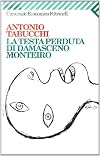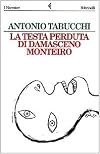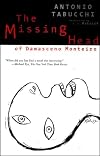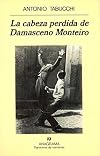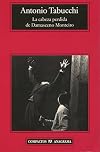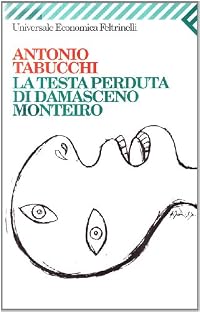
The Missing Head of Damasceno Monteiro
by Antonio Tabucchi
On This Page
Description
Antonio Tabucchi, Italy's premier writer and a best-selling author throughout Europe, draws together Manolo the gypsy, Firmino, a young tabloid journalist with a weakness for Lukacs and Vittorini, and Don Fernando, an overweight lawyer with a professed resemblance to the actor Charles Laughton, to solve a murder that leads far up and down Portugal's social ladder. As the investigation leads deeper into Portugal's power structure, the novel defies expectations, departing from the formulaic show more twists of a suspense story to consider the moral weight of power and its abuse. show lessTags
Recommendations























Member Recommendations
Member Reviews
It's sort of a mystery & I saw noir mentioned in passing in relation to this. It isn't so much a mystery (which is solved halfway through) as a search for truth & justice, such as both can be had (or not) in the face of police brutality, corruption, prejudice, nationalism, class divisions, & more, all with some literature & philosophy woven in. It's a book from the '90s & hearkens back to "the good old days" of journalism serving as the fourth estate & a lawyer who helps the underserved & underrepresented -- in this case in Portugal but there are plenty of international parallels.
A note at the back says that while the story is fiction, Tabucchi based the murder in his book on the real murder of 25-year-old Portuguese citizen Carlos show more Rosa who was killed in the police station of the Republican National Guard in 1966. The aspects of how Rosa was found & that his body showed evidence of torture are also similarly used in the story.
Tabucchi has a sly humor that he sprinkles throughout the story:
In spite of the heaviness of multiple facets of this story, it's a quick read & I enjoyed the angle of a young journalist working with the lawyer & various townspeople to expose the crime & corruption.
Tabucchi basically nails it, imo -- with such a wondrous universe that we inhabit, why oh why is man so base & focused on being evil?
It is, I suppose, the eternal question. Hopefully one day man will be able to ponder the universe rather than thinking of ways to torture fellow humans. Despite being decades old, it still feels as relevant today. show less
Tabucchi has a sly humor that he sprinkles throughout the story:
What he said in effect was that once a man has allowed himself to commit murder, it won't be long before he thinks it a small matter to steal, and then he'll proceed to getting drunk and to not observing the Sabbath, then to behaving like a boor and breaking his word. Once he's on that slippery slope there's no knowing where he'll end, and there are many who have to blame their ruin on some murder or other to which they had paid little heed at the time.
In spite of the heaviness of multiple facets of this story, it's a quick read & I enjoyed the angle of a young journalist working with the lawyer & various townspeople to expose the crime & corruption.
Tabucchi basically nails it, imo -- with such a wondrous universe that we inhabit, why oh why is man so base & focused on being evil?
"Millions of stars," he said, "millions of nebulae, fuck, millions of nebulae, and here we are fretting about electrodes applied to people's genitals.
It is, I suppose, the eternal question. Hopefully one day man will be able to ponder the universe rather than thinking of ways to torture fellow humans. Despite being decades old, it still feels as relevant today. show less
Vuelvo a leer este libro, muchos años después de su primera lectura, esta vez como guía de la ciudad en la que se desarrollan los acontecimientos de la novela. Pero a pesar de ello he disfrutado más la narración de los hechos y las disquisiciones de Tabucchi, puestas en los parlamentos del abogado Loton, sobre el poder, la tortura, la Grundnorm, que está en la base de todo, "solo que la llamada "base" que ocupa la norma es el vértice de una pirámide invertida. Un policía viola la ley? ¿Una SS mata a los judíos? Estos son casos de Grundnorm: "Lo hice porque el sargento lo ordenó, a lo que el capitán lo ordenó, a lo que él lo ordenó .... (de esta manera) Hitler, a quien le ordenó ... a Dios ". Y todo está justificado. show more
Tabucchi escribió el libro tras la aparición del cadáver decapitado de un ciudadano portugués, asesinado en circunstancias poco claras en una comisaría de las afueras de Lisboa en los años 90. “Cuando un crimen ofende la naturaleza humana, nos ofende también personalmente. Te sientes al mismo tiempo escandalizado y culpable. Mi emoción, mi sensibilidad y mi imaginación como escritor fueron conmovidas por este hecho”
Pese al aparentemente inacabado fin, la novela, casi thriller, con un periodista que quiere investigar sobre literatura, el abogado Lotón, un sabio cansado pero no vencido, esa guía de la ciudad de Porto, la sutil descripción del carácter portugués, Manolo el gitano, prácticamente un refugiado expulsado de España y Dona Rosa, un personaje al que Tabucchi debería haber dedicado una novela para ella solita, no estará a la altura del Sostiene Pereira del mismo autor, pero se le acerca mucho. show less
Tabucchi escribió el libro tras la aparición del cadáver decapitado de un ciudadano portugués, asesinado en circunstancias poco claras en una comisaría de las afueras de Lisboa en los años 90. “Cuando un crimen ofende la naturaleza humana, nos ofende también personalmente. Te sientes al mismo tiempo escandalizado y culpable. Mi emoción, mi sensibilidad y mi imaginación como escritor fueron conmovidas por este hecho”
Pese al aparentemente inacabado fin, la novela, casi thriller, con un periodista que quiere investigar sobre literatura, el abogado Lotón, un sabio cansado pero no vencido, esa guía de la ciudad de Porto, la sutil descripción del carácter portugués, Manolo el gitano, prácticamente un refugiado expulsado de España y Dona Rosa, un personaje al que Tabucchi debería haber dedicado una novela para ella solita, no estará a la altura del Sostiene Pereira del mismo autor, pero se le acerca mucho. show less
This literary thriller opens in a gypsy settlement outside of Oporto, Portugal. Manolo, one of the older men in the village, takes his usual early morning walk in the woods, and finds a headless body that was not there the day before. He notifies the Guardia Nacional, the police department in Oporto, and the crime is reported by the local media. Firmino, the crime reporter for O Acontecimento, a sensationalist rag in Lisbon, is sent to interview Manolo and investigate the murder. With the help of a local and well connected owner of a pension, he meets Manolo and a witness to the crime, and discovers that their accounts differ significantly from the ones provided by the Guardia Nacional officers that arrested the young man, who is show more subsequently identified as Damasceno Monteiro. Firmino is subsequently introduced to Loton, a morbidly obese lawyer and polymath, who comes from a wealthy family but has dedicated his life to representing the downtrodden of Oporto in court. Loton serves as an adviser to Firmino and his investigation, while in turn Firmino helps Loton with the case. The two engage in interesting but occasionally obtuse philosophical discussions about society, the unequal distribution of justice, and the use of torture to maintain and control individuals.
While I didn't enjoy Damasceno Monteiro as much Pereira Declares, Tabucchi's masterpiece, it was a very good mystery novel with interesting characters and a solid plot line. show less
While I didn't enjoy Damasceno Monteiro as much Pereira Declares, Tabucchi's masterpiece, it was a very good mystery novel with interesting characters and a solid plot line. show less
Once upon there was a guy, me, who used to just seemed to dislike novels that took the piss out of philosophies (or at least any I liked)… “Candide” was a good piss-take, - and in fact very bleak about humanity rather than cheerily commonsensical. Even though Swift wasn't atheist, it seemed to me that Candide had much in common with Gulliver's Travels... I don't think there is a useful category to be termed "philosophical fiction"....there is more just that baggy old category, "the Novel of Ideas", and even that breaks down when one considers that most "great works" of fiction have quite a strong relationship to ideas of their time, including sometimes philosophically elaborate ideas (Proust influenced by Bergson, Tolstoy doing show more ""philosophy of history"- but fortunately not only that, in “War and Peace”, Thomas Mann influenced by Jung - despite denials, etc., etc...). Sorry. I missed that epistemology class where the criterion of truth was determined to be cultural greatness, presumably because I was busy thinking for myself, and comparing the subtlety of Leibniz to the crassness of Voltaire (in that work). To be fair to Voltaire, he did not have sight of all the philosophical papers Leibniz kept hidden from the world during his life for very sensible reasons, but even so, enough could be established to see where Leibniz was driving from and just how astonishing some of his ideas were. It's that kind of thinking for oneself that Voltaire was trying to support with the work. Leibniz however, perhaps second only to Spinoza, was a "thinker for himself" of the first order - autodidact, he had to work stuff out for himself and experienced the joy of self-determined understanding. It got him into trouble when he showed off his discoveries only for someone else to say they had already found it - part of this was Leibniz's own excitement about what he was doing off his own back. Perhaps he should have just kept nodding to cultural "greats" like so many of his German contemporaries.
Also, love Sartre - and Simone de Beauvoir...and Camus. There was an affinity between Dostoyevsky and Nietzsche, who mentions D's Notes from Underground. What about Swift? Could he be considered a philosophical novelist? Or George Eliot? I suppose the 19th Century, being such a time of intellectual change, with the novel as a primary form of communication, entertainment and debate, was a time when novelists were very engaged with ideas.
And where is Antonio Tabucchi’s “The Missing Head of Dasmaceno Monteiro” in all of this? There’s more wisdom in Tabucchi’s Portuguese milieu (in this case Oporto) than in the light beams delineated by dust moats of 18th/19th Century literature. I like reading novels which engage with contemporary ideas - through the medium of the characters and their relationship with the world -which can make the ideas and concepts come alive. Dostoyevsky was driven to debate ideas which he saw as fundamentally important - engaging with authenticity and empiricism and rationality, individual freedom and mass culture and socialism, Christian faith and alienation- in his work. Thus, he often argues against himself, questions his own views, through the medium of fiction, and this gives his work its great power. Yes, Tabucchi like Leibniz, and Nietzsche were original thinkers, if that is what we mean by 'thinking for ourselves.' Of course my criteria of truth began and ended in God as instigator of the best possible world within which our freedom and will is self-determined.
As soon as I saw there was an English version of this Tabucchi, I snapped it up. A quote taken from the English version which I also took from my Portuguese edition:
“For his piss he had chosen a massive oak that cast its great shadow over a grassy clearing just on the verge of the pines. Who knows why it gave him a sense of comfort to piss against the trunk of that tree, perhaps because it was very much older than he was, and Manolo liked to think there were living things in the world older than him, even if they were only trees. The fact is that it made him feel at his ease, and filled with peace, in harmony with himself and with the universe. So he walked up to the great trunk and urinated with relief. And at that moment he saw a shoe.
(“…Para mijar tinha escolhido um grande carvalho que espalhava a sua sombra sobre um campo à beira do pinhal. Não sabia porquê mas dava-lhe prazer mijar contra aquele carvalho. Talvez por ser uma árvore muito mais velha que ele, e o Manolo gostava que no mundo houvesse seres vivos mais velhos do que ele, mesmo que se tratasse de uma árvore. A verdade é que se sentia bem, como se uma serenidade o invadisse enquanto fazia as suas necessidades. Sentia-se em paz consigo próprio e com o universo. Aproximou-se do carvalho e urinou com alívio. E nesse momento viu um sapato” in the Portuguese edition).
When I was young I also liked to piss against light poles, particularly in Festas dos Santos Populares in the Summer in Lisbon where we couldn’t find a bathroom even if our lives depended on it… packed Bon Vivants thronging the streets in Lisbon…
This is Tabucchi at his best. I can feel what Manolo feels, I can empathise with Loton’s speculations and with Firmino’s literary interests…
Bottom-line: Tabucchi is dead. He got rid of the restlessness. We, among the restless and the nonconformists, continue reading his books to appease our own restlessness. It is the least consolation that we deserve I’d say. show less
Also, love Sartre - and Simone de Beauvoir...and Camus. There was an affinity between Dostoyevsky and Nietzsche, who mentions D's Notes from Underground. What about Swift? Could he be considered a philosophical novelist? Or George Eliot? I suppose the 19th Century, being such a time of intellectual change, with the novel as a primary form of communication, entertainment and debate, was a time when novelists were very engaged with ideas.
And where is Antonio Tabucchi’s “The Missing Head of Dasmaceno Monteiro” in all of this? There’s more wisdom in Tabucchi’s Portuguese milieu (in this case Oporto) than in the light beams delineated by dust moats of 18th/19th Century literature. I like reading novels which engage with contemporary ideas - through the medium of the characters and their relationship with the world -which can make the ideas and concepts come alive. Dostoyevsky was driven to debate ideas which he saw as fundamentally important - engaging with authenticity and empiricism and rationality, individual freedom and mass culture and socialism, Christian faith and alienation- in his work. Thus, he often argues against himself, questions his own views, through the medium of fiction, and this gives his work its great power. Yes, Tabucchi like Leibniz, and Nietzsche were original thinkers, if that is what we mean by 'thinking for ourselves.' Of course my criteria of truth began and ended in God as instigator of the best possible world within which our freedom and will is self-determined.
As soon as I saw there was an English version of this Tabucchi, I snapped it up. A quote taken from the English version which I also took from my Portuguese edition:
“For his piss he had chosen a massive oak that cast its great shadow over a grassy clearing just on the verge of the pines. Who knows why it gave him a sense of comfort to piss against the trunk of that tree, perhaps because it was very much older than he was, and Manolo liked to think there were living things in the world older than him, even if they were only trees. The fact is that it made him feel at his ease, and filled with peace, in harmony with himself and with the universe. So he walked up to the great trunk and urinated with relief. And at that moment he saw a shoe.
(“…Para mijar tinha escolhido um grande carvalho que espalhava a sua sombra sobre um campo à beira do pinhal. Não sabia porquê mas dava-lhe prazer mijar contra aquele carvalho. Talvez por ser uma árvore muito mais velha que ele, e o Manolo gostava que no mundo houvesse seres vivos mais velhos do que ele, mesmo que se tratasse de uma árvore. A verdade é que se sentia bem, como se uma serenidade o invadisse enquanto fazia as suas necessidades. Sentia-se em paz consigo próprio e com o universo. Aproximou-se do carvalho e urinou com alívio. E nesse momento viu um sapato” in the Portuguese edition).
When I was young I also liked to piss against light poles, particularly in Festas dos Santos Populares in the Summer in Lisbon where we couldn’t find a bathroom even if our lives depended on it… packed Bon Vivants thronging the streets in Lisbon…
This is Tabucchi at his best. I can feel what Manolo feels, I can empathise with Loton’s speculations and with Firmino’s literary interests…
Bottom-line: Tabucchi is dead. He got rid of the restlessness. We, among the restless and the nonconformists, continue reading his books to appease our own restlessness. It is the least consolation that we deserve I’d say. show less
A young journalist is called to investigate a death in a city which is not his own. He encounters a landlady who gives him important clues and contacts to solve the mystery. This is an unusual detective story which is used by the author to comment on police corruption and the role of the press as an agent for change. It is a reflection on individual responsibility to bring about changes in corrupt regimes as well. Philosophical and very rewarding
Set in Portugal of the 1990s, The Missing Head of Damasceno Monteiro was inspired by a real event: the discovery in 1966 of a headless corpse in a park. As it turned out, the dead man had been killed in a police station in Lisbon; his tortured body was later dumped. The novel is at the same time a story of murder and a commentary on several social, political and philosophical issues -- none the least of which is torture and moral decay. And I loved it.
As a crime novel, it's not so much a whodunit or a whydunit ...the answers to these questions are conveyed very close to the beginning. And there's a lot of theoretical discussion going on, so if that's not your thing, you may get very bored very quickly. But if you hang in there, there's show more definitely a message involved in all of this madness.
I liked the book, and ironically, I lost the same book twice and had to order a new copy -- for a while there The Missing Head of Damasceno Monteiro had to stay missing until I could replace it. I would recommend this book to anyone who is interested in the importance of literature as a medium for change or social & political awareness.
For a more lengthy review, click here. show less
As a crime novel, it's not so much a whodunit or a whydunit ...the answers to these questions are conveyed very close to the beginning. And there's a lot of theoretical discussion going on, so if that's not your thing, you may get very bored very quickly. But if you hang in there, there's show more definitely a message involved in all of this madness.
I liked the book, and ironically, I lost the same book twice and had to order a new copy -- for a while there The Missing Head of Damasceno Monteiro had to stay missing until I could replace it. I would recommend this book to anyone who is interested in the importance of literature as a medium for change or social & political awareness.
For a more lengthy review, click here. show less
This is a unique book. An erudite, intellectual murder mystery set in modern day Portugal. Among the main characters are a young tabloid journalist, a renaissance lawyer and defender of the abused, a gypsy, a crooked cop and an ex-madam running a bed and breakfast.
I believe this is enough to wet your appetite.
A fast read that will not dissappoint and will introduce you to a major talent!
I believe this is enough to wet your appetite.
A fast read that will not dissappoint and will introduce you to a major talent!
Members
- Recently Added By
Author Information

202+ Works 7,779 Members
Antonio Tabucchi was born in Pisa, Italy on September 24, 1943. He studied literature and philosophy at the city's university. He was a writer and academic. He was professor of Portuguese literature at the University of Siena and the Italian Cultural Institute in Lisbon. His works include Piazza d'Italia, Piccoli Equivoci Senza Importanza (Little show more Misunderstandings of No Importance), Requiem, uma Alucinaçaõ (Requiem: A Hallucination), Tristano Muore (Tristan Is Dying), and Racconti con Figure. Many of his works were adapted into films including Sostiene Pereira (Pereira Maintains) and Notturno Indiano (Indian Nocturne). In addition to his fictional writing, he translated works by Fernando Pessoa and other Portuguese writers into Italian. He received numerous literary prizes including the Chevalier des Arts et des Lettres in France. In 1993, he was one of the founder members of the International Parliament of Writers and contributed articles to its journal, Autodafé. He died of cancer on March 25, 2012 at the age of 68. (Bowker Author Biography) show less
Some Editions
Awards and Honors
Series
Belongs to Publisher Series
Common Knowledge
- Canonical title
- The Missing Head of Damasceno Monteiro
- Original title
- La testa perduta di Damasceno Monteiro
- Original publication date
- 1997
- People/Characters*
- Manolo El Rey; Firmino; Donya Rosa; Advocat Loton; Titânio Silva
- Important places*
- Porto
- Epigraph
- The Martian met me in the street
and was frightened by the possibility of my being human
How can a being exist, he wondered, who invests
the business of existing with so huge a denial of existence?
Carlos Drum... (show all)mond de Andrade - Dedication
- a Antonio Cassese
e a Manolo il Gitano. - First words
- Manolo the Gypsy opened his eyes, peered at the dim light creeping through the cracks in his hovel, and got to his feet trying not to make a sound.
- Last words*
- (Click to show. Warning: May contain spoilers.)La Wanda és una criatura fràgil com el cristall, una paraula mal triada i li agafa una crisi de plorera.
Hèlsinki, 30 d'octubre de 1996 - Blurbers
- Pye, Michael
- Original language*
- Italià
*Some information comes from Common Knowledge in other languages. Click "Edit" for more information.
Classifications
- Genres
- Fiction and Literature, General Fiction
- DDC/MDS
- 853.914 — Literature & rhetoric Italian, Romanian & related literatures Italian fiction 1900- 20th Century 1945-1999
- LCC
- PQ4880 .A24 .T4713 — Language and Literature French, Italian, Spanish and Portuguese literatures Italian literature Individual authors, 1961-2000
- BISAC
Statistics
- Members
- 563
- Popularity
- 52,055
- Reviews
- 11
- Rating
- (3.62)
- Languages
- 18 — Catalan, Chinese, Czech, Danish, Dutch, English, Finnish, French, German, Greek, Italian, Farsi/Persian, Polish, Portuguese, Croatian, Spanish, Swedish, Turkish
- Media
- Paper, Audiobook, Ebook
- ISBNs
- 40
- ASINs
- 3