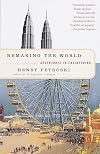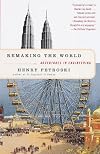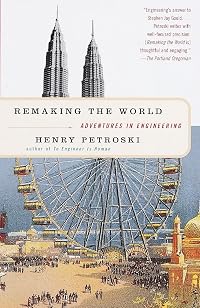
Remaking the World: Adventures in Engineering
by Henry Petroski
On This Page
Description
This collection of informative and pleasurable essays by Henry Petroski elucidates the role of engineers in shaping our environment in countless ways, big and small. In Remaking the World Petroski gravitates this time, perhaps, toward the big: the English Channel tunnel, the Panama Canal, Hoover Dam, the QE2, and the Petronas Towers in Malaysia, now the tallest buildings in the world. He profiles Charles Steinmetz, the genius of the General Electric Company; Henry Martyn Robert, a military show more engineer who created Robert's Rules of Order; and James Nasmyth, the Scotsman whose machine tools helped shape nineteenth-century ocean and rail transportation. Petroski sifts through the fossils of technology for cautionary tales and remarkable twists of fortune, and reminds us that failure is often a necessary step on the path to new discoveries. He explains soil mechanics by way of a game of "rock, scissors, paper," and clarifies fundamental principles of engineering through the spokes of a Ferris wheel. show lessTags
Recommendations











Member Reviews
Henry Petroski, professor of engineering at Duke University, may not be our era’s best writer of popular books about the history of technology, but I’d be hard-pressed to name another who’s so prolific, and – even more important – so consistently good. His seventeen books (so far) include two classics (To Engineer is Human and The Evolution of Useful Things) and one near-classic (The Pencil), but all of them are worth reading. Remaking the World, a collection of essays originally written for magazine publication, is no exception.
Like those in its successor volume Pushing the Limits: Further Adventures in Engineering, the essays in Remaking the World were written to stand alone, and (for the most part) they stand alone in the show more book. They deal, variously, with success and failure, with person and object and process, with the particular and with the universal. An ode to the value of back-of-the-envelope calculations shares space with a history of the Golden Gate Bridge. The Ferris wheel – a wonder of the Gilded Age, unveiled at the Chicago world’s fair of 1893 – shares space with the Petronas Towers, built in Kuala Lampur, Malaysia, a century later. Some of the essays – notably a trio on Victorian engineering genius Isambard Kingdom Brunel, his immense steamship Great Eastern, and the economics of large passenger ships in general – interlock with one another. Others – particularly a set of case studies of fatally flawed designs – exist in dialogue with Petroski’s other published work. Unlike the case studies of technological failure in To Engineer is Human or of everyday technologies in The Evolution of Useful Things the essays collected here are not marshaled in order to present and elaborate on a single, unifying idea.
The book as a whole thus, almost inevitably, makes less of an impact than (say) To Engineer is Human or The Pencil. The loss is modest, however, and the value of having these otherwise inaccessible essays available in convenient form far outweighs it. Precisely because they were written as stand-alones, they highlight one of Petroski’s most notable talents: the ability to clearly tell a complex story in limited space. The essays in this book deal with big concepts, important individuals, and major engineering achievements. There are multiple biographies of Brunel, for example, and at least one book devoted solely to the Great Eastern, but Petroski’s essays are the best short introductions to either subject I have ever read. Finishing one of them (or the equally good essays on the Golden Gate Bridge, the Ferris wheel, or the Petronas Towers), you have a sense that – although there is much more to learn about the subject – you’ve learned enough to claim a solid understanding of it.
A book collecting nothing but Petroski’s essays on the history of engineers and engineering would, for that reason, make an exceptional textbook for an introductory course on the history of technology. Until some publisher has the sense to produce such a book, however, Remaking the World and its sequel are well worth seeking out – both for their historical content and for their insider’s view of how the engineering mind works. show less
Like those in its successor volume Pushing the Limits: Further Adventures in Engineering, the essays in Remaking the World were written to stand alone, and (for the most part) they stand alone in the show more book. They deal, variously, with success and failure, with person and object and process, with the particular and with the universal. An ode to the value of back-of-the-envelope calculations shares space with a history of the Golden Gate Bridge. The Ferris wheel – a wonder of the Gilded Age, unveiled at the Chicago world’s fair of 1893 – shares space with the Petronas Towers, built in Kuala Lampur, Malaysia, a century later. Some of the essays – notably a trio on Victorian engineering genius Isambard Kingdom Brunel, his immense steamship Great Eastern, and the economics of large passenger ships in general – interlock with one another. Others – particularly a set of case studies of fatally flawed designs – exist in dialogue with Petroski’s other published work. Unlike the case studies of technological failure in To Engineer is Human or of everyday technologies in The Evolution of Useful Things the essays collected here are not marshaled in order to present and elaborate on a single, unifying idea.
The book as a whole thus, almost inevitably, makes less of an impact than (say) To Engineer is Human or The Pencil. The loss is modest, however, and the value of having these otherwise inaccessible essays available in convenient form far outweighs it. Precisely because they were written as stand-alones, they highlight one of Petroski’s most notable talents: the ability to clearly tell a complex story in limited space. The essays in this book deal with big concepts, important individuals, and major engineering achievements. There are multiple biographies of Brunel, for example, and at least one book devoted solely to the Great Eastern, but Petroski’s essays are the best short introductions to either subject I have ever read. Finishing one of them (or the equally good essays on the Golden Gate Bridge, the Ferris wheel, or the Petronas Towers), you have a sense that – although there is much more to learn about the subject – you’ve learned enough to claim a solid understanding of it.
A book collecting nothing but Petroski’s essays on the history of engineers and engineering would, for that reason, make an exceptional textbook for an introductory course on the history of technology. Until some publisher has the sense to produce such a book, however, Remaking the World and its sequel are well worth seeking out – both for their historical content and for their insider’s view of how the engineering mind works. show less
Ratings
Members
- Recently Added By
Lists

Authors from the United States
245 works; 3 members
Author Information

24+ Works 9,789 Members
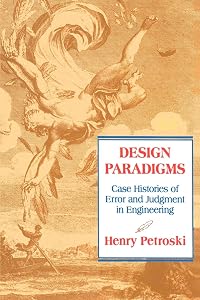
Henry Petroski is an American engineer with wide-ranging historical and sociocultural interests. He earned a Ph.D. in theoretical and applied mechanics from the University of Illinois at Urbana-Champaign in 1968, and became Aleksandar S. Vesic professor and chair of the Department of Civil and Environmental Engineering at Duke University. Petroski show more teaches traditional engineering subjects, as well as courses for nonengineering students, that place the field in a broad social context. One of the major themes that transcends his technical and nontechnical publications is the role of failure and its contribution to successful design. This is the central theme in his study To Engineer Is Human: The Role of Failure in Successful Design, which is accessible to both engineers and general readers. This theme is also incorporated into Petroski's The Pencil: A History of Design and Circumstance (1990), which relates the history of the pencil to broader sociocultural themes. The theme is expanded further, illustrating the relationship of engineering to our everyday life in The Evolution of Useful Things (1992). Petroski's most recent book, Design Paradigms: Case Histories of Error and Judgment in Engineering, is planned for publication in 1994. After that, he will begin a study of the complex interrelationships between engineering and culture. Widely recognized and supported by both the technical and humanities communities, Petroski's work has effectively conveyed the richness and essence of engineering in its societal context for the general reader. (Bowker Author Biography) show less
Common Knowledge
- Canonical title
- Remaking the World: Adventures in Engineering
- Alternate titles
- Remaking the World
- Original publication date
- 1997
- People/Characters
- Alfred Nobel; Henry Martyn Robert; James Nasmyth; Isambard Kingdom Brunel
- Important events
- Building of the Panama Canal; Building of the Hoover Dam
- Epigraph
- The scientist seeks
to understand what is;
the engineer seeks
to create was never was.
--attributed to Theodore von Karman - Dedication
- To my sister, Marianne
- First words
- When I was an engineering student, a friend of a friend nicknamed me "Steinmetz" and refused to call me by any other name.
Classifications
- Genres
- Nonfiction, General Nonfiction, Science & Nature, History, Art & Design, Technology, Biography & Memoir
- DDC/MDS
- 620 — Applied science & technology Engineering Mechanical & Civil Engineering
- LCC
- TA145 .P47 — Technology Engineering Civil engineering (General). Engineering (General). Civil engineering (General)
- BISAC
Statistics
- Members
- 347
- Popularity
- 91,471
- Reviews
- 1
- Rating
- (3.67)
- Languages
- English, Korean
- Media
- Paper, Ebook
- ISBNs
- 5
- ASINs
- 3