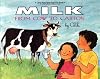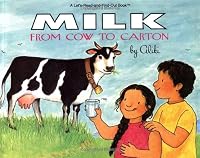
Milk: From Cow to Carton
by Aliki
On This Page
Description
Briefly describes how a cow produces milk, how the milk is processed in a dairy, and how various other dairy products are made from milk.Tags
Recommendations

Member Reviews
I believe this is a great book to introduce a science concept to young children. It follows the path of milk from the cows in the pasture all the way to the cartons in the store. This book gives children a chance to see a different side of things they see everyday.
Aliki takes the reader to a dairy farm to consider how milk is produced and how a farmer might do things differently, depending on his purchasing demographic.
Whether you're raised in the country or in the city it is important for children to understand where food comes. For example Milk: From Cow to Carton is a great children's book which informs its readers that the milk comes from a cow. It also goes into detail about cows which helps readers have a better understanding fo the large four legged animal. A lot of children's favorite drink is milk whether its for breaksfast or chocolate chip cookies it interesting to know where the drink has been processed.
This book gave a good breakdown for students studying food and nutrition. This book also allowed to see how their favorite drink is processed. I would recommend this book to curious students who are interested in processed foods and where certain foods/drinks come from.
Summary:
This book is a very informative book for children on the process that is taken for milk. It starts on the farm and makes its way to the store but this entails various steps. The book also gives examples of other ways milk is used and manufactured.
Personal Reflection:
I thought this book was very well written and is easy for children to understand. There is quite the process that goes into a carton of milk and I think this is the perfect book to help children to understand this process.
Extension Ideas:
1. Bring a cooler to school with difference things that are made of milk. Cheese, ice cream bars, and milk are some of the things that could be brought.
2. This would be a perfect book to be read before going on a field trip to an show more ice cream company. In Oklahoma Braums gives many ice cream tours. This would be a perfect place for the students to see the cows in the pasture and the process of the manufacturing in the company. Another option would be finding a local farmer and asking for a tour of how the process works. This would help the hands-on learners to see it in person.
3. Have the students write a paragraph about what they’ve learned about milk show less
This book is a very informative book for children on the process that is taken for milk. It starts on the farm and makes its way to the store but this entails various steps. The book also gives examples of other ways milk is used and manufactured.
Personal Reflection:
I thought this book was very well written and is easy for children to understand. There is quite the process that goes into a carton of milk and I think this is the perfect book to help children to understand this process.
Extension Ideas:
1. Bring a cooler to school with difference things that are made of milk. Cheese, ice cream bars, and milk are some of the things that could be brought.
2. This would be a perfect book to be read before going on a field trip to an show more ice cream company. In Oklahoma Braums gives many ice cream tours. This would be a perfect place for the students to see the cows in the pasture and the process of the manufacturing in the company. Another option would be finding a local farmer and asking for a tour of how the process works. This would help the hands-on learners to see it in person.
3. Have the students write a paragraph about what they’ve learned about milk show less
Summary:
This informational book is about how milk is made and the process the cow goes through to produce good milk. The books goes from the grazing process and how they feed them, milking them, and then a trip to the dairy. This books also informs children what other products are produced through the milk of the cow such as cheese and butter.
Personal Reaction:
I really liked this book it showed you the process of the milking process and what can be made from milk. The illustration also showed the process and gave you a mental picture as well. I remember my brother going to the Braum's factory and telling me all they saw they went to where the cows grazed, milking area, and then to the factory where they made the ice cream. I thought show more would have been really fun and exciting to go to.
Classroom Extension Ideas:
1) Bring a milk carton, cottage cheese carton, and cheese to class. Tell the students the process for each product and tell them that these products are great for building strong bones.
2)Milk’s Journey
Distribute the milk sequence pictures to 6 students; ask them to stand in front of the group with the picture facing the group. Ask for a volunteer (one not holding a picture) to identify the picture showing first step of milk’s journey (the cow) from the farm to consumption. Ask the child holding the cow picture to be first in line. Proceed until the six pictures are in the correct sequence showing milk’s journey from the farm to consumption.
3)Moovin’ with Milk (physical activity)
Ask students to stand. Have students touch their nose for each statement if they have never tasted or don’t like the food mentioned. Then follow the following statements:
1. Reach for the ceiling if you like milk.
2. Jog in place if you like to drink chocolate milk with lunch at school.
3. Pretend you’re hitting a tennis ball if you like cereal with milk on it.
4. Touch your elbow if you like cheese on crackers.
5. Flap your arms like a chicken if you like string cheese for a snack.
6. Hop in place if you like cheese pizza.
7. Act like you are skiing if you like yogurt in a tube. show less
This informational book is about how milk is made and the process the cow goes through to produce good milk. The books goes from the grazing process and how they feed them, milking them, and then a trip to the dairy. This books also informs children what other products are produced through the milk of the cow such as cheese and butter.
Personal Reaction:
I really liked this book it showed you the process of the milking process and what can be made from milk. The illustration also showed the process and gave you a mental picture as well. I remember my brother going to the Braum's factory and telling me all they saw they went to where the cows grazed, milking area, and then to the factory where they made the ice cream. I thought show more would have been really fun and exciting to go to.
Classroom Extension Ideas:
1) Bring a milk carton, cottage cheese carton, and cheese to class. Tell the students the process for each product and tell them that these products are great for building strong bones.
2)Milk’s Journey
Distribute the milk sequence pictures to 6 students; ask them to stand in front of the group with the picture facing the group. Ask for a volunteer (one not holding a picture) to identify the picture showing first step of milk’s journey (the cow) from the farm to consumption. Ask the child holding the cow picture to be first in line. Proceed until the six pictures are in the correct sequence showing milk’s journey from the farm to consumption.
3)Moovin’ with Milk (physical activity)
Ask students to stand. Have students touch their nose for each statement if they have never tasted or don’t like the food mentioned. Then follow the following statements:
1. Reach for the ceiling if you like milk.
2. Jog in place if you like to drink chocolate milk with lunch at school.
3. Pretend you’re hitting a tennis ball if you like cereal with milk on it.
4. Touch your elbow if you like cheese on crackers.
5. Flap your arms like a chicken if you like string cheese for a snack.
6. Hop in place if you like cheese pizza.
7. Act like you are skiing if you like yogurt in a tube. show less
What a cool book to show kids how milk is made and where it comes from. Introduces the process of where is comes from, how to milk cows and how it is made into the milk they like to drink. Would bring great discussion about who likes milk, who has drank milk before. You can talk about chocolate milk and how you make that as well!
Members
- Recently Added By
Author Information

105+ Works 29,369 Members
Aliki was born Aliki was born on September 3, 1929 in Wildwood Crest, New Jersey and raised in Philadelphia, PA. She graduated from the Philadelphia Museum College of Art in 1951. After college, she worked in the display department at J. C. Penney Co. in New York for a year and then as a free-lance artist and art teacher in Philadelphia. In 1956 show more she spent several months traveling, painting, and sketching in Europe. In 1957, Aliki married Franz Brandenberg, also a writer, and they settled in Switzerland, where she worked as a free-lance artist. In 1960 the Brandenbergs moved to New York City. Aliki continued to write and illustrate children's books, both fiction and nonfiction. As well as illustrating her own works, she has also illustrated over fifty books for others, including those of her husband Franz, Joanna Cole and Paul Showers. Aliki and her family moved to England in 1977 where she continues to write and illustrate. She has been the recipient of many honours including the New York Academy of Sciences Children's Book Award and the Prix du Livre pour Enfants (Geneva). She received the New Jersey Institute of Technology Award for The Listening Walk in 1961 and for Bees and Beelines in 1964, the Boys Club of America Junior Book Award for Three Gold Pieces: A Greek Folk Tale in 1968, and the Children's Book Showcase for At Mary Bloom's in 1977. She also won the New York Academy of Sciences (younger) Award for Corn Is Maize: The Gift of the Indians in 1977 and the Garden State Children's Book Award (younger nonfiction) for Mummies Made In Egypt in 1982. (Bowker Author Biography) show less
Series
Belongs to Publisher Series
Common Knowledge
- Canonical title
- Milk: From Cow to Carton
Classifications
Statistics
- Members
- 420
- Popularity
- 73,580
- Reviews
- 11
- Rating
- (4.00)
- Languages
- English, Spanish
- Media
- Paper
- ISBNs
- 12
- ASINs
- 1