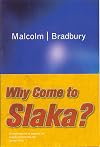
Why Come to Slaka?
by Malcolm Bradbury
47 Members (3.25)
On This Page
Description
A master not only of language and comedy but of feeling too' Sunday TimesSlaka! Land of lake and forest, of beetroot and tractor. Slaka! Land whose borders are sometimes here, often further north, and sometimes not at all. Land of cultural riches, of a language that is easy enough to learn if you speak Finnish, or perhaps a little Hittite. In this wickedly funny satire Malcolm Bradbury rescues from obscurity the country that formed the backdrop to Rates of Exchange. This, then, is the show more official guidebook to that mysteriously mobile piece of Europe. It confirms that Slaka is reassuringly the same - captivating, infuriating, bureaucratic, anarchic, comic and sinister. Within this deceptively slender handbook, stories and narratives bubble up between the lines to keep you reading and chuckling. For Slaka is instantly recognizable to any traveller, anyone who has grappled with an unyielding language, argued with officialdom, outdrunk their welcome, mislaid their luggage, missed their train or just misjudged a tip. The guidebook to end - with any luck - all guidebooks. 'Malcolm Bradbury is a satirist of great assurance and accomplishment' Observer show lessTags
Recommendations































Member Reviews
Members
- Recently Added By
Lists

Fictional European countries
58 works; 2 members
Author Information

66+ Works 5,676 Members
A professor of English literature and American studies who has published numerous critical works, Malcolm Bradbury is also a novelist whose protagonists are academics who make muddles of their personal and professional lives. He maintains that his main concern is to explore problems and dilemmas of liberalism and issues of moral responsibility. show more The targets of Bradbury's satires include intellectual pretension, cultural myopia, and official smugness. His protagonists are largely sympathetic, if comic, failures at mastering their own fates in a world of absurd rules and regulations. His major novels include Eating People Is Wrong (1959), Stepping Westward (1965), and The History Man (1975). This last, a novel of intellectual and political conflict at an English university in the late 1960s, was made into a successful television minidrama. More recent novels include Rates of Exchange (1983) and Cuts (1987). (Bowker Author Biography) Malcolm Bradbury is a novelist, critic, television dramatist, & satirist. His many books include "Rates of Exchange", which was short-listed for the Booker Prize, & "The Modern American Novel". (Publisher Provided) show less
Classifications
Statistics
- Members
- 47
- Popularity
- 637,507
- Rating
- (3.25)
- Languages
- English
- Media
- Paper
- ISBNs
- 5