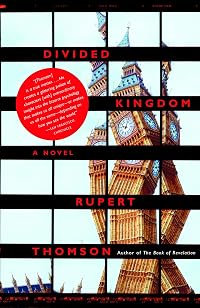
Divided Kingdom
by Rupert Thomson
On This Page
Description
It is winter, somewhere in the United Kingdom, and an eight-year-old boy is removed from his home and family in the middle of the night. He learns that he is the victim of an extraordinary experiment. In an attempt to reform society, the government has divided the population into four groups, each representing a different personality type. The land, too, has been divided into quarters. Borders have been established, reinforced by concrete walls, armed guards and rolls of razor wire. Plunged show more headlong into this brave new world, the boy tries to make the best of things, unaware that ahead of him lies a truly explosive moment, a revelation that will challenge everything he believes in and will, in the end, put his very life in jeopardy... show lessTags
Recommendations














Member Reviews
The premise of this novel is that a nation hopelessly divided by internecine strife, presumably the UK, divides itself into four nations, whose inhabitants are assigned to one of them according to a psychological profile based upon the four medieval physiological humors. Intercourse between the nations is strictly controlled, save for a group which the authorities believe defy classification. Called Achromatics, they constitute a sort of Dalit class; harassed and despised, they live on the margins but have the right to travel between the nations. That's one impressive premise and the author delivers in spades. His protagonist is a civil servant who has been removed from his parents as a child and assigned to the sanguine nation, but who show more develops a wanderlust whilst attending a conference in the phlegmatic nation, instilled in him by visits to a sort of virtual reality site therein which allows him to revisit the most idyllic moments of his life. However, exigency intrudes, and he finds himself forced into an odyssey which sends him on a wander through all four nations, sometimes in the company of Achromatics. The book is a surreal picaresque delight throughout its ramblings, somehow extremely believable amidst all the magic realism.. show less
I really loved this book. The premise is fantastic (all the population in one country is divided according to their "humor" : sangine, phelmatic, choleric or melancholic and even after the traumatic division are subject to perpetual vigilance. Those who no longer comply with their assignate humor will be relocated thus repeating the trauma)and from my point of view, fully explored.
Also there are some amazing images, like the burning of the animals. The ending is open to interpretation (as is the whole book)and I've read reviews saying that the reader didn't like the ending.
My interpretation (which may differ from that of other readers)of the book was from the psycology/mental illness angle, as some mental illnesses such as bipolar show more disorders are characterized by periods in which the sufferer will have one mood prevail over the others. Thus, the character travels from the sanguine to the plegmantic then choleric and melancholic states, to finally join the completely silent white people, who share saeveral characteristics with severely menatlly ill homless people or mentally retarded people such as being percieved as infertile by others, with whom he experiences terrible abuse reaching an ending that for me was completely congruent and satisfactory. show less
Also there are some amazing images, like the burning of the animals. The ending is open to interpretation (as is the whole book)and I've read reviews saying that the reader didn't like the ending.
My interpretation (which may differ from that of other readers)of the book was from the psycology/mental illness angle, as some mental illnesses such as bipolar show more disorders are characterized by periods in which the sufferer will have one mood prevail over the others. Thus, the character travels from the sanguine to the plegmantic then choleric and melancholic states, to finally join the completely silent white people, who share saeveral characteristics with severely menatlly ill homless people or mentally retarded people such as being percieved as infertile by others, with whom he experiences terrible abuse reaching an ending that for me was completely congruent and satisfactory. show less
Intriguing idea but the author doesn't really do anything with it. And obviously if you think about the proposal of segregating people by class geographically for longer than 30 seconds it's rather absurd. OK, they call it humours but it's just class, like we have today except without border guards. Who's going to clean the houses of all the upper class in the red quarter? But I would've gone with it if there was any story to go with it.
My post-apocalyptic book club selection for this month.
Not actually post-apocalyptic as dystopian, Thompson's novel posits a near-future England which has been divided into four sectors, based on the four 'humors' of Hippocratic medicine. In order to describe these four areas, Thompson then has a narrator who manages to travel through all four restricted sectors: Red: for those of a sanguine temperament, who are expected to be positive and energetic. Yellow, choleric, for those with a tendency toward violence. Green, melancholic, for the depressed and insane. Blue, phlegmatic, for the tranquil and artistic.
I like Thompson's writing style, and his handling of the beginning of the book, with forcibly divided families, is very good. The show more creation of artificial geopolitical divisions is very much based on Berlin during the wall, and feels convincing.
However, as the book went on, I felt like it lost focus. The narrator was being mechanically moved from one place to another simply to illustrate the author's ideas. I liked the author's point about how people will often live up to the expectations placed upon them, but I didn't see the political utility of having whole sectors full of people expected to be aggressive yobs, or expected to be cripplingly depressed. I didn't feel like the execution of the idea lived up to its full potential. It wasn't bad though - I'd try another of the author's books if I come across one. show less
Not actually post-apocalyptic as dystopian, Thompson's novel posits a near-future England which has been divided into four sectors, based on the four 'humors' of Hippocratic medicine. In order to describe these four areas, Thompson then has a narrator who manages to travel through all four restricted sectors: Red: for those of a sanguine temperament, who are expected to be positive and energetic. Yellow, choleric, for those with a tendency toward violence. Green, melancholic, for the depressed and insane. Blue, phlegmatic, for the tranquil and artistic.
I like Thompson's writing style, and his handling of the beginning of the book, with forcibly divided families, is very good. The show more creation of artificial geopolitical divisions is very much based on Berlin during the wall, and feels convincing.
However, as the book went on, I felt like it lost focus. The narrator was being mechanically moved from one place to another simply to illustrate the author's ideas. I liked the author's point about how people will often live up to the expectations placed upon them, but I didn't see the political utility of having whole sectors full of people expected to be aggressive yobs, or expected to be cripplingly depressed. I didn't feel like the execution of the idea lived up to its full potential. It wasn't bad though - I'd try another of the author's books if I come across one. show less
Fascinatingly unique take on the dystopian genre. Thomson makes a somewhat outlandish idea believable, thought provoking, and chilling.
I am a fan of Thomson--one of the accomplished and perhaps the most varied author writing in English today--and to give this novel less than five stars seems almost sinful. But the narrative took too long to take hold for me. Although, as usual, it also took many odd and interesting turns, while making points about humanity and politics that made me ponder as I read. (After you read the book, go to its website and take a test to see into which category you would have been sorted.)
A disturbing twisted near view of our future. Intriguing. Poetically written. And one that’s hard to classify. I loved the first half of the book (at this point, it was five stars all the way) but from then on, much like the protagonist (which may have been the point) it seemed to meander without any clear direction. I kept waiting for the denouement which never quite materialised. Worth reading and I’ll certainly be reading more from Rupert Thomson but have mixed feelings as to whether I really enjoyed it.
Members
- Recently Added By
Lists

Best Dystopias
280 works; 271 members

Global Reads: Books Set in the United Kingdom and Ireland
109 works; 5 members
Alternate Englands
34 works; 7 members

Books Read in 2011
684 works; 19 members
Author Information

18+ Works 2,635 Members
Common Knowledge
- Original publication date
- 2005
- Epigraph
- It was as if a curtain had fallen, hiding everything I had ever known. Jean Rhys
- Dedication
- To darling Eva, with a love that knows no boundaries.
- First words
- There were men in my room, and it was bright, too bright, and I was being lifted out of bed.
- Last words
- (Click to show. Warning: May contain spoilers.)I'm going to be all right.
- Blurbers
- Craig, Amanda
Classifications
Statistics
- Members
- 369
- Popularity
- 85,068
- Reviews
- 11
- Rating
- (3.38)
- Languages
- English, Italian, Portuguese
- Media
- Paper, Audiobook, Ebook
- ISBNs
- 14
- ASINs
- 3