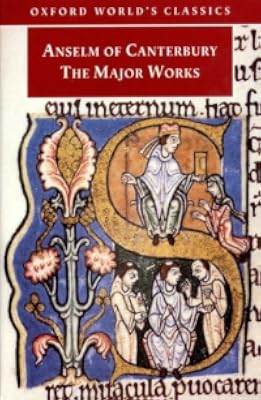
Anselm of Canterbury: The Major Works
by St. Anselm
On This Page
Description
After Aquinas, Anselm is the most significant medieval thinker. Utterly convinced of the truth of the Christian religion, he was none the less determined to try to make sense of his Christian faith, and the result is a rigorous engagement with problems of logic which remain relevant for philosophers and theologians even today. This translation provides the first opportunity to read all of Anselm's most important works in one volume. - ;`For I do not seek to understand so that I may believe; show more but I believe so that I may understand. For I believe this also, that unless I believe, I shall not show lessTags
Recommendations




Member Reviews
Anselm of Canterbury was utterly convinced of the truth of the Christian religion, but he was also determined to try to make sense of his Christian faith. Recognizing that the Christian God is incomprehensible, he also believed that Christianity is not simply something to be swallowed with mouth open and eyes shut. For Anselm, the doctrines of Christianity are an invitation to question, to think, and to learn.
Throughout the Middle Ages priests and theologians pondered the great questions about the Christian faith and this is a compilation one of the major thinkers of the time. The Major Works of Anselm of Canterbury brings together all of the important works—and some fragments of miscellaneous writing—of this Doctor of the Church on numerous issues to make sense of his faith.
Containing 11 works, this volume explores such questions as relating to the Christian faith. However except for Anselm’s first major work, “Monologian” in which he sets out to prove God exists through reason than faith, almost everything in this book is either bordering on heretical or barely comprehensible at best. Such works as “De Grammatico”, “The show more Truth, and “Free Will” quickly make no sense in their dialogue form while “On the Fall of the Devil” appears to indicate that God created evil which is frankly should have resulted in a one-way ticket bonfire for Anselm. Anselm’s attempt to better articulate his thoughts of the “Monologian” in the “Proslogion” were a disaster of incomprehensibility. The three works “On the Incarnation of the Word”, “Why God Became Man”, and “On the Virgin Conception and Original Sin” were insightful in a few spots though exposed the fallacy of original sin even though Anselm might have thought he had validate it. The two other major pieces were so disappointing that it is best not to mention them by name.
After reading St. Augustine’s City of God, I hoped for a clear understanding of medieval theological thought in this book as well. To say I was disappointed would be an understatement, in fact even though “Monologian” was tougher than I expected I wasn’t discouraged but as I continued reading it became harder to read. On top of that, the rise of so many unbiblical theological statements that Anselm “proves” through reason then “backs up” through scripture was getting hard to take. In fact, the worst part of “Monologian” was Anselm attempting to prove the immortality of the soul and failing completely. The only other positive thing I can say, except for my general liking of “Monologian”, is that any notes of the text were put in the footers and not in the back of the book like other Oxford World’s Classics editions I read have done.
The Major Works contains serious theological and philosophical works by Anselm of Canterbury that the honest reader will find barely comprehensible and at times almost heretical. Do not waste your time with this book unless you are a very serious scholar. show less
Containing 11 works, this volume explores such questions as relating to the Christian faith. However except for Anselm’s first major work, “Monologian” in which he sets out to prove God exists through reason than faith, almost everything in this book is either bordering on heretical or barely comprehensible at best. Such works as “De Grammatico”, “The show more Truth, and “Free Will” quickly make no sense in their dialogue form while “On the Fall of the Devil” appears to indicate that God created evil which is frankly should have resulted in a one-way ticket bonfire for Anselm. Anselm’s attempt to better articulate his thoughts of the “Monologian” in the “Proslogion” were a disaster of incomprehensibility. The three works “On the Incarnation of the Word”, “Why God Became Man”, and “On the Virgin Conception and Original Sin” were insightful in a few spots though exposed the fallacy of original sin even though Anselm might have thought he had validate it. The two other major pieces were so disappointing that it is best not to mention them by name.
After reading St. Augustine’s City of God, I hoped for a clear understanding of medieval theological thought in this book as well. To say I was disappointed would be an understatement, in fact even though “Monologian” was tougher than I expected I wasn’t discouraged but as I continued reading it became harder to read. On top of that, the rise of so many unbiblical theological statements that Anselm “proves” through reason then “backs up” through scripture was getting hard to take. In fact, the worst part of “Monologian” was Anselm attempting to prove the immortality of the soul and failing completely. The only other positive thing I can say, except for my general liking of “Monologian”, is that any notes of the text were put in the footers and not in the back of the book like other Oxford World’s Classics editions I read have done.
The Major Works contains serious theological and philosophical works by Anselm of Canterbury that the honest reader will find barely comprehensible and at times almost heretical. Do not waste your time with this book unless you are a very serious scholar. show less
Well, yeah, I skimmed a lot of this, but I got the gist. Self-important monk pompously waxes philosophical about God. And, weirdly, sometimes about grammar.
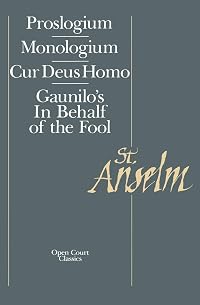
Its Anselm. I mean can I offer any other summary or review that would do this collection justice? Included are the Proslogion and Monologion as well as Cur Deus Homo. Absolutely essential reading for any scholar of medieval theology, any modern theologian wishing to understand historical theology, and anyone interested in theology at all. Don't be sucked into believing Anselm is only good for his "proof" of God's existence. There is so much here to digest and meditate on. Wonderful stuff.
I read part of this, I probably won't pick it back up for a very very long time.
Ratings
Members
- Recently Added By
Author Information

105+ Works 4,307 Members
Anselm of Canterbury, far and away the best philosopher of the eleventh century, described his philosophical work as faith seeking understanding. Following Augustine of Hippo, he argues that without faith he could not find the convincing rational arguments that establish understanding and that convincing evidence of a contradiction to the faith show more would invalidate any argument. Nonetheless, faith with understanding is better than faith alone. He avoids the citation of authorities in his writings, using argument alone to establish his points (something for which his teacher Lanfranc chided him), and he insists on answering every possible objection to his views with clear reasons against it. He is but little interested in the task of reconciling authorities or finding a unity of doctrine in the thought of the various Church Fathers. However, Augustine is, in fact, his constant inspiration, providing him even with the dialogue form he uses in his works. Anselm's thought is rooted in dialectical and grammatical technique. He is particularly skilled at resolving difficulties by uncovering the true logical form of expressions with misleading grammatical forms. His writings are without exception a feast for the analytical mind, yet accessible even to a beginner. (Bowker Author Biography) show less
Series
Belongs to Publisher Series
Work Relationships
Common Knowledge
- Canonical title
- Anselm of Canterbury: The Major Works
- Original publication date
- 1998
- Original language
- Latin
Classifications
- Genres
- Religion & Spirituality, Philosophy, Nonfiction, History
- DDC/MDS
- 189.4 — Philosophy & psychology Ancient, medieval & eastern philosophy Medieval western philosophy Scholastic: Scotus, Aquinas, Anselm, Abelard
- LCC
- B765 .A82 .E54 — Philosophy, Psychology and Religion Philosophy (General) By period Medieval
- BISAC
Statistics
- Members
- 1,297
- Popularity
- 18,758
- Reviews
- 5
- Rating
- (3.59)
- Languages
- English
- Media
- Paper, Ebook
- ISBNs
- 5
- ASINs
- 8